| |

| Piú votate - The Universe in Super Definition |

EpsilonEridani-PIA11375.jpgEpsilon Eridani66 visiteThis artist's conception shows the closest known Planetary System to our own, called Epsilon Eridani. Observations from NASA's Spitzer Space Telescope show that the system hosts two Asteroid Belts, in addition to previously identified candidate planets and an outer Comet Ring.
Epsilon Eridani is located about 10 LY away in the constellation Eridanus. It is visible in the night skies with the naked eye.
The System's Inner Asteroid Belt appears as the yellowish ring around the star, while the Outer Asteroid Belt is in the foreground. The outermost Comet Ring is too far out to be seen in this view, but comets originating from it are shown in the upper right corner.
Astronomers think that each of Epsilon Eridani's Asteroid Belts could have a planet orbiting just outside it, shepherding its rocky debris into a ring in the same way that Jupiter helps keep our asteroid belt confined.
The planet near the inner belt was previously identified in 2000 via the radial velocity, or "star wobble", technique, while the planet near the outer belt was inferred when Spitzer discovered the belt.
The inner belt orbits at a distance of about 3 AU from its star — or about the same position as the Asteroid Belt in our own Solar System (an astronomical unit is the distance between Earth and the Sun). The second Asteroid Belt lies at about 20 AU from the star, or a position comparable to Uranus in our Solar System.
The outer Comet Ring orbits from 35 to 90 AU from the star; our Solar System's analogous Kuiper Belt extends from about 30 to 50 AU from the sun.MareKromium
(9 voti)
|
|
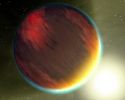
HD189733b-PIA09200.jpgJust like Jupiter...62 visiteThis artist's concept shows a cloudy Jupiter-like planet that orbits very close to its fiery hot star. NASA's Spitzer Space Telescope was recently used to capture spectra, or molecular fingerprints, of two "hot Jupiter" worlds like the one depicted here. This is the first time a spectrum has ever been obtained for an exoplanet, or a planet beyond our solar system.
The ground-breaking observations were made with Spitzer's spectrograph, which pries apart infrared light into its basic wavelengths, revealing the "fingerprints" of molecules imprinted inside. Spitzer studied two planets, HD 209458b and HD 189733b, both of which were found, surprisingly, to have no water in the tops of their atmospheres. The results suggest that the hot planets are socked in with dry, high clouds, which are obscuring water that lies underneath. In addition, HD209458b showed hints of silicates, suggesting that the high clouds on that planet contain very fine sand-like particles.
Capturing the spectra from the two hot-Jupiter planets was no easy feat. The planets cannot be distinguished from their stars and instead appear to telescopes as single blurs of light. One way to get around this is through what is known as the secondary eclipse technique. In this method, changes in the total light from a so-called transiting planet system are measured as a planet is eclipsed by its star, vanishing from our Earthly point of view. The dip in observed light can then be attributed to the planet alone.
This technique, first used by Spitzer in 2005 to directly detect the light from an exoplanet, currently only works at infrared wavelengths, where the differences in brightness between the planet and star are less, and the planet's light is easier to pick out. For example, if the experiment had been done in visible light, the total light from the system would appear to be unchanged, even as the planet disappeared from view.
To capture spectra of the planets, Spitzer observed their secondary eclipses with its spectrograph. It took a spectrum of a star together with its planet, then, as the planet disappeared from view, a spectrum of just the star. By subtracting the spectrum of the star from the spectrum of the star and planet together, astronomers were able to determine the spectrum of the planet itself.
Neither of the parent stars for HD 209458b or HD 189733b can be seen with the naked eye. HD 209458b is located about 153 light-years away in the constellation Pegasus, while HD 189733b is about 62 light-years away in the constellation Vulpecula. Both planets zip around their stars in very tight orbits; HD 209458b circles once every 3.5 days, while HD 189733b orbits once every 2.2 days.
Of the approximately 200 known exoplanets, there are 12 besides HD 209458b and HD 189733b whose orbits are inclined in such a way that, from our point of view, they pass in front of their stars. At least three of these transiting exoplanets are bright enough to follow in the footsteps of HD 209458b and HD 189733 and reveal their infrared spectra to Spitzer. Astronomers hope to use Spitzer's spectrograph in the future to study HD 209458b and HD 189733b again in much greater detail, and to examine some of the other candidates for the first time.
(9 voti)
|
|

NGC-1313.jpgNCG 1313 - Barred Spiral64 visite"...You have no idea how much nastier would be if I was not a Catholic.
Without "Supernatural Aid" I would hardly be a human being..."
Evelyn Waugh (1903 - 1966) - replying to Nancy Mitford who rebuked her for cruelty
(9 voti)
|
|

M-016-PIA09107.jpgM 16 - The "Eagle Nebula"64 visiteThis majestic view taken by NASA's Spitzer Space Telescope tells an untold story of life and death in the Eagle Nebula, an industrious star-making factory located 7000 L.Y. away in the Serpens constellation. The image shows the region's entire network of turbulent clouds and newborn stars in infrared light.
The color green denotes cooler towers and fields of dust, including the three famous space pillars, dubbed the "Pillars of Creation," which were photographed by NASA's Hubble Space Telescope in 1995 (see inset).
But it is the color red that speaks of the drama taking place in this region. Red represents hotter dust thought to have been warmed by the explosion of a massive star about 8,000 to 9,000 years ago. Since light from the Eagle nebula takes 7000 years to reach us, this "supernova" explosion would have appeared as an oddly bright star in our skies about 1000 to 2000 years ago.
According to astronomers' estimations, the explosion's blast wave would have spread outward and toppled the three pillars about 6,000 years ago (which means we wouldn't witness the destruction for another 1,000 years or so). The blast wave would have crumbled the mighty towers, exposing newborn stars that were buried inside, and triggering the birth of new ones.
The pillars of the Eagle nebula were originally sculpted by radiation and wind from about 20 or so massive stars hidden from view in the upper left portion of the image. The radiation and wind blew dust away, carving out a hollow cavity (center) and leaving only the densest nuggets of dust and gas (tops of pillars) flanked by columns of lighter dust that lie in shadow (base of pillars). This sculpting process led to the creation of a second generation of stars inside the pillars.
If a star did blow up in this region, it is probably located among the other massive stars in the upper left portion of the image. Its blast wave might have already caused a third generation of stars to spring from the wreckage of the busted pillars.
This image is a composite of infrared light detected by Spitzer's infrared array camera and multiband imaging photometer. Blue is 4.5-micron light; green is 8-micron light; and red is 24-micron light.
(9 voti)
|
|

M-016-PIA09108.jpgThe many colors of the Eagle63 visiteThis set of images from NASA's Spitzer Space Telescope shows the Eagle Nebula in different hues of infrared light. Each view tells a different tale. The left picture shows lots of stars and dusty structures with clarity. Dusty molecules found on Earth called polycyclic aromatic hydrocarbons produce most of the red; gas is green and stars are blue.
The middle view is packed with drama, because it tells astronomers that a star in this region violently erupted, or went supernova, heating surrounding dust (orange). This view also reveals that the hot dust is shell shaped, another indication that a star exploded.
The final picture highlights the contrast between the hot, supernova-heated dust (green) and the cooler dust making up the region's dusty star-forming clouds and towers (red, blue and purple).
The left image is a composite of infrared light with the following wavelengths: 3.6 microns (blue); 4.5 microns (green); 5.8 microns (orange); and 8 microns (red). The right image includes longer infrared wavelengths, and is a composite of light of 4.5 to 8.0 microns (blue); 24 microns (green); and 70 microns (red). The middle image is made up solely of 24-micron light.
(9 voti)
|
|
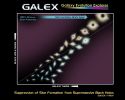
Black Hole-PIA08697_fig1.jpgBlack Holes66 visiteThis diagram illustrates research from NASA's Galaxy Evolution Explorer showing that black holes -- once they reach a critical size -- can put the brakes on new star formation in elliptical galaxies.
In this graph, galaxies and their supermassive black holes are indicated by the drawings (the black circle at the center of each galaxy represents the black hole). The relative masses of the galaxies and their black holes are reflected in the sizes of the drawings. Blue indicates that the galaxy has new stars, while red means the galaxy does not have any detectable new stars.
The Galaxy Evolution Explorer observed the following trend: the biggest galaxies and black holes (shown in upper right corner) are more likely to have no observable star formation (red) than the smaller galaxies with smaller black holes. This is evidence that black holes can create environments unsuitable for stellar birth.
The white line in the diagram illustrates that, for any galaxy no matter what the mass, its black hole must reach a critical size before it can shut down star formation.
(9 voti)
|
|
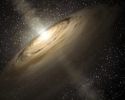
PIA03243.jpgThe way we were...78 visiteThis artist's concept illustrates a solar system that is a much younger version of our own. Dusty disks, like the one shown here circling the star, are thought to be the breeding grounds of planets, including rocky ones like Earth. Astronomers using NASA's Spitzer Space Telescope spotted some of the raw ingredients for DNA and protein in one such disk belonging to a star called IRS 46. The ingredients, gaseous precursors to DNA and protein called acetylene and hydrogen cyanide, were detected in the star's inner disk, the region where scientists believe Earth-like planets would be most likely to form.
(9 voti)
|
|

M 42 - HST-1.jpgOrion's Nebula an LL Orionis (the "Bow-Shock" effect)69 visiteThis close-up of cosmic clouds and stellar winds features LL Orionis interacting with the Orion Nebula flow. Adrift in Orion's stellar nursery and still in its formative years, variable star LL Orionis produces a wind more energetic than the wind from our own middle-aged Sun.
As the fast stellar wind runs into slow moving gas, a shock front is formed, analogous to the bow wave of a boat moving through water or a plane traveling at supersonic speed.
The small and graceful structure just above and left of center, is LL Ori's "Cosmic Bow Shock", measuring about 1/2 a LY across.
The slower gas is flowing away from the Orion Nebula's hot central star cluster, the Trapezium, located off the upper left corner of the picture.
In 3D, LL Ori's wrap-around shock front is shaped like a bowl that appears brightest when viewed along the bottom edge.
The beautiful picture is part of a large mosaic view of the complex stellar nursery in Orion, filled with a myriad of fluid shapes associated with star formation.
(9 voti)
|
|
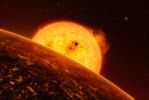
COROT7b-ESO.jpgExo-Planet CoRoT-7b68 visiteHow similar is exoplanet CoRoT-7b to Earth?
The newly discovered Extra-Solar Planet is the closest physical match yet, with a mass about five Earths and a radius of about 1,7 Earths. Also, the home star to CoRoT-7b, although 500 LY distant, is very similar to our Sun.
Unfortunately, the similarities likely end there, as CoRoT-7b orbits its home star well inside the orbit of Mercury, making its year last only 20 hours, and making its peak temperature much hotter than humans might find comfortable. CoRoT-7b was discovered in February by noting a predictable slight decrease in the brightness of its parent star.
Pictured above, an artist's depiction shows how CoRoT-7b might appear in front of its Parent Star. The composition of CoRoT-7b remains unknown, but given its size and mass, it cannot be a gas giant like Jupiter, and is very likely composed predominantly of rock. Future observations will likely narrow the composition of one of the first known rocky planets discovered outside of our Solar System.MareKromium
(8 voti)
|
|

Asteroid-PIA11735.jpgUnsuccesful crossing of the Roche Limit72 visiteIl Limite di Roche è la distanza minima dal centro di un Pianeta o di una Stella (qui di seguito definiti "Corpo Maggiore"), al di sotto della quale un satellite, o un pianeta (qui di seguito definito "Corpo Minore"), si può frammentare a causa delle Onde Gravitazionali Mareali (o "Forze di Marea"). Se si suppone che entrambi i Corpi (Maggiore e Minore) considerati abbiano la medesima densità, il Limite di Roche viene fatto pari a circa 2,5 volte il raggio del Corpo Maggiore (Pianeta o Stella che sia).
È possibile che all'interno di tale Limite esistano dei satelliti, ma essi devono essere sufficientemente piccoli e leggeri, così che le tensioni ad essi interne gli impediscano la frammentazione.
In un disco di frammenti che avvolge un pianeta appena formato (cd. "Protoplanetary Cloud Remainders" o anche "Accretion Disk"), la materia esistente oltre il Limite di Roche può assemblarsi in uno o più satelliti di modeste dimensioni, poichè all'interno di tale Limite le Forze di Marea impediscono la formazione di satelliti grandi.
Un buon esempio di questo tipo di fenomeno è negli anelli che vediamo intorno a Giove, Saturno, Urano e Nettuno: tutti questi anelli, infatti e ad esempio, si trovano all'interno del Limite di Roche.
Nel Sistema Solare sono quattro i pianeti che presentano anelli e per ciascuno di essi è stato calcolato il relativo Limite di Roche:
Giove = 175.000 Km
Saturno = 147.000 Km
Urano = 62.000 Km
Nettuno = 59.000 Km
Édouard Albert Roche, nel 1850, studiò in particolare gli Anelli di Saturno e giunse a dimostrare che il valore di 2,44 Raggi Planetari Saturniani si posizionava leggermente al di fuori dell'Anello più esterno, dentro il quale effettivamente non esistevano corpi di rilevanza.
Dalle riprese effettuate durante i Programmi Voyager e CASSINI-Huygens, si è potuto notare che gli Anelli di Saturno (al pari di quelli di tutti i Giganti Gassosi) non sono "unitari e compatti", bensì composti da aggregazioni promiscue di rocce di modeste dimensioni e ghiaccio: tutti elementi, questi, che - come detto - trovandosi all'interno del Limite di Roche ed avendo resistito alle Onde Gravitazionali emanate da Saturno, ci dimostrano una scarsissima densità intrinseca (e dunque una evidente idoneità alla "sopravvivenza" verso le Onde Gravitazionali Mareali).MareKromium
(8 voti)
|
|

ARP-147.jpgARP 14765 visiteJust a couple of days after the orbiting observatory was brought back online, Hubble aimed its prime working camera, the Wide Field Planetary Camera 2 (WFPC2), at a particularly intriguing target, a pair of Gravitationally Interacting Galaxies called Arp 147.
The image demonstrated that the camera is working exactly as it was before going offline, thereby scoring a "perfect 10" both for performance and beauty.
The two galaxies happen to be oriented so that they appear to mark the number 10. The left-most galaxy, or the "one" in this image, is relatively undisturbed apart from a smooth ring of starlight. It appears nearly on edge to our line of sight. The right-most galaxy, resembling a zero, exhibits a clumpy, blue ring of intense star formation.
The blue ring was most probably formed after the galaxy on the left passed through the galaxy on the right. Just as a pebble thrown into a pond creates an outwardly moving circular wave, a propagating density wave was generated at the point of impact and spread outward. As this density wave collided with material in the target galaxy that was moving inward due to the gravitational pull of the two galaxies, shocks and dense gas were produced, stimulating star formation.
The dusty reddish knot at the lower left of the blue ring probably marks the location of the original nucleus of the galaxy that was hit.
Arp 147 appears in the Arp Atlas of Peculiar Galaxies, compiled by Halton Arp in the 1960s and published in 1966.
This picture was assembled from WFPC2 images taken with three separate filters. The blue, visible-light, and infrared filters are represented by the colors blue, green, and red, respectively.
The galaxy pair was photographed on October 27-28, 2008. Arp 147 lies in the constellation Cetus, and it is more than 400 MLY away from Earth.MareKromium
(8 voti)
|
|

M-042-PIA09411.jpgOut of Orion's Head (1)61 visiteThis image from NASA's SST shows infant stars "hatching" in the Head of the Hunter constellation, Orion. Astronomers suspect that shockwaves from a supernova explosion in Orion's head, nearly 3 MY ago, may have initiated this newfound birth
The Region featured in this Spitzer image is called Barnard 30.
It is located approx. 1,300 LY away and sits on the right side of Orion's "Head" just North of the massive star Lambda Orionis.
Wisps of green in the cloud are organic molecules called polycyclic aromatic hydrocarbons. These molecules are formed anytime carbon-based materials are burned incompletely. On Earth, they can be found in the sooty exhaust from automobile and airplane engines. They also coat the grills where charcoal-broiled meats are cooked.
Tints of orange-red in the cloud are dust particles warmed by the newly forming stars. The reddish-pink dots at the top of the cloud are very young stars embedded in a cocoon of cosmic gas and dust. Blue spots throughout the image are background Milky Way along this line of sight.
This composite includes data from Spitzer's infrared array camera instrument, and multiband imaging photometer instrument. Light at 4.5 microns is shown as blue, 8.0 microns is green, and 24 microns is red.
MareKromium
(8 voti)
|
|
| 157 immagini su 14 pagina(e) |
2 | |
|
|
|
|
|
|
|
|
|
|
|





