| Piú votate - The Universe in Super Definition |
M-101-PIA11797.jpgM 10164 visiteIn 1609, Galileo improved the newly invented telescope, turned it toward the heavens, and revolutionized our view of the universe. In celebration of the 400th anniversary of this milestone, 2009 has been designated as the International Year of Astronomy.
Today, NASA's Great Observatories are continuing Galileo's legacy with stunning images and breakthrough science from the Hubble Space Telescope, the Spitzer Space Telescope, and the Chandra X-ray Observatory.
While Galileo observed the sky using visible light seen by the human eye, technology now allows us to observe in many wavelengths, including Spitzer's infrared view and Chandra's view in X-rays. Each wavelength region shows different aspects of celestial objects and often reveals new objects that could not otherwise be studied.
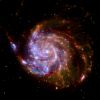
This image of the spiral galaxy Messier 101 is a composite of views from Spitzer, Hubble, and Chandra.
The red color shows Spitzer's view in infrared light. It highlights the heat emitted by dust lanes in the galaxy where stars can form.
The yellow color is Hubble's view in visible light. Most of this light comes from stars, and they trace the same spiral structure as the dust lanes.
The blue color shows Chandra's view in X-ray light. Sources of X-rays include million-degree gas, exploded stars, and material colliding around black holes.
Such composite images allow astronomers to see how features seen in one wavelength match up with those seen in another wavelength. It's like seeing with a camera, night vision goggles, and X-ray vision all at once.
In the four centuries since Galileo, astronomy has changed dramatically. Yet our curiosity and quest for knowledge remain the same. So, too, does our wonder at the splendor of the universe.
The International Year of Astronomy Great Observatories Image Unveiling is supported by the NASA Science Mission Directorate Astrophysics Division. The project is a collaboration between the Space Telescope Science Institute, the Spitzer Science Center, and the Chandra X-ray Center.
MareKromium
(2 voti)
|
|
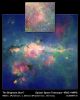
PIA10955.jpgThe brightest Stars of the (known) Universe65 visiteIf our galaxy, the Milky Way, were to host its own version of the Olympics, the title for the brightest known star would go to a massive star called Eta Carinae. However, a new runner-up — now the second-brightest star in our galaxy — has been discovered in the galaxy's dusty and frenzied interior. This image from NASA's Spitzer Space Telescope shows the new silver medalist, circled in the inset above, in the central region of our Milky Way.
Dubbed the 'Peony Nebula' star, this blazing ball of gas shines with the equivalent light of 3,2 million Suns. The reigning champ, Eta Carinae, produces the equivalent of 4,7 million Suns worth of light — though astronomers say these estimates are uncertain, and it's possible that the Peony Nebula star could be even brighter than Eta Carinae.
If the Peony Star is so bright, why doesn't it stand out more in this view? The answer is dust. This star is located in a very dusty region jam packed with stars. In fact, there could be other super bright stars still hidden deep in the stellar crowd. Spitzer's infrared eyes allowed it to pierce the dust and assess the Peony Nebula star's true brightness.
Likewise, infrared data from the European Southern Observatory's New Technology Telescope in Chile were integral in calculating the Peony Nebula star's luminosity.
The Peony Nebula, which surrounds the Peony nebular star, is the reddish cloud of dust in and around the white circle.
This is a three-color composite showing infrared observations from two Spitzer instruments. Blue represents 3.6-micron light and green shows light of 8 microns, both captured by Spitzer's infrared array camera. Red is 24-micron light detected by Spitzer's multiband imaging photometer.MareKromium
(2 voti)
|
|
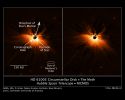
HD_61005.jpgCircumstellar Dust Takes Flight in 'The Moth'64 visiteWhat superficially resembles a giant moth floating in space is giving astronomers new insight into the formation and evolution of planetary systems.
This is not your typical flying insect. It has a wingspan of about 22 billion miles. The wing- like structure is actually a dust disk encircling the nearby, young star HD 61005, dubbed "The Moth." Its shape is produced by starlight scattering off dust.
Dust disks around roughly 100-million-year-old stars like HD 61005 are typically flat, pancake-shaped structures where planets can form. But images taken with NASA's Hubble Space Telescope of "The Moth" are showing that some disks sport surprising shapes.
"It is completely unexpected to find a dust disk with this unusual shape," said senior research scientist Dean Hines of the Space Science Institute, New Mexico Office in Corrales, New Mexico, and a member of the Hubble team that discovered the disk. "We think HD 61005 is plowing through a local patch of higher-density gas in the interstellar medium, causing material within HD 61005's disk to be swept behind the star. What effect this might have on the disk, and any planets forming within it, is unknown."
Hines called this possible collision "unusual, because we don't expect very much interstellar material to be in the solar neighborhood. That's because the area through which our Sun is moving was evacuated within the past few million years by at least one supernova, the explosion of a massive star. Yet, here's evidence of dense material that's very close, only 100 light-years away."
Astronomers have found evidence that the environment in which a star forms influences its prospects for planet formation. Hubble has actually seen that young planet-forming disks can be affected directly by their environment. The harsh stellar radiation from the Trapezium stars in the Orion Nebula has altered some disks. It is unclear, however, what effect passage through a cloud similar to the one in which HD 61005 finds itself would have on planet formation. Researchers have speculated that passage through dense regions of the interstellar medium could impact the atmospheres of evolving planets.
The Moth is part of a survey of Sun-like stars that Hines and collaborators observed with Hubble's Near-Infrared Camera and Multi-Object Spectrometer (NICMOS) and NASA's Spitzer Space Telescope to study the formation and evolution of planetary systems. Under the lead of Michael Meyer of the University of Arizona in Tucson, the team initially used Spitzer to look for heat radiation—the tell-tale sign of dust warmed by the star—to identify interesting star systems.
Hines then teamed with Glenn Schneider of the University of Arizona to use Hubble's high- contrast imaging capability of the NICMOS coronagraph to image these disks and reveal where the dust detected by Spitzer resides. The NICMOS coronagraph blocked out the starlight so that astronomers could see details in the surrounding disk.
"These symbiotic capabilities, uniquely implemented in NASA's Great Observatories, provide astronomers with the powerful observational tools to study the circumstellar environments of potentially planet-forming systems," Schneider said.
Added Meyer: "Combining observations from these two spacecraft gives us information about the composition of the dust grains, whether they're icy or sandy, or whether they're like the sooty smoke particles rising from a chimney. The composition and sizes of the dust can tell us a lot about the dynamics and evolution of a solar system. In our solar system, for example, astronomers have evidence of rocks smashing into each other and generating dust, as in the asteroid and Kuiper belts. We're seeing these same processes unfold in other planetary systems."
MareKromium
(2 voti)
|
|
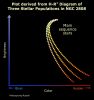
NGC-2808-2.jpgTriple Stellar Evolution Epochs in NGC 280864 visiteLike a simplified version of the Hertzsprung-Russell (HR) Diagram and by using the original HST data, this graph schematically plots the brightness of the stars in Globular Cluster NGC 2808 (along the vertical axis) against stellar color and temperature (along the horizontal axis).
The cooler a star is, the redder it appears, and it diminishes in brightness.
The bluer stars are to the left; redder stars are to the right.
The brightest stars are near the top.
The 3 curves represent the 3 different populations of stars that are present in NGC 2808.MareKromium
(2 voti)
|
|

SN-1987A-Starfield_-_HST_(dtl).jpgSupernova 1987A - HST215 visiteDa NASA - Picture of the Day del 9-02-1999: "Bright stars don't last forever. A bright star similar to others in this field exploded in a spectacular supernova that was witnessed on Earth in 1987. The result is visible even today as unusual rings and glowing gas. The above picture is a composite of recent images taken over several years. The explosion originated from a bright massive star that ran out of nuclear fuel. SN1987A occurred in the Large Magellanic Cloud (LMC), a satellite galaxy only 150.000 LY from our Milky Way Galaxy. The rings of SN1987A are currently excited by light from the initial explosion. Astronomers expect the inner ring to brighten in the next few years as expanding supernova debris overtakes it".
(30 voti)
|
|
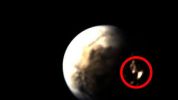
Proxima_Centauri_B_-_2.jpgProxima Centauri "b" - Alien City Lights or Super-volcanic Activity? (2)150 visiteE', a mio umile avviso, un Fenomeno di Super-vulcanismo che accade su scala (di fatto) planetaria. Guardate BENE! E guardate bene le foto di "Io"...MareKromium
(5 voti)
|
|

M 42.jpgM 42 in different colors184 visiteUna suggestiva combinazione di immagini ottenute con 3 filtri distinti, ciascuno capace di registrare una diversa linea di emissione: Zolfo (S), Ossigeno (O2) e Idrogeno (H). A bassa densità (ovvero nelle condizioni esistenti all'interno della Grande Nebulosa di Orione), S ed H emettono luce rossa mentre l'O2 emette luce verde. Per distinguerli bene nell'immagine, tuttavia, allo Zolfo è stato - in sede di sviluppo finale - assegnato il rosso, all'Idrogeno il verde ed all'Ossigeno il blu.
Il risultato, sebbene la colorazione finale NON sia "realistica", appare comunque non solo utile a fini della ricerca e dell'esatta mappatura dei gas presenti nella Nebulosa, ma anche molto suggestivo.
(16 voti)
|
|

M 55.jpgM 55 - Globular Star Cluster76 visiteM 55 is a large Globular Star Cluster of around 100.000 stars. Only 20.000 LY away in the constellation Sagittarius, M 55 appears to earth-bound observers to be nearly 2/3 the size of the full Moon. Globular star clusters like M 55 roam the halo of our Milky Way Galaxy as gravitationally bound populations of stars known to be much older than stellar groups found in the galactic disk. Astronomers who make detailed studies of globular cluster stars can accurately measure the cluster ages and distances. Their results ultimately constrain the age of the Universe and provide a fundamental rung on the astronomical distance ladder.
(15 voti)
|
|

M-087.jpgM 87 - Elliptical Galaxy92 visiteElliptical galaxy M 87 is a type of galaxy that looks much different than our own Milky Way Galaxy. Even for an elliptical galaxy, though, M 87 is peculiar. M 87 is MUCH bigger than an average galaxy, appears near the center of a whole cluster of galaxies (known as the Virgo Cluster) and shows an unusually high number of globular clusters. These globular clusters are visible as faint spots surrounding the bright center of M 87. In general, elliptical galaxies contain similar numbers of stars as spiral galaxies, but are ellipsoidal in shape (spirals are mostly flat), have no spiral structure and little gas and dust.
(14 voti)
|
|
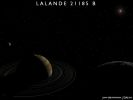
Lalande Solar System.jpgLalande 21185 and a possible extra-solar system164 visiteThe closest extrasolar planetary system could be made by the planets of the dim red dwarf star known as Lalande 21185: only 8 LY distant! This star is too faint to be seen by the naked eye and its planets have never been imaged directly but their presence is inferred by a long series of telescopic observations, tracking the star as it wiggles and wobbles in mutual gravitational response to the masses of its orbiting planets. University of Pitsburgh astronomer George Gatewood recently announced that much of Lalande 21185's wobble is most likely due to an unseen planet with approximately 90% of the mass of Jupiter and an orbital period of 5.8 years. His work also indicates that a second and possibly third planet of similar mass could well be present in the system.
(27 voti)
|
|

M 17.jpgM 17 - The "Omega Nebula" detail mgnf128 visiteIn the depths of the dark clouds of dust and molecular gas known as M 17, stars continue to form. Also known as the Omega Nebula and Horseshoe Nebula, the darkness of M17's molecular clouds results from background starlight being absorbed by thick filaments of carbon-based smoke-sized dust. As bright massive stars form, they produce intense and energetic light that slowly boils away the dark shroud. Colors in the above image were picked to highlight specific elements that emit nebular light: red indicates emission from sulfur, green from hydrogen, and blue from oxygen. The Swan Nebula is visible with binoculars towards the constellation of Sagittarius, lies 5000 LY away, and spans 20 LY across.
(26 voti)
|
|
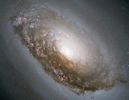
M 64.jpgM 64 (NGC 4826) - Great Spiral Galaxy114 visiteThe "Sleeping Beauty Galaxy" may appear peaceful at first sight but it is actually tossing and turning. In an unexpected twist, recent observations have shown that the gas in the outer regions of this spiral is rotating in the opposite direction from all of the stars! Collisions between gas in the inner and outer regions are creating many hot blue stars and pink emission nebulae. The above image was taken by the Hubble Space Telescope in 2001. The fascinating internal motions of M 64 (also known as NGC 4826), are thought to be the result of a collision between a small galaxy and a large galaxy where the resultant mix has not yet settled down.
(13 voti)
|
|
| 157 immagini su 14 pagina(e) |
 |
|
|
|
|
|
|
|
|
13 |
|





