| |

| Piú votate - The Universe in Super Definition |

HD-80606b.jpgA Dangerous Summer on HD 80606b80 visiteOn the distant planet HD 80606b, Summers might be dangerous.
Hypothetic life forms floating in HD 080606b's Atmosphere or lurking on one of its (presently hypothetical) moons might fear the 1500 Kelvin Summer heat, which is hot enough not only to melt Lead but also Nickel. Although Summers are defined for Earth by the daily amount of Sunlight, Summers on HD 80606b are more greatly influenced by how close the Planet gets to its Parent Star.
HD 80606b, about 200 LY distant, has the most elliptical orbit of any planet yet discovered. In comparison to the Solar System, the distance to its Parent Star would range from outside the orbit of Venus to well inside the orbit of Mercury.
In this sequence, the night side of HD 80606b is computer simulated as it might glow in infrared light in nearly daily intervals as it passed the closest point in its 111-day orbit around its Parent Star.
The simulation is based on infrared data taken in late 2007 by the Spitzer Space Telescope.
Nota Lunexit (a chi interessa): la Formula di Conversione per le Temperature espresse in Kelvin in Temperature espresse in Celsius è la seguente: T° Celsius = T Kelvin - 273,15
Nel nostro caso di specie, quindi, la temperatura diurna media Estiva di HD 80606b dovrebbe essere pari a circa 1227° C.
Un bel "tepore", davvero...MareKromium
(3 voti)
|
|
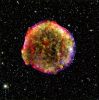
SNR-Tycho-SR-PIA11435.jpgTycho: the most colourful Supernova Remnant82 visiteThis composite image of the Tycho Supernova Remnant combines InfraRed and X-Ray observations obtained with NASA's Spitzer and Chandra space observatories, respectively, and the Calar Alto observatory, Spain.
It shows the scene more than four centuries after the brilliant star explosion witnessed by Tycho Brahe and other astronomers of that era.
The explosion has left a blazing hot cloud of expanding debris (green and yellow). The location of the blast's outer shock wave can be seen as a blue sphere of ultra-energetic electrons. Newly synthesized dust in the ejected material and heated pre-existing dust from the area around the supernova radiate at infrared wavelengths of 24 microns (red).
Foreground and background stars in the image are white.MareKromium
(3 voti)
|
|
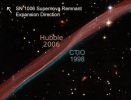
SN-1006-PIA10926.jpgStars and a Stripe in Celestial Fireworks65 visiteA delicate ribbon of gas floats eerily in our galaxy. A contrail from an alien spaceship? A jet from a black-hole? Actually this image, taken by NASA's Hubble Space Telescope, is a very thin section of a supernova remnant caused by a stellar explosion that occurred more than 1,000 years ago.
On or around May 1, 1006 A.D., observers from Africa to Europe to the Far East witnessed and recorded the arrival of light from what is now called SN 1006, a tremendous supernova explosion caused by the final death throes of a white dwarf star nearly 7,000 light-years away. The supernova was probably the brightest star ever seen by humans, and surpassed Venus as the brightest object in the night time sky, only to be surpassed by the moon. It was visible even during the day for weeks, and remained visible to the naked eye for at least two and a half years before fading away.
It wasn't until the mid-1960s that radio astronomers first detected a nearly circular ring of material at the recorded position of the supernova. The ring was almost 30 arcminutes across, the same angular diameter as the full moon. The size of the remnant implied that the blast wave from the supernova had expanded at nearly 20 million miles per hour over the nearly 1,000 years since the explosion occurred.
In 1976, the first detection of exceedingly faint optical emission of the supernova remnant was reported, but only for a filament located on the northwest edge of the radio ring. A tiny portion of this filament is revealed in detail by the Hubble observation. The twisting ribbon of light seen by Hubble corresponds to locations where the expanding blast wave from the supernova is now sweeping into very tenuous surrounding gas.
The hydrogen gas heated by this fast shock wave emits radiation in visible light. Hence, the optical emission provides astronomers with a detailed "snapshot" of the actual position and geometry of the shock front at any given time. Bright edges within the ribbon correspond to places where the shock wave is seen exactly edge on to our line of sight.
Today we know that SN 1006 has a diameter of nearly 60 light-years, and it is still expanding at roughly 6 million miles per hour. Even at this tremendous speed, however, it takes observations typically separated by years to see significant outward motion of the shock wave against the grid of background stars. In the Hubble image as displayed, the supernova would have occurred far off the lower right corner of the image, and the motion would be toward the upper left.
SN 1006 resides within our Milky Way Galaxy. Located more than 14 degrees off the plane of the galaxy's disk, there is relatively little confusion with other foreground and background objects in the field when trying to study this object. In the Hubble image, many background galaxies (orange extended objects) far off in the distant universe can be seen dotting the image. Most of the white dots are foreground or background stars in our Milky Way galaxy.
This image is a composite of hydrogen-light observations taken with Hubble's Advanced Camera for Surveys in February 2006 and Wide Field Planetary Camera 2 observations in blue, yellow-green, and near-infrared light taken in April 2008. The supernova remnant, visible only in the hydrogen-light filter was assigned a red hue in the Heritage color image.
For images and more information about SN 1006, visit:
http://hubblesite.org/news/2008/22
http://heritage.stsci.edu/2008/22
For additional information, contact:
Ray Villard Space Telescope Science Institute, Baltimore, Md. 410-338-4514 villard@stsci.edu
William Blair Johns Hopkins University, Baltimore, Md. 410-516-8447 wpb@pha.jhu.edu
MareKromium
(3 voti)
|
|

The_Missing_Matter.jpgWhat is "missing" in the Universe?68 visiteIn the May 20, 2008, issue of The Astrophysical Journal, Charles Danforth and Mike Shull (University of Colorado, Boulder) report on NASA's Hubble Space Telescope and NASA's Far Ultraviolet Spectroscopic Explorer (FUSE) observations taken along sight-lines to 28 quasars. Their analysis represents the most detailed observations to date of how the intergalactic medium looks within about 4 Billion Light-Years of Earth.
The astronomers say they have definitively found about half of the missing normal matter, called "Baryons", in the space between the galaxies.
This illustration shows how the Hubble Space Telescope searches for missing Baryons, by looking at the light from quasars several Billion Light-Years away. Imprinted on that light are the spectral fingerprints of the missing ordinary matter that absorbs the light at specific frequencies (shown in the colorful spectra at right).
The missing Baryonic Matter helps trace out the structure of intergalactic space, called the "Cosmic Web".MareKromium
(3 voti)
|
|
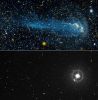
Mira-PIA09961.jpgMira's Tail64 visiteCaption NASA:"NASA's Galaxy Evolution Explorer discovered an exceptionally long comet-like tail of material trailing behind Mira -- a star that has been studied thoroughly for about 400 years.
So, why had this tail gone unnoticed for so long? The answer is that nobody had scanned the extended region around Mira in ultraviolet light until now.
As this composite demonstrates, the tail is only visible in ultraviolet light (top), and does not show up in visible light (bottom). Incidentally, Mira is much brighter in visible than ultraviolet light due to its low surface temperature of about 3000 Kelvin (about 5000° Fahrenheit)".MareKromium
(3 voti)
|
|

TwoSuns-PIA09227.jpgTwin Suns62 visiteThis diagram illustrates that mature planetary systems like our own might be more common around twin, or binary, stars that are either really close together, or really far apart.
NASA's Spitzer Space Telescope observed that debris disks, which are signposts of mature planetary systems, are more abundant around the tightest and widest of binary stars it studied. Specifically, the infrared telescope found significantly more debris disks around binary stars that are 0 to 3 Astronomical Units (AU) apart (top panel) and 50 to 500 AU apart (bottom panel) than binary stars that are 3 to 50 AU apart (middle panel). An astronomical unit is the distance between Earth and the Sun.
In other words, if 2 stars are as far apart from each other as the Sun is from Jupiter (5 AU) or Pluto (40 AU), they would be unlikely to host a family of planetary bodies.
The Spitzer data also revealed that debris disks circle all the way around both members of a close-knit binary (top panel), but only a single member of a wide duo (bottom panel). This could explain why the intermediately spaced binary systems (middle panel) can be inhospitable to planetary disks: they are too far apart to support one big disk around both stars, and they are too close together to have enough room for a disk around just one star.
(3 voti)
|
|

Spectrum-PIA09196.jpgHow to get a Spectrum of an Alien World61 visiteThis diagram illustrates how astronomers using NASA's Spitzer Space Telescope can capture the elusive spectra of hot-Jupiter planets. Spectra are an object's light spread apart into its basic components, or wavelengths. By dissecting light in this way, scientists can sort through it and uncover clues about the composition of the object giving off the light.
To obtain a spectrum for an object, one first needs to capture its light. Hot-Jupiter planets are so close to their stars that even the most powerful telescopes can't distinguish their light from the light of their much brighter stars.
But, there are a few planetary systems that allow astronomers to measure the light from just the planet by using a clever technique. Such "transiting" systems are oriented in such a way that, from our vantage point, the planets' orbits are seen edge-on and cross directly in front of and behind their stars.
In this technique, known as the secondary eclipse method, changes in the total infrared light from a star system are measured as its planet transits behind the star, vanishing from our Earthly point of view. The dip in observed light can then be attributed to the planet alone.
To capture a spectrum of the planet, Spitzer must observe the system twice. It takes a spectrum of the star together with the planet (first panel), then, as the planet disappears from view, a spectrum of just the star (second panel). By subtracting the star's spectrum from the combined spectrum of the star plus the planet, it is able to get the spectrum for just the planet (third panel).
This ground-breaking technique was used by Spitzer to obtain the first-ever spectra of two planets beyond our solar system, HD 209458b and HD 189733b. The results suggest that the hot planets are socked in with dry clouds high up in the planet's stratospheres. In addition, HD 209458b showed hints of silicates, indicating those high clouds might be made of very fine sand-like particles.
(3 voti)
|
|

Spectrum-PIA09197.jpgSpectrum of an Alien World63 visiteThis infrared data from NASA's Spitzer Space Telescope - called a spectrum - tells astronomers that a distant gas planet, a so-called "hot Jupiter" called HD 209458b, might be smothered with high clouds. It is one of the first spectra of an alien world.
A spectrum is created when an instrument called a spectrograph cracks light from an object open into a rainbow of different wavelengths. Patterns or ripples within the spectrum indicate the presence, or absence, of molecules making up the object.
Astronomers using Spitzer's spectrograph were able to obtain infrared spectra for two so-called "transiting" hot-Jupiter planets using the "secondary eclipse" technique. In this method, the spectrograph first collects the combined infrared light from the planet plus its star, then, as the planet is eclipsed by the star, the infrared light of just the star. Subtracting the latter from the former reveals the planet's own rainbow of infrared colors.
When astronomers first saw the infrared spectrum above, they were shocked. It doesn't look anything like what theorists had predicted. For example, theorists thought there'd be signatures of water in the wavelength ranges of 8 to 9 microns. The fact that water is not detected might indicate that it is hidden under a thick blanket of high, dry clouds.
In addition, the spectrum shows signs of silicate dust -- tiny grains of sand -- in the wavelength range of 9 to 10 microns. This suggests that the planet's skies could be filled with high clouds of dust unlike anything seen in our own solar system.
There is also an unidentified molecular signature at 7.78 microns. Future observations using Spitzer's spectrograph should be able to determine the nature of the mysterious feature.
This spectrum was produced by Dr. Jeremy Richardson of NASA's Goddard Space Flight Center, Greenbelt, Md. and his colleagues. The data were taken by Spitzer's infrared spectrograph on July 6 and 13, 2005.
(3 voti)
|
|

Spectrum-PIA09198.jpgSpectrum of an Alien World61 visiteThis infrared data from NASA's Spitzer Space Telescope - called a spectrum - tells astronomers that a distant gas planet, a so-called "hot Jupiter" called HD 209458b, might be smothered with high clouds. It is one of the first spectra of an alien world.
A spectrum is created when an instrument called a spectrograph spreads light from an object apart into a rainbow of different wavelengths. Patterns or ripples within the spectrum indicate the presence, or absence, of molecules making up the object.
Astronomers using Spitzer's spectrograph were able to obtain infrared spectra for two so-called "transiting" hot-Jupiter planets using the "secondary eclipse" technique. In this method, the spectrograph first collects the combined infrared light from the planet plus its star, then, as the planet is eclipsed by the star, the infrared light of just the star. Subtracting the latter from the former reveals the planet's own rainbow of infrared colors.
When astronomers first saw the infrared spectrum above, they were shocked. It doesn't look anything like what theorists had predicted. Theorists though the spectra for hot, Jupiter-like planets like this one would be filled with the signatures of molecules in the planets' atmospheres. But the spectrum doesn't show any molecules. It is what astronomers call "flat." For example, theorists thought there'd be signatures of water in the wavelength ranges of 8 to 9 microns. The fact that water is not seen there might indicate that the water is hidden under a thick blanket of high, dry clouds.
This spectrum was produced by Dr. Mark R. Swain of NASA's Jet Propulsion Laboratory in Pasadena, Calif., using a complex set of mathematical tools. It was derived using two different methods, both of which led to the same result. The data were taken on July 6 and 13, 2005, by Dr. Jeremy Richardson of NASA's Goddard Space Flight Center and his team using Spitzer's infrared spectrograph.
(3 voti)
|
|

30-Doradus_and_R-136.jpg30 Doradus and R-13675 visiteJust in time for the holidays: a Hubble Space Telescope picture postcard of hundreds of brilliant blue stars wreathed by warm, glowing clouds. The festive portrait is the most detailed view of the largest stellar nursery in our local galactic neighborhood. The massive, young stellar grouping, called R136, is only a few million years old and resides in the 30 Doradus Nebula, a turbulent star-birth region in the Large Magellanic Cloud (LMC), a satellite galaxy of our Milky Way. There is no known star-forming region in our galaxy as large or as prolific as 30 Doradus. Many of the diamond-like icy blue stars are among the most massive stars known. Several of them are over 100 times more massive than our Sun. These hefty stars are destined to pop off, like a string of firecrackers, as supernovas in a few million years.
The image, taken in ultraviolet, visible, and red light by Hubble's Wide Field Camera 3, spans about 100 light-years. The nebula is close enough to Earth that Hubble can resolve individual stars, giving astronomers important information about the birth and evolution of stars in the universe. The Hubble observations were taken Oct. 20-27, 2009. The blue color is light from the hottest, most massive stars; the green from the glow of oxygen; and the red from fluorescing hydrogen.MareKromium
(2 voti)
|
|

HR8799b.jpgExoplanet HR8799b67 visiteA powerful, newly refined image-processing technique may allow astronomers to discover extrasolar planets that are possibly lurking in over a decade's worth of Hubble Space Telescope archival data.
David Lafreniere of the University of Toronto, Ontario, Canada, has successfully demonstrated this new strategy for planet hunting by identifying an exoplanet that went undetected in Hubble images taken in 1998 with its Near Infrared Camera and Multi-Object Spectrometer (NICMOS). In addition to illustrating the power of new data-processing techniques, this finding underscores the value of the Hubble data archive, on which those new techniques can be used.
The planet, estimated to be at least seven times Jupiter's mass, was originally discovered in images taken with the Keck and Gemini North telescopes in 2007 and 2008. It is the outermost of three massive planets known to orbit the dusty young star HR 8799, which is 130 light-years away. NICMOS could not see the other two planets because its coronagraphic spot — a device which blots out the glare of the star — also interferes with observing the two inner planets.
"We've shown that NICMOS is more powerful than previously thought for imaging planets," says Lafreniere. "Our new image-processing technique efficiently subtracts the glare from a star that spills over the coronagraph's edge, allowing us to see planets that are one-tenth the brightness of what could be detected before with Hubble." Lafreniere adapted an image reconstruction technique that was first developed for ground-based observatories.
Using the new technique, he recovered the planet in NICMOS observations taken 10 years before the Keck/Gemini discovery. The Hubble picture not only provides important confirmation of the planet's existence, it provides a longer baseline for demonstrating that the object is in an orbit about the star. "To get a good determination of the orbit we have to wait a very long time because the planet is moving so slowly (it has a 400-year period)," says Lafreniere. "The 10-year-old Hubble data take us that much closer to having a precise measure of the orbit."
NICMOS's view provided new insights into the physical characteristics of the planet, too. This was possible because NICMOS works at near-infrared wavelengths that are severely blocked by Earth's atmosphere due to absorption by water vapor.
"The planet seems to be only partially cloud covered and we could be detecting the absorption of water vapor in the atmosphere," says Travis Barman of Lowell Observatory, Flagstaff, Ariz. "The infrared light measured from the Hubble data is consistent with a spectrum showing a broad water absorption feature (at 1.4-1.49 microns), but the level of absorption seen is lower than it would be if the photosphere were completely devoid of dust. Dust clouds can smooth out many of the spectral features that would otherwise be there—including water absorption bands," Barman says. "Measuring the water absorption properties will tell us a great deal about the temperatures and pressures in the atmospheres, in addition to the cloud coverage. If we can accurately measure the water absorption features for the outermost planet around HR 8799, we will learn a great deal about their atmospheric properties. Hubble, situated well above the Earth's atmosphere, is excellently located for such a study."
"During the past 10 years Hubble has been used to look at over 200 stars with coronagraphy, looking for planets and disks. We plan to go back and look at all of those archived images and see if anything can be detected that has gone undetected until now," says Christian Marois of the Herzberg Institute of Astrophysics, Victoria, Canada. "We'll need a baseline of a few years for most objects to detect Keplerian motion and hence confirm their status as planets. The hardest part is to find them in the first place."
If his team sees a companion object to a star in more than one NICMOS picture, and it appears to have moved along an orbit, follow-up observations will be made with ground-based telescopes. If they see something once but its brightness and separation from the star would be reasonable for a planet, they will also do follow-up observations with ground-based telescopes.
Taking the image of an exoplanet is not an easy task. Planets can be billions of times fainter than the star around which they orbit and are typically located at separations smaller than 1/2000th the angular size of the full moon from their star. The planet recovered in the NICMOS data is about 100,000 times fainter than the star when viewed in the near-infrared.
"Even when using the best telescopes available, with the best resolution, the light from the bright star spills out in the area where the much fainter planets are located, making them impossible to see. It is essential to subtract out this bright glare of stellar light from the image to see faint dots, i.e., planets, that could be hidden underneath," says Rene Doyon of the University of Montreal.
The stability of how light is scattered in the NICMOS camera, called the point spread function (PSF), is key for using Hubble images to recover planets. This technique works by taking images of different stars and combining them to create a PSF of a star that closely resembles the star that is being studied for planets. This requires a reasonably steady PSF because images of different stars are taken on different days. Atmospheric conditions would vary from day-to-day for ground-based telescopes, but not for a space telescope that enjoys unprecedented image stability over repeated visits to a target.
MareKromium
(2 voti)
|
|

M-033-PIA11969.jpgM 33 - Spiral Galaxy (3-color composite)65 visiteOne of our closest galactic neighbors shows its awesome beauty in this new image from NASA's Spitzer Space Telescope. M 33, also known as the "Triangulum Galaxy", is a member of what's known as our Local Group of galaxies.
Along with our own Milky Way, this group travels together in the universe, as they are gravitationally bound. In fact, M 33 is one of the few galaxies that is moving toward the Milky Way despite the fact that space itself is expanding, causing most galaxies in the universe to grow farther and farther apart.
When viewed with Spitzer's InfraRed eyes, this elegant spiral galaxy sparkles with color and detail. Stars appear as glistening blue gems (several of which are actually foreground stars in our own galaxy), while dust rich in organic molecules glows green. The diffuse orange-red glowing areas indicate star-forming regions, while small red flecks outside the spiral disk of M 33 are most likely distant background galaxies. But not only is this new image beautiful, it also shows M 33 to be surprising large — bigger than its Visible-Light appearance would suggest.
With its ability to detect cold, dark dust, Spitzer can see emission from cooler material well beyond the visible range of M 33's disk. Exactly how this cold material moved outward from the galaxy is still a mystery, but winds from giant stars or supernovas may be responsible.
M 33 is located about 2,9 MLY away in the constellation Triangulum. This is a three-color composite image showing InfraRed observations from two of Spitzer instruments. Blue represents combined 3.6- and 4.5-micron light and green shows light of 8 microns, both captured by Spitzer's IRAC.
Red is 24-micron light detected by Spitzer's Multiband Imaging Photometer.MareKromium
(2 voti)
|
|
| 157 immagini su 14 pagina(e) |
|
|
|
|
|
|
|
|
12 | |
|
|
|





