| |

| Piú votate - The Universe in Super Definition |

Red_Sun-PIA13994.jpgRed Sun129 visiteCaption NASA:"This artist's concept illustrates a young, Red Dwarf Star surrounded by three planets. Such stars are dimmer and smaller than yellow stars like our Sun, which makes them ideal targets for astronomers wishing to take images of planets (called "Exoplanets") outside our Solar System. NASA's Galaxy Evolution Explorer is helping to identify young, Red Dwarf Stars that are close to us by detecting their UltraViolet Light (stars give off a lot of UV Light in their youth). Astronomers will use telescopes to try to image giant planets that orbit farther out from these stars, such as the one depicted here at lower left".MareKromium
(3 voti)
|
|

NGC-2683.jpgNGC 2683 - Spiral Edge-On Galaxy110 visitenessun commentoMareKromium
(3 voti)
|
|

PIA13120.jpgWISE Eyes...74 visiteThis frame shows the progress of the WISE All-Sky Survey at the present time. WISE, or NASA's Wide-field InfraRed Survey Explorer, is perched up in the sky like a wise, old owl, scanning the whole sky one-and-a-half times in IR Light. On July 17, 2010, it will have completed its first scan of the entire sky, delivering more than one million image frames so far.
This map is filled in to show the sky areas that WISE scanned over time. Red indicates regions with the greatest coverage, and blue the least. The Poles received the most coverage because WISE orbits Earth around the Poles, scanning out strips of sky as Earth moves around the Sun. The red lines between the Poles show areas that received extra coverage because of the mission's strategy to avoid the Moon.
When the moon is in WISE's field of view, about twice every month, the space telescope captures the region it blocks, by first moving ahead of the moon and then behind it. This results in overlapped coverage for certain slices of sky. During this first all-sky scan, every point was covered by at least eight image frames.
The Infrared Astronomical Satellite was a joint project of the United States, United Kingdom and the Netherlands.
The Two-Micron All-Sky Survey was a project of NASA; the National Science Foundation; the University of Massachusetts, Amherst, and the California Institute of Technology, Pasadena, California.MareKromium
(3 voti)
|
|

30-Doradus.jpg30 Doradus and R-13667 visiteThe massive, young stellar grouping, called R136, is only a few million years old and resides in the 30 Doradus Nebula, a turbulent star-birth region in the Large Magellanic Cloud (LMC), a satellite galaxy of our Milky Way. Many of the stars are among the most massive known. Several of them are over 100 times more massive than our Sun. These hefty stars are destined to become supernovae in a few million years.
The image, taken by Hubble's Wide Field Camera 3, spans about 100 light-years. The nebula is close enough to Earth that Hubble can resolve individual stars, giving astronomers important information about the stars' birth and evolution.
The brilliant stars are carving deep cavities in the surrounding material by unleashing a torrent of ultraviolet light, and hurricane-force stellar winds (streams of charged particles), which are etching away the enveloping hydrogen gas cloud in which the stars were born. The image reveals a fantasy landscape of pillars, ridges, and valleys, as well as a dark region in the center that roughly looks like the outline of a holiday tree. Besides sculpting the gaseous terrain, the brilliant stars can also help create a successive generation of offspring. When the winds hit dense walls of gas, they create shocks, which may be generating a new wave of star birth.
The movement of the LMC around the Milky Way may have triggered the massive cluster's formation in several ways. The gravitational tug of the Milky Way and the companion Small Magellanic Cloud may have compressed gas in the LMC. Also, the pressure resulting from the LMC plowing through the Milky Way's halo may have compressed gas in the satellite. The cluster is a rare, nearby example of the many super star clusters that formed in the distant, early universe, when star birth and galaxy interactions were more frequent. Previous Hubble observations have shown astronomers that super star clusters in faraway galaxies are ubiquitous. The LMC is located 170,000 light-years away and is a member of the Local Group of Galaxies, which also includes the Milky Way.
The Hubble image was taken at infrared wavelengths (1.1 microns and 1.6 microns). Hubble sees through the dusty nebula, revealing many stars that cannot be seen in visible light. The large bright star just above the center of the image is in the 30 Doradus nebula. The Hubble observations of 30 Doradus were made October 20-27, 2009.MareKromium
(3 voti)
|
|

M-083-a.jpgHubble Wide Field Camera 3 - Image Details Star Birth in Galaxy M-8392 visiteThe spectacular new camera installed on NASA's Hubble Space Telescope during Servicing Mission 4 in May has delivered the most detailed view of star birth in the graceful, curving arms of the nearby spiral galaxy M83.
Nicknamed the Southern Pinwheel, M83 is undergoing more rapid star formation than our own Milky Way galaxy, especially in its nucleus. The sharp "eye" of the Wide Field Camera 3 (WFC3) has captured hundreds of young star clusters, ancient swarms of globular star clusters, and hundreds of thousands of individual stars, mostly blue supergiants and red supergiants.
The image, taken in August 2009, provides a close-up view of the myriad stars near the galaxy's core, the bright whitish region at far right.
WFC3's broad wavelength range, from ultraviolet to near-infrared, reveals stars at different stages of evolution, allowing astronomers to dissect the galaxy's star-formation history.
The image reveals in unprecedented detail the current rapid rate of star birth in this famous "grand design" spiral galaxy. The newest generations of stars are forming largely in clusters on the edges of the dark dust lanes, the backbone of the spiral arms. These fledgling stars, only a few million years old, are bursting out of their dusty cocoons and producing bubbles of reddish glowing hydrogen gas.
The excavated regions give a colorful "Swiss cheese" appearance to the spiral arm. Gradually, the young stars' fierce winds (streams of charged particles) blow away the gas, revealing bright blue star clusters. These stars are about 1 million to 10 million years old. The older populations of stars are not as blue.
A bar of stars, gas, and dust slicing across the core of the galaxy may be instigating most of the star birth in the galaxy's core. The bar funnels material to the galaxy's center, where the most active star formation is taking place. The brightest star clusters reside along an arc near the core.
The remains of about 60 supernova blasts, the deaths of massive stars, can be seen in the image, five times more than known previously in this region. WFC3 identified the remnants of exploded stars. By studying these remnants, astronomers can better understand the nature of the progenitor stars, which are responsible for the creation and dispersal of most of the galaxy's heavy elements.
M83, located in the Southern Hemisphere, is often compared to M51, dubbed the Whirlpool galaxy, in the Northern Hemisphere. Located 15 million light-years away in the constellation Hydra, M83 is two times closer to Earth than M51.
MareKromium
(3 voti)
|
|

IC-348-PIA12210.jpgCreation...146 visiteThis artist's conception shows a lump of material in a swirling, planet- forming disk. Astronomers using NASA's Spitzer Space Telescope found evidence that a companion to a star -- either another star or a planet -- could be pushing planetary material together, as illustrated here.
Planets are born out of spinning disks of gas and dust. They can carve out lanes or gaps in the disks as they grow bigger and bigger. Scientists used Spitzer's infrared vision to study the disk around a star called LRLL 31, located about 1000 LY away in the IC 348 Region of the constellation Perseus. Spitzer's new infrared observations reveal that the disk has both an inner and outer gap.
What's more, the data show that infrared light from the disk is changing over as little time as one week -- a very unusual occurrence. In particular, light of different wavelengths seesawed back and forth, with short-wavelength light going up when long-wavelength light went down, and vice versa.
According to astronomers, this change could be caused by a companion to the star (illustrated as a planet in this picture). As the companion spins around, its gravity would cause the wall of the inner disk to squeeze into a lump. This lump would also spin around the star, shadowing part of the outer disk. When the bright side of the lump is on the far side of the star, and facing Earth, more infrared light at shorter wavelengths should be observed (hotter material closer to the star emits shorter wavelengths of infrared light). In addition, the shadow of the lump should cause longer-wavelength infrared light from the outer disk to decrease. The opposite would be true when the lump is in front of the star and its bright side is hidden (shorter-wavelength light would go down, and longer- wavelength light up). This is precisely what Spitzer observed.
The size of the lump and the planet have been exaggerated to better illustrate the dynamics of the system.MareKromium
(3 voti)
|
|

VB10-b-PIA12014.jpgThe VB10 Star System and the Solar System64 visiteThis artist's diagram compares our Solar System (below) to the VB 10 Star System. Astronomers successfully used the astrometry planet-hunting method for the first time to discover a gas planet, called VB 10b, around a very tiny star, VB 10. All of the bodies in this diagram are shown in circular insets at the same relative scales.
The VB 10 star is one of the smallest known — and holds the record for the smallest known to host a planet. It's a dim, red M-dwarf with only one-tenth the size, and one-twelfth the mass, of our sun. Its planet, on the other hand, is quite hefty, with six times the mass of Jupiter. Though the planet is less massive than the star, the two orbs would be about the same size.
The VB 10 Star System is essentially a shrunken version of our Solar System. Even though its planet is at a similar distance from its star as Mercury is from our Sun, it wouldn't receive as much heat and would be classified as a "cold Jupiter" similar to our own. If any rocky planets do orbit in the VB 10 System, they would be located even closer in than VB 10b, and could lie within the star's "Habitable Zone" — a region where temperatures are right for water to be liquid.
Astrometry involves measuring the wobble of a star on the sky, caused by an unseen planet yanking it back and forth. Because the VB 10b Planet is so big relative to its star, it really tugs the star around. The red circle seen at the center of the VB 10 system shows just how big this wobble is. Because our sun is more massive than VB 10, its planets do not cause it to wobble nearly as much.MareKromium
(3 voti)
|
|
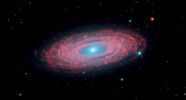
NGC-2841-PIA12001.jpgNGC 2841 - Spiral Galaxy65 visiteThis image from NASA's Spitzer Space Telescope shows the Spiral Galaxy NGC 2841, located about 46 MLY from Earth in the constellation Ursa Major. The galaxy is helping astronomers solve one of the oldest puzzles in astronomy: Why do galaxies look so smooth, with stars sprinkled evenly throughout?
An international team of astronomers has discovered that rivers of young stars flow from their hot, dense stellar nurseries, dispersing out to form large, smooth distributions.
This image is a composite of three different wavelengths from Spitzer's InfraRed Array Camera. The shortest wavelengths are displayed in blue, and mostly show the older stars in NGC 2841, as well as foreground stars in our own Milky Way galaxy. The cooler areas are highlighted in red, and show the dusty, gaseous regions of the galaxy.
Blue shows InfraRed Light of 3,6 microns, green represents 4,5-micron light and red, 8,0-micron light. The contribution from starlight measured at 3,6 microns has been subtracted from the 8,0-micron data to enhance the visibility of the dust features. The shortest wavelengths are displayed in blue, and mostly show the older stars in NGC 2841, as well as foreground stars in our own Milky Way Galaxy.MareKromium
(3 voti)
|
|

K4-55-HST.jpgK4-55 Planetary Nebula64 visiteThe Hubble Community bids farewell to the soon-to-be decommissioned Wide Field Planetary Camera 2 (WFPC2) onboard the Hubble Space Telescope.
In tribute to Hubble's longest-running optical camera, Planetary Nebula K 4-55 has been imaged as WFPC2's final "pretty picture".MareKromium
(3 voti)
|
|

Cepheid-HST-2009-08-a-print.jpgRefined Hubble Constant narrows possible explanations for Dark Energy83 visiteWhatever Dark Energy is, explanations for it have less wiggle room following a Hubble Space Telescope observation that has refined the measurement of the Universe's present Expansion Rate to a precision where the error is smaller than 5%. The new value for the Expansion Rate, known as the "Hubble Constant", or "H0" (after Edwin Hubble who first measured the expansion of the universe nearly a century ago), is 74,2 Km-per-second-per-megaparsec (with an error margin of ± 3,6).
The results agree closely with an earlier measurement gleaned from Hubble of 72 ± 8 km/sec/megaparsec, but are now more than twice as precise.
The Hubble measurement, conducted by the SHOES (Supernova H0 for the Equation of State) Team and led by Adam Riess, of the Space Telescope Science Institute and the Johns Hopkins University, uses a number of refinements to streamline and strengthen the construction of a cosmic "Distance Ladder", a Billion LY in length, that astronomers use to determine the Universe's Expansion Rate.
Hubble observations of pulsating stars called "Cepheid Variables" in a nearby cosmic mile marker, the galaxy NGC 4258, and in the host galaxies of recent supernovae, directly link these distance indicators. The use of Hubble to bridge these rungs in the ladder eliminated the systematic errors that are almost unavoidably introduced by comparing measurements from different telescopes.
Riess explains the new technique: "It's like measuring a building with a long tape measure instead of moving a yard stick end over end. You avoid compounding the little errors you make every time you move the yardstick. The higher the building, the greater the error".
Lucas Macri, professor of physics and astronomy at Texas A&M, and a significant contributor to the results, said, "Cepheids are the backbone of the distance ladder because their pulsation periods, which are easily observed, correlate directly with their luminosities. Another refinement of our ladder is the fact that we have observed the Cepheids in the Near-InfraRed parts of the electromagnetic spectrum where these variable stars are better distance indicators than at optical wavelengths."
This new, more precise value of the Hubble Constant was used to test and constrain the properties of Dark Energy, the form of energy that produces a repulsive force in space, which is causing the expansion rate of the Universe to accelerate.
By bracketing the expansion history of the universe between today and when the universe was only approx. 380.000 years old, the astronomers were able to place limits on the nature of the Dark Energy that is causing the expansion to speed up.
(The measurement for the far, early universe is derived from fluctuations in the Cosmic Microwave Background (---> Radiazione di Fondo), as resolved by NASA's Wilkinson Microwave Anisotropy Probe, WMAP, in 2003.)
Their result is consistent with the simplest interpretation of Dark Energy: that it is mathematically equivalent to Albert Einstein's hypothesized Cosmological Constant, introduced a century ago to push on the fabric of space and prevent the Universe from collapsing under the pull of gravity. (Einstein, however, removed the Constant once the expansion of the universe was discovered by Edwin Hubble.)
"If you put in a box all the ways that Dark Energy might differ from the Cosmological Constant, that box would now be 3 times smaller", says Riess. "That's progress, but we still have a long way to go to pin down the nature of Dark Energy".
Though the cosmological constant was conceived of long ago, observational evidence for Dark Energy didn't come along until 11 years ago, when two studies, one led by Riess and Brian Schmidt of Mount Stromlo Observatory, and the other by Saul Perlmutter of Lawrence Berkeley National Laboratory, discovered Dark Energy independently, in part with Hubble observations. Since then astronomers have been pursuing observations to better characterize Dark Energy.
Riess's approach to narrowing alternative explanations for Dark Energy — whether it is a static Cosmological Constant or a dynamical field (like the repulsive force that drove inflation after the Big Bang) — is to further refine measurements of the Universe's expansion history.
Before Hubble was launched in 1990, the estimates of the Hubble Constant varied by a factor of two. In the late 1990s the Hubble Space Telescope Key Project on the Extragalactic Distance Scale refined the value of the Hubble constant to an error of only about 10%. This was accomplished by observing Cepheid variables at optical wavelengths out to greater distances than obtained previously and comparing those to similar measurements from ground-based telescopes.
The SHOES team used Hubble's Near Infrared Camera and Multi-Object Spectrometer (NICMOS) and the Advanced Camera for Surveys (ACS) to observe 240 Cepheid variable stars across 7 galaxies. One of these galaxies was NGC 4258, whose distance was very accurately determined through observations with radio telescopes. The other 6 galaxies recently hosted Type Ia Supernovae that are reliable distance indicators for even farther measurements in the Universe.
Type Ia Supernovae all explode with nearly the same amount of energy and therefore have almost the same intrinsic brightness.
By observing Cepheids with very similar properties at Near-InfraRed wavelengths in all 7 galaxies and using the same telescope and instrument, the team was able to more precisely calibrate the luminosity of Supernovae.
With Hubble's powerful capabilities, the team was able to sidestep some of the shakiest rungs along the previous Distance Ladder involving uncertainties in the behavior of Cepheids. Riess would eventually like to see the Hubble constant refined to a value with an error of no more than 1%, to put even tighter constraints on solutions to Dark Energy.MareKromium
(3 voti)
|
|

Sharpless308-Goldman.jpgSharpless 30863 visiteCaption NASA:"Blown by fast winds from a hot, massive star, this cosmic bubble is huge. Cataloged as Sharpless 308 it lies some 5200 LY away in the constellation Canis Major and covers over 2/3° on the sky (compared with 0,5° for the Full Moon). That corresponds to a diameter of 60 LY at its estimated distance. The massive star itself, a Wolf-Rayet Star, is the bright blue one near the center of the Nebula.
Wolf-Rayet Stars have over 20 times the mass of the Sun and are thought to be in a brief, pre-supernova phase of massive star evolution. Fast winds from this Wolf-Rayet Star create the bubble-shaped nebula as they sweep up slower moving material from an earlier phase of evolution.
The windblown nebula has an age of about 70.000 years. Relatively faint emission captured in the expansive image is dominated by the glow of Ionized Oxygen atoms mapped to bluish hues".MareKromium
(3 voti)
|
|
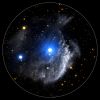
NGC-3242-PIA11968.jpgThe Extended Region around the Planetary Nebula NGC 324263 visiteThe unfortunate name of Planetary Nebula for this class of Celestial Objects is a historical legacy credited to William Herschel during the 18th Century — a time when telescopes where small and objects like these, at least the central region, looked very similar to gas-giant planets such as Saturn and Jupiter. In fact, NGC 3242 has no relation to Jupiter or any other planet.
Telescopes and their detectors have dramatically improved over the past few centuries. Our understanding of what Planetary Nebulae truly are has improved accordingly.
When stars with a mass similar to our Sun approach the end of their lives by exhausting supplies of Hydrogen and Helium fuel in their cores, they swell up into cool red-giant stars. In a last gasp before death, they expel the layers of gas in their Outer Atmosphere. This exposes the core of the dying star, a dense hot ball of Carbon and Oxygen called a "White Dwarf".
The White Dwarf is so hot that it shines very brightly in the UltraViolet Spectrum. The UltraViolet Light from the White Dwarf, in turn, ionizes the gaseous material expelled by the star causing it to glow. A Planetary Nebula is really the death of a low-mass star.
Although low-mass stars like our Sun live for billions of years, Planetary Nebulae only last for about ten thousand years. As the central white dwarf quickly cools and the UltraViolet Light dwindles, the surrounding gas also cools and fades.
In this image of NGC 3242 from the Galaxy Evolution Explorer, the Extended Region around the Planetary Nebula is shown in dramatic detail. The small circular white and blue area at the center of the image is the well-known portion of the famous Planetary Nebula. The precise origin and composition of the extended wispy white features is not known for certain. It is most likely material ejected during the star's red-giant phase before the White Dwarf was exposed.
However, it may be possible that the extended material is simply interstellar gas that, by coincidence, is located close enough to the White Dwarf to be energized by it, and induced to glow with UltraViolet Light.
NGC 3242 is located 1400 to 2500 Light-Years away in the constellation of Hydra. It was discovered by William Herschel in 1785.MareKromium
(3 voti)
|
|
| 157 immagini su 14 pagina(e) |
|
|
|
|
|
|
|
11 | |
|
|
|
|





