| |

| Piú votate - The Universe in Super Definition |
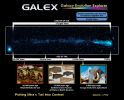
Mira-PIA09958-0.jpgMira soars through the Sky!65 visiteNew ultraviolet images from NASA's Galaxy Evolution Explorer shows a speeding star that is leaving an enormous trail of "seeds" for new solar systems. The star, named Mira (pronounced my-rah) after the latin word for "wonderful," is shedding material that will be recycled into new stars, planets and possibly even life as it hurls through our galaxy.
In figure 1, the upper panel shows Mira's full, comet-like tail as seen only in shorter, or "far" ultraviolet wavelengths, while the lower panel is a combined view showing both far and longer, or "near" ultraviolet wavelengths. The close-up picture at bottom gives a better look at Mira itself, which appears as a pinkish dot, and is moving from left to right in this view. Shed material appears in light blue. The dots in the picture are stars and distant galaxies. The large blue dot on the left side of the upper panel, and the large yellow dot in the lower panel, are both stars that are closer to us than Mira.
The Galaxy Evolution Explorer discovered the strange tail during part of its routine survey of the entire sky at ultraviolet wavelengths. When astronomers first saw the picture, they were shocked because Mira has been studied for over 400 years yet nothing like this has ever been documented before.
Mira's comet-like tail stretches a startling 13 light-years across the sky. For comparison, the nearest star to our sun, Proxima Centauri, is only about 4 light-years away. Mira's tail also tells a tale of its history -- the material making it up has been slowly blown off over time, with the oldest material at the end of the tail being released about 30,000 years ago (figure 2).
Mira is a highly evolved, "red giant" star near the end of its life. Technically, it is called an asymptotic giant branch star. It is red in color and bloated; for example, if a red giant were to replace our sun, it would engulf everything out to the orbit of Mars. Our sun will mature into a red giant in about 5 billion years.
Like other red giants, Mira will lose a large fraction of its mass in the form of gas and dust. In fact, Mira ejects the equivalent of the Earth's mass every 10 years. It has released enough material over the past 30,000 years to seed at least 3,000 Earth-sized planets or 9 Jupiter-sized ones.
While most stars travel along together around the disk of our Milky Way, Mira is charging through it. Because Mira is not moving with the "pack," it is moving much faster relative to the ambient gas in our section of the Milky Way. It is zipping along at 130 kilometers per second, or 291,000 miles per hour, relative to this gas.
Mira's breakneck speed together with its outflow of material are responsible for its unique glowing tail. Images from the Galaxy Evolution Explorer show a large build-up of gas, or bow shock, in front of the star, similar to water piling up in front of a speeding boat. Scientists now know that hot gas in this bow shock mixes with the cooler, hydrogen gas being shed from Mira, causing it to heat up as it swirls back into a turbulent wake. As the hydrogen gas loses energy, it fluoresces with ultraviolet light, which the Galaxy Evolution Explorer can detect.
Mira, also known as Mira A, is not alone in its travels through space. It has a distant companion star called Mira B that is thought to be the burnt-out, dead core of a star, called a white dwarf. Mira A and B circle around each other slowly, making one orbit about every 500 years. Astronomers believe that Mira B has no effect on Mira's tail.
Mira is also what's called a pulsating variable star. It dims and brightens by a factor of 1,500 every 332 days, and will become bright enough to see with the naked eye in mid-November 2007. Because it was the first variable star with a regular period ever discovered, other stars of this type are often referred to as "Miras."
Mira is located 350 light-years from Earth in the constellation Cetus, otherwise known as the whale. Coincidentally, Mira and its "whale of a tail" can be found in the tail of the whale constellation.
These images were between November 18 and December 15, 2006.
MareKromium
(4 voti)
|
|
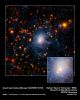
PIA09955_fig2.jpgFearsome Foursome (Figure 2)67 visiteFigure 2 is similar to figure 1 except the color blue represents X-ray light captured by NASA's Chandra X-ray Observatory. The colliding galaxies appear white in this picture because they are in areas where all the colors overlap.
The WIYN telescope, located near Tucson, Ariz., is owned and operated by the WIYN Consortium, which consists of the University of Wisconsin, Indiana University, Yale University, and the National Optical Astronomy Observatory.MareKromium
(4 voti)
|
|

NGC-2237_and_NGC-2244-SST.jpgThe "O" Stars inside the Rosette Nebula114 visiteIn this sub-frame are highlighted 5 dangerous hot stars that can be found inside the Rosette Nebula; these stars are classified as "O" Stars (meaning stars with a surface temperatures of 25.000 Kelvins - such as 24.726,85° Celsius - or higher).
Astronomers calculate that cool stars wandering within about 1,6 Light-Years of the Rosette's "O" Stars are in danger of having their planet forming disks destroyed.
MareKromium
(4 voti)
|
|
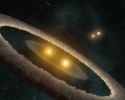
HD98800-PIA09939.jpgEvidence for Strange Stellar Family77 visiteThis artist concept depicts a Quadruple-Star System called HD 98800. The System is approx. 10 MY old, and is located 150 LY away in the constellation TW Hydrae.
HD 98800 contains four stars, which are paired off into doublets, or binaries.
The stars in the binary pairs orbit around each other, and the two pairs also circle each other like choreographed ballerinas. One of the stellar pairs, called HD 98800B, has a disk of dust around it, while the other pair does not.
Although the four stars are gravitationally bound, the distance separating the two binary pairs is about 50 astronomical units (AU) -- slightly more than the average distance between our sun and Pluto.
Using NASA's Spitzer Space Telescope, scientists finally have a detailed view of HD 98800B's potential planet-forming disk. Astronomers used the telescope's infrared spectrometer to detect the presence of two belts in the disk made of large dust grains. One belt sits approx. 5.9 AU away from the central binary, or about the distance from the sun to Jupiter, and is likely made up of asteroids and comets. The other belt sits at 1.5 to 2 AU, comparable to the area where Mars and the asteroid belt sit, and is made up of sand-sized dust grains.
MareKromium
(4 voti)
|
|

HD_189733b-PIA09715_01.jpgExoplanet HD 189733b63 visiteCaption NASA:"This plot of data from NASA's Spitzer Space Telescope (SST) tells astronomers that a toasty gas exoplanet, or a planet beyond our Solar System, contains water vapor.
Spitzer observed the Planet, called HD 189733b, cross in front of its star at three different infrared wavelengths: 3,6; 4,5 and 8 microns (see lime-colored dots). For each wavelength, the Planet's Atmosphere absorbed different amounts of the starlight that passed through it. The pattern by which this absorption varies with wavelength matches known signatures of water, as shown by the theoretical model in blue".MareKromium
(4 voti)
|
|
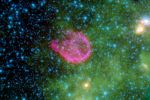
SNR-N132D-PIA09604.jpgThe "Shock-Waves" of N132D62 visiteSupernovae are the explosive deaths of the universe's most massive stars. In death, these volatile creatures blast tons of energetic waves into the cosmos, destroying much of the dust surrounding them.
This false-color composite from NASA's Spitzer Space Telescope and NASA's Chandra X-ray Observatory shows the remnant of one such explosion. The remnant, called N132D, is the wispy pink shell of gas at the center of this image. The pinkish color reveals a clash between the explosion's high-energy shockwaves and surrounding dust grains.
In the background, small organic molecules called polycyclic aromatic hydrocarbons are shown as tints of green. The blue spots represent stars in our galaxy along this line of sight.
N132D is located 163.000 LY away in the Large Magellanic Cloud.
In this image, infrared light at 4,5 microns is mapped to blue, 8,0 microns to green and 24 microns to red. Broadband X-ray light is mapped purple. The infrared data were taken by Spitzer's infrared array camera and multiband imaging photometer, while the X-ray data were captured by Chandra.
MareKromium
(4 voti)
|
|

TwoSuns-PIA09229.jpgTwin Suns, Planets and Asteroids68 visiteThis artist's image depicts a faraway Solar System like our own -- except for one big difference: planets and asteroids circle around not one, but two Suns. NASA's Spitzer Space Telescope found evidence that such Solar Systems might be common in the Universe. Spitzer did not see any planets directly, but it detected dust that is kicked up from disks like this one. The disks were spotted circling all the way around several double, or binary, stars, some of which were closer together than Earth is to our sun. In fact, Spitzer found more disks in orbit around close-knit binary stars than single stars. This could mean that planets prefer two parent stars to one, but more research is needed to figure out exactly what's going on.
(4 voti)
|
|
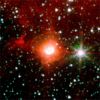
Supernova-PIA09119.jpgBipolar Nebula65 visiteCaption NASA:"A luminous blue variable star in our galaxy, named HD168625, surrounded by a bipolar nebula that is similar to the one around SN1987A.
SN1987A was a supernova that exploded in 1987 in the Large Magellanic Cloud, and was the nearest supernova in about 400 years.
Rings near the equator are sometimes seen around stars that shed mass from their surfaces, but the larger rings above the poles are very rare. Tipped toward Earth and illuminated by the star, the rings look like ellipses in images taken with NASA's Spitzer Space Telescope.
The image was taken in 2004 by the infrared array camera on Spitzer at wavelengths between 3,6 and 8 microns. The massive star at the center, which lies within the constellation Sagittarius, is about 7.200 Light-Years from Earth". MareKromium
(4 voti)
|
|

Spectrum-PIA09199.jpgSpectrum of an Alien World64 visiteThis infrared data from NASA's Spitzer Space Telescope - called a spectrum - tells astronomers that a distant gas planet, a so-called "hot Jupiter" called HD 189733b, might be smothered with high clouds. It is one of the first spectra of an alien world.
A spectrum is created when an instrument called a spectrograph cracks light from an object open into a rainbow of different wavelengths. Patterns or ripples within the spectrum indicate the presence, or absence, of molecules making up the object.
Astronomers using Spitzer's spectrograph were able to obtain infrared spectra for two so-called "transiting" hot-Jupiter planets using the "secondary eclipse" technique. In this method, the spectrograph first collects the combined infrared light from the planet plus its star, then, as the planet is eclipsed by the star, the infrared light of just the star. Subtracting the latter from the former reveals the planet's own rainbow of infrared colors.
Astronomers were perplexed when they first saw the infrared spectrum above. It doesn't look anything like what theorists had predicted. Theorists thought the spectra of hot, Jupiter-like planets like this one would be filled with the signatures of molecules in the planets' atmospheres. But the spectrum doesn't show any molecules, and is instead what astronomers call "flat." For example, theorists thought there'd be a strong signature of water in the form of a big drop in the wavelength range between 7 and 10 microns. The fact that water is not detected may indicate that it is hidden underneath a thick blanket of high, dry clouds. The average brightness of the spectrum is also a bit lower than theoretical predictions, suggesting that very high winds are rapidly moving the terrific heat of the noonday sun from the day side of HD 189733b to the night side.
This spectrum was produced by Dr. Carl Grillmair of NASA's Spitzer Science Center at the California Institute of Technology in Pasadena, Calif., and his colleagues. The data were taken by Spitzer's infrared spectrograph on November 22, 2006.
(4 voti)
|
|

M 42-PIA08653.jpgMoments of M-4269 visiteThis infrared image from NASA's Spitzer Space Telescope shows the Orion nebula, our closest massive star-making factory, 1,450 light-years from Earth. The nebula is close enough to appear to the naked eye as a fuzzy star in the sword of the popular hunter constellation.
The nebula itself is located on the lower half of the image, surrounded by a ring of dust. It formed in a cold cloud of gas and dust and contains about 1,000 young stars. These stars illuminate the cloud, creating the beautiful nebulosity, or swirls of material, seen here in infrared.
In the center of the nebula (bottom inset of figure 1) are four monstrously massive stars, up to 100,000 times as luminous as our sun, called the Trapezium (tiny yellow smudge to the lower left of green splotches. Radiation and winds from these stars are blasting gas and dust away, excavating a cavity walled in by the large ring of dust.
Behind the Trapezium, still buried deeply in the cloud, a second generation of massive stars is forming (in the area with green splotches). The speckled green fuzz in this bright region is created when bullets of gas shoot out from the juvenile stars and ram into the surrounding cloud.
Above this region of intense activity are networks of cold material that appear as dark veins against the pinkish nebulosity (upper inset pf figure 1). These dark veins contain embryonic stars. Some of the natal stars illuminate the cloud, creating small, aqua-colored wisps. In addition, jets of gas from the stars ram into the cloud, resulting in the green horseshoe-shaped globs.
Spitzer surveyed a significant swath of the Orion constellation, beyond what is highlighted in this image. Within that region, called the Orion cloud complex, the telescope found 2,300 stars circled by disks of planet-forming dust and 200 stellar embryos too young to have developed disks.
This image shows infrared light captured by Spitzer's infrared array camera. Light with wavelengths of 8 and 5.8 microns (red and orange) comes mainly from dust that has been heated by starlight. Light of 4.5 microns (green) shows hot gas and dust; and light of 3.6 microns (blue) is from starlight.
(4 voti)
|
|

M 42-PIA08654-ed.jpgInfrared Orion62 visiteThis image composite compares infrared and visible views of the famous Orion nebula and its surrounding cloud, an industrious star-making region located near the hunter constellation's sword. The infrared picture is from NASA's Spitzer Space Telescope, and the visible image is from the National Optical Astronomy Observatory, headquartered in Tucson, Ariz.
In addition to Orion, two other nebulas can be seen in both pictures. The Orion nebula, or M42, is the largest and takes up the lower half of the images; the small nebula to the upper left of Orion is called M43; and the medium-sized nebula at the top is NGC 1977. Each nebula is marked by a ring of dust that stands out in the infrared view. These rings make up the walls of cavities that are being excavated by radiation and winds from massive stars. The visible view of the nebulas shows gas heated by ultraviolet radiation from the massive stars.
Above the Orion nebula, where the massive stars have not yet ejected much of the obscuring dust, the visible image appears dark with only a faint glow. In contrast, the infrared view penetrates the dark lanes of dust, revealing bright swirling clouds and numerous developing stars that have shot out jets of gas (green). This is because infrared light can travel through dust, whereas visible light is stopped short by it.
The infrared image shows light captured by Spitzer's infrared array camera. Light with wavelengths of 8 and 5.8 microns (red and orange) comes mainly from dust that has been heated by starlight. Light of 4.5 microns (green) shows hot gas and dust; and light of 3.6 microns (blue) is from starlight.
(4 voti)
|
|

M 45 - PIA08260.jpgM 45 - The "Seven Sisters", from Cassini61 visiteCaption NASA originale:"The stars of the Pleiades cluster, also known by the names "M 45" and "The Seven Sisters," shine brightly in this view from the Cassini spacecraft. The cluster is comprised of hundreds of stars, a few of which are visible to the unaided eye on Earth as a brilliant grouping in the constellation Taurus.
Some faint nebulous material is seen here. This reflection nebula is dust that reflects the light of the hot, blue stars in the cluster.
The monochrome view was made by combining 49 clear filter images of the Pleiades taken with the Cassini spacecraft wide-angle camera on Aug. 1, 2006. The images were taken as a part of a sequence designed to help calibrate the camera electronics".
(4 voti)
|
|
| 157 immagini su 14 pagina(e) |
|
|
|
|
|
|
10 | |
|
|
|
|
|





