| |

| Piú votate - The Universe in Super Definition |

M 42~0.jpgM 42 in real colors166 visiteUna visione ad HD della Grande Nebulosa di Orione: visibile nei nostri cieli invernali anche ad occhio nudo, ma in forma di gran lunga meno spettacolare rispetto a quanto ci č dato vedere in questa ed in altre immagini similari. Ma cos'č che permette alla splendida Grande Nebulosa di Orione di manifestarsi cosė come noi la vediamo? La "fonte" dello splendore della Nebulosa č dato dal "Trapezio": un gruppo di 4 stelle, le pių luminose presenti nella nebulosa. Le strutture a "filamento" che rendono la Nebulosa ancora pių suggestiva alla vista sono il prodotto di "onde d'urto" (ovvero di "collisioni" vere e proprie fra elementi pesanti - e che si muovono velocemente nello spazio - con gas stazionari o anch'essi in movimento, ma pių lentamente rispetto ai primi). La Grande Nebulosa di Orione si estende nello spazio interstellare per oltre 40 AL e si trova ad una distanza da noi pari a circa 1500 AL, comunque all'interno del medesimo braccio della Via Lattea in cui si trova il nostro Sole (e noi con esso).
(14 voti)
|
|

Black Hole-PIA08696.jpgBlack Hole64 visiteThis artist's concept depicts a supermassive black hole at the center of a galaxy. NASA's Galaxy Evolution Explorer found evidence that black holes -- once they grow to a critical size -- stifle the formation of new stars in elliptical galaxies. Black holes are thought to do this by heating up and blasting away the gas that fuels star formation.
The blue color here represents radiation pouring out from material very close to the black hole. The grayish structure surrounding the black hole, called a torus, is made up of gas and dust. Beyond the torus, only the old red-colored stars that make up the galaxy can be seen. There are no new stars in the galaxy.
(13 voti)
|
|

PIA07854.jpgA beautiful "Asteroid Belt"62 visiteThis artist's animation illustrates a massive asteroid belt in orbit around a star the same age and size as our Sun. Evidence for this possible belt was discovered by NASA's Spitzer Space Telescope when it spotted warm dust around the star, presumably from asteroids smashing together.
The view starts from outside the belt, where planets like the one shown here might possibly reside, then moves into to the dusty belt itself. A collision between two asteroids is depicted near the end of the movie. Collisions like this replenish the dust in the asteroid belt, making it detectable to Spitzer.
The alien belt circles a faint, nearby star called HD 69830 located 41 light-years away in the constellation Puppis. Compared to our own solar system's asteroid belt, this one is larger and closer to its star - it is 25 times as massive, and lies just inside an orbit equivalent to that of Venus. Our asteroid belt circles between the orbits of Mars and Jupiter.
Because Jupiter acts as an outer wall to our asteroid belt, shepherding its debris into a series of bands, it is possible that an unseen planet is likewise marshalling this belt's rubble. Previous observations using the radial velocity technique did not locate any large gas giant planets, indicating that any planets present in this system would have to be the size of Saturn or smaller.
Asteroids are chunks of rock from "failed" planets, which never managed to coalesce into full-sized planets. Asteroid belts can be thought of as construction sites that accompany the building of rocky planets.
(13 voti)
|
|

Life-PIA03538.jpgLife!63 visiteThis artist's conception symbolically represents complex organic molecules, known as polycyclic aromatic hydrocarbons, seen in the early universe. These large molecules, comprised of carbon and hydrogen, are considered among the building blocks of life.
NASA's Spitzer Space Telescope is the first telescope to see polycyclic aromatic hydrocarbons so early -- 10 billion years further back in time than seen previously. Spitzer detected these molecules in galaxies when our universe was one-fourth of its current age of about 14 billion years.
These complex molecules are very common on Earth. They form any time carbon-based materials are not burned completely. They can be found in sooty exhaust from cars and airplanes, and in charcoal broiled hamburgers and burnt toast.
Polycyclic aromatic hydrocarbons are pervasive in galaxies like our own Milky Way, and play a significant role in star and planet formation.
(13 voti)
|
|

Large Magellanic Cloud-1.jpgThe Large Cloud of Magellan (HR)63 visiteAn alluring sight in dark Southern skies, the Large Magellanic Cloud (LMC) is seen here through a narrow filter that transmits only the red light of Hydrogen Atoms. Ionized by energetic starlight, a Hydrogen Atom emits the characteristic red H-alpha light as its single electron is recaptured and transitions to lower energy states. As a result, this image of the LMC seems covered with shell-shaped clouds of Hydrogen gas surrounding massive, young stars. Sculpted by the strong stellar winds and ultraviolet radiation, the glowing Hydrogen clouds are known as "H-II" (such as Ionized Hydrogen) Regions. This HR mosaic view was recorded in 6 segments, each with 200 minutes of exposure time. Itself composed of many overlapping shells, the Tarantula Nebula, is the large star forming Region near top center. A satellite of our Milky Way Galaxy, the LMC is about 15,000 light-years across and lies a mere 180.000 LY away in the constellation known as Dorado.
(12 voti)
|
|

NGC-4696.jpgNGC 469695 visiteIn many cosmic environments, when material falls toward a Black Hole energy is produced as some of the matter is blasted back out in jets. In fact, such Black Hole "Engines" appear to be the most efficient in the Universe, at least on a galactic scale. This composite image illustrates one example of an elliptical galaxy with an efficient Black Hole Engine, NGC 4696. The large galaxy is the brightest member of the Centaurus galaxy cluster, some 150 MLY away. Exploring NGC 4696 in X-Rays (red) astronomers can measure the rate at which infalling matter fuels the supermassive Black Hole and compare it to the energy output in the jets to produce giant radio emitting bubbles. The bubbles, shown here in blue, are about 10.000 LY across. The results confirm that the process is much more efficient than producing energy through nuclear reactions - not to mention using fossil fuels. Astronomers also suggest that as the Black Hole pumps out energy and heats the surrounding gas, star formation is ultimately shut off, limiting the size of large galaxies like NGC 4696.
(12 voti)
|
|
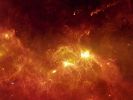
M 42~3.jpgM 42 - In Memory Of IRAS (infrared vision)146 visiteCaption NASA originale:"Do you recognize the constellation Orion? This striking but unfamiliar looking picture of the familiar Orion region of the sky was produced using survey data from the now-defunct InfraRed Astronomical Satellite (IRAS). The above image combines information recorded at three different invisible infrared wavelengths and covers about 30x24° on the sky. Most of Orion's visually impressive stars don't stand out, but bright Betelgeuse does appear as a small bright purplish dot on the lower left. The bright region on the right contains the Great Nebula in Orion, while the bright region just above the image bottom is the Rosette Nebula. Surrounding these regions are a jumble of chaotic glowing gas and dark dust jettisoned by stars forming and exploding over millions of years".
(12 voti)
|
|

M 82-PIA08093.jpgM 82: A "Space Rainbow"63 visiteCaption NASA originale:"NASA's Spitzer, Hubble and Chandra Space Observatories teamed up to create this multi-wavelength, false-colored view of the M82 galaxy.
The lively portrait celebrates Hubble's "sweet sixteen" birthday.
X-ray data recorded by Chandra appears in blue; infrared light recorded by Spitzer appears in red; Hubble's observations of hydrogen emission appear in orange, and the bluest visible light appears in yellow-green".
(11 voti)
|
|

M-002-PIA04926.jpgM 2 - Globular Star Cluster in Aquarius80 visiteCaption NASA originale:"This image of the Globular Cluster Messier 2 (M2) was taken by Galaxy Evolution Explorer on August 20, 2003. This image is a small section of a single All Sky Imaging Survey exposure of only 129 seconds in the constellation Aquarius. This picture is a combination of Galaxy Evolution Explorer images taken with the far ultraviolet (colored blue) and near ultraviolet detectors (colored red). Globular clusters are gravitationally bound systems of hundreds of thousands of stars that orbit in the halos of galaxies. The globular clusters in out Milky Way galaxy contain some of the oldest stars known. M2 lies 33.000 LY from our Sun with stars distributed in a spherical system with a radius of approximately 100 LY".
(11 voti)
|
|

AlienWorld-PIA09228.jpgTwin Suns' Sunset66 visiteOur solitary sunsets here on Earth might not be all that common in the grand scheme of things. New observations from NASA's Spitzer Space Telescope have revealed that mature planetary systems -- dusty disks of asteroids, comets and possibly planets -- are more frequent around close-knit twin, or binary, stars than single stars like our sun. That means sunsets like the one portrayed in this artist's photo concept, and more famously in the movie "Star Wars," might be quite commonplace in the universe.
Binary and multiple-star systems are about twice as abundant as single-star systems in our galaxy, and, in theory, other galaxies. In a typical binary system, two stars of roughly similar masses twirl around each other like pair-figure skaters. In some systems, the two stars are very far apart and barely interact with each other. In other cases, the stellar twins are intricately linked, whipping around each other quickly due to the force of gravity.
Astronomers have discovered dozens of planets that orbit around a single member of a very wide stellar duo. Sunsets from these worlds would look like our own, and the second sun would just look like a bright star in the night sky.
But do planets exist in the tighter systems, where two suns would dip below a planet's horizon one by one? Unveiling planets in these systems is tricky, so astronomers used Spitzer to look for disks of swirling planetary debris instead. These disks are made of asteroids, comets and possibly planets. The rocky material in them bangs together and kicks up dust that Spitzer's infrared eyes can see. Our own solar system is swaddled in a similar type of disk.
Surprisingly, Spitzer found more debris disks around the tightest binaries it studied (about 20 stars) than in a comparable sample of single stars. About 60 percent of the tight binaries had disks, while the single stars only had about 20 percent. These snug binary systems are as close or closer than just three times the distance between Earth and the sun. And the disks in these systems were found to circumnavigate both members of the star pair, rather than just one.
Though follow-up studies are needed, the results could mean that planet formation is more common around extra-tight binary stars than single stars. Since these types of systems would experience double sunsets, the artistic view portrayed here might not be fiction.
The original sunset photo used in this artist's concept was taken by Robert Hurt of the Spitzer Science Center at the California Institute of Technology, Pasadena, Calif.
(10 voti)
|
|

HD-209458b-00.jpgExtra-Solar Planet HD-209458b (1)63 visiteThe powerful vision of NASA's HST has allowed astronomers to study for the first time the layer-cake structure of the atmosphere of a planet orbiting another star. HST discovered a dense upper layer of hot Hydrogen gas where the super-hot planet's atmosphere is bleeding off into space.
The planet, designated HD 209458b, is unlike any world in our Solar System. It orbits so close to its star and gets so hot that its gas is streaming into space, making the planet appear to have a comet-like tail. This new research reveals the layer in the planet's upper atmosphere where the gas becomes so heated it escapes, like steam rising from a boiler.
"The layer we studied is actually a transition zone where the temperature skyrockets from about 1340 deg. Fahrenheit (1000 Kelvin) to about 25.540 degrees (15.000 Kelvin), which is hotter than the Sun " said Gilda Ballester of the University of Arizona in Tucson, leader of the research team.
"With this detection we see the details of how a planet loses its atmosphere."
The findings by Ballester, David K. Sing of the University of Arizona and the Institut d'Astrophysique de Paris, and Floyd Herbert of the University of Arizona will appear Feb. 1 in a letter to the journal Nature.
The Hubble data show how intense ultraviolet radiation from the host star heats the gas in the upper atmosphere, inflating the atmosphere like a balloon. The gas is so hot that it moves very fast and escapes the planet's gravitational pull at a rate of 10,000 tons a second, more than three times the rate of water flowing over Niagara Falls. The planet, however, will not wither away any time soon. Astronomers estimate its lifetime is more than 5 billion years.
The scorched planet is a big puffy version of Jupiter. In fact, it is called a "hot Jupiter," a large gaseous planet orbiting very close to its parent star. Jupiter might even look like HD 209458b if it were close to the Sun, Ballester said.
The planet completes an orbit around its star every 3.5 days. It orbits 4.7 million miles from its host, 20 times closer than the Earth is to the Sun. By comparison, Mercury, the closest planet to our Sun, is 10 times farther away from the Sun than HD 209458b is from its star. Unlike HD 209458b, Mercury is a small ball of iron with a rocky crust.
(10 voti)
|
|

GALEX Portrait-PIA03295.jpgPortrait of the Universe66 visiteFrom sparkling blue rings to dazzling golden disks, Galaxy Evolution Explorer (Galex) scientists are handing out a collection of their finest galactic treasures at the January 2006 American Astronomical Society meeting in Washington, D.C.
Mined from the mission's Survey of Nearby Galaxies data, these cosmic gems were collected with the telescope's sensitive ultraviolet instruments. The gallery of galaxies has been made into a poster for meeting attendees visiting the mission's booth. Organized from far-ultraviolet to near-ultraviolet bright galaxies, this poster encapsulates the heart of the mission to study how galaxies and star formation rates have changed over the past 10 billion years.
Events in space take millions or billions of years to unfold, which means that astronomers can't watch individual galaxies and stars age over time. Luckily, because the physics of light travel dictates that the farther away an object is from Earth, the longer it takes for its light to travel to us, the universe can be thought of as a time machine. By building telescopes sensitive enough to capture objects that are 10 billion light-years away, astronomers can essentially see an object the way it looked 10 billion years ago. Galex astronomers are using this phenomenon to their advantage by taking snapshots of different galaxies at various distances in space. By comparing portraits of numerous objects at various times in the universe's history, the team can begin to piece together the life cycle of stars and galaxies.
For the poster, Galex scientists organized 196 different nearby galaxies in bins of increasing ultraviolet color. By placing the various snapshots side by side, astronomers can see how galaxies age differently. When viewed in ultraviolet, active star-forming regions in galaxies can be seen as glittering blue structures, while a soft, golden glow indicates the presence of older stars.
The 196 galaxies represented in the poster were selected from more than 1,000 galaxies in the "Ultraviolet Atlas of Nearby Galaxies." So far, the Galex mission has surveyed more than 100 million galaxies.
(10 voti)
|
|
| 157 immagini su 14 pagina(e) |
1 |
|
|
|
|
|
|
|
|
|
|
|
|





