| Piú viste - MOON |

APOLLO 16 AS 16-4502.jpgAS 16-4502 - The beautiful Isidorus "D"54 visiteThis oblique view of the crater Isidorus "D" was taken with the PanCam on Apollo 16. Isidorus "D" is about 15 Km in diameter and is located in the highlands between Mare Tranquillitatis and Mare Nectaris.
Evidence of avalanching (Howard, 1973) and of other types of downslope movement of material are clearly visible on the inner walls of the crater. The streaks resembling shooting stars on the left wall appear to be avalanche scars. The avalanches probably were spearheaded by large blocks followed by fine-grained material. On the near wall (arrow) a larger landslide terminates in a straight line against the relatively flat crater floor. In the shadowed part of the crater wall many short irregular benches or narrow terraces mark the tops of masses of slumped material. The brightness of the avalanche scars is an indication of their freshness; in general, freshly exposed lunar materials are brighter than undisturbed materials nearby.
|
|

APOLLO 17 AS 17-2321.jpgAS 17-2321 - Crater Chain54 visiteThis crater chain in Southern Mare Serenitatis is clearly of internal origin because it is lined up parallel to several fault valleys or grabens.
The craters in the chain do not appear to have any rims; consequently, they may have formed by collapse and not by the explosive ejection of volcanic material.
The large crater in the right side of this scene, however, has a rim and so cannot be the result of collapse alone.
The finely lineated texture across the left side of the photograph is caused by ejecta from the crater Dawes to the south.
|
|

APOLLO 16 AS 16-4530.jpgAS 16-4530 - Seconday impact craters, faults and rifles54 visiteLinear features of external and internal origin are contrasted in this area of Southernmost Mare Tranquillitatis.
The North-trending line of overlapping, very irregular craters along the East edge of the picture is clearly a chain of secondary impact craters. Its trend is radial to Theophilus, a large crater of early Copernican age that lies about 105 Km south of this area. The flaring shapes of some of the craters and their state of preservation also suggest that Theophilus is the primary crater. The narrow, straight rifle or graben that extends westward across the picture is clearly of internal origin. It formed when tensional forces ruptured the crust, causing the floor of the rifle to subside along faults.
Straight rifles are commonly the sites of volcanic cones or of blankets of volcanic ejecta; however, there are no signs of volcanism here that can be related to this rifle.
|
|

APOLLO 15 AS 15-0274.jpgAS 15-0274 - Euler Crater54 visiteIn this oblique view of Euler, some details are shown that are not visible in other pictures. Note, for example, the ledges (L) of bedrock cropping out along the South Wall and the low terraces (T) at the points of contact between the slump masses and the floor. They may be aprons of debris or "bathtub rings" of lava. This oblique viewing angle also enhances the polygonal outline of Euler's rim crest and the size and ruggedness of the huge masses that have slumped from the walls.
|
|

APOLLO 15 AS 15-9328.jpgAS 15-9328 - Bessel Crater54 visiteOutcrops of layered rock are strikingly evident in the upper part of the far wall of the crater Bessel (17- Km diameter) in South-Central Mare Serenitatis. The outcrop is most evident where it forms shadows; however, the dark debris that streams downslope from the layered rock is visible even on parts of the crater wall where the Sun has washed out all details of relief. The outcrop is at a uniform distance below the crater rim, indicating that the strata are horizontal. Thus, Bessel furnishes convincing evidence that mare surfaces are underlain by dark layered rock. The dark rock is now known to be basalt that accumulated as successive flows or layers of lava.
Bessel is youthful enough that boulders are abundant on its rim and floor.
An anomalously high number of boulders is visible in and around the 750-m diameter crater (arrow) on the floor.
|
|

90-August Moon.jpgThe "Impact Site" of SMART-154 visiteCaption ESA originale:"Reconnaissance view of the Moon on 20 August 2006 at 00:00 UT.
The Lunar North Pole is up.
The SMART-1 impact is expected on 3 September 2006 in the Lacus Excellentiae Region, at the top of the U-shape feature situated North of the crater Clausius "B". The nominal impact position is marked by the red circle".
|
|

40-Jacobi Crater.jpgJacobi Crater (HR)54 visiteThis HR image was taken by the advanced Moon Imaging Experiment (AMIE) on 18 March 2006 from a distance of about 578 Km from the Moon's surface, with a ground resolution of 52 mt per pixel. It shows part of crater Jacobi in the Moon's Southern Hemisphere. The western crater rim can be seen on the left edge of the image. The imaged area is centred at a Latitude of 56,5° South and a Longitude of 10,9° East, with a field of view of 27 Km. North is up.
Crater Jacobi itself is much larger than this image - 68 Km in diameter - with the imaged area only showing about 1/5th of the crater floor area. The crater is centred at a Latitude of 56,7° South and a Longitude of 11,4° East. The single prominent crater to the upper left of the image centre is Jacobi "W", with a diameter of only 7 Km.
Peculiar surface structure can be seen in the lower left part of the image, and indicates several heavily eroded big-sized craters.
SMART-1 resolution at high solar elevation angle allows for the detection of eroded structures buried under more recent layers, giving a window on the past evolution of the Moon.
The crater is named after the German mathematician Karl Gustav Jacob Jacobi (1804 - 1851), who worked on elliptic functions and was active in the field of celestial mechanics
|
|

42-CuvierC-AMI_EAE3_002085_L,1.jpgCuvier "C"54 visiteCaption ESA originale:"This high-resolution image, taken by the Advanced Moon Imaging Experiment (AMIE) on board ESA’s SMART-1 spacecraft, shows the young crater ‘Cuvier C’ on the Moon.
AMIE obtained this sequence on 18 March 2006 from a distance of 591 Km from the surface, with a ground resolution of 53 mt per pixel. The imaged area is centred at a Latitude of 50,1º South and a Longitude of 11,2º East, with a field of view of 27 Km. The North is on the right of the image.
Cuvier "C", a crater about 10 Km across, is visible in the lower right part of the image. Cuvier "C" is located at the edge of the larger old crater Cuvier, a crater 77 Km in diameter. The upper left quadrant of the image contains the smooth floor of Cuvier, only one fourth of which is visible in this image".
|
|
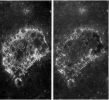
APOLLO 15 AS 15-9960.jpgAS 15-9960 - The "D" in "Detail"...54 visiteThe enlarged view provided by this stereogram shows that there are at least 3 different types of material within the floor of the D-shaped depression (see AS 17-1672). A brighter annulus parallels the wall, and darker material fills the inner floor.
Within both areas numerous bulbous and slightly raised comical structures are easily distinguishable.
There are craters on the summits of many of the structures, suggesting that each one is probably an extrusive dome with a summit crater.
Many similar features on Earth are caused by the subterranean drainage of lavas following extrusion and release of pressure following the upward movement of a central plug.
|
|

APOLLO 16 AS 16-120-19266.jpgAS 16-120-19266 - The "Playa" of King Crater54 visiteThe Apollo 16 Astronauts captured this spectacular view of the large dark "pool" on the North flank of the crater King as they approached from the East.
The pool (also known as a "lake", "pond" or "playa") is in an old crater swamped by King ejecta. The maximum width of the pool is about 21 Km. The peculiar dark material that forms the large pool and also coats adjacent hills was first discovered on Apollo 10 and was later seen again from Apollo 14.
The most exciting part of the discovery had to wait until the mapping and Panoramic Cameras of Apollo 16 showed that this material contains some of the freshest and most spectacular flow structures on the Moon.
These structures, some of which are seen in the following figures, show that the material behaved like lava.
The material is very similar in appearance to that filling parts of the floor of King.
|
|

61-smart-1_data1002887_030_H.jpgDouble Crater54 visiteCaption ESA originale:"This beautiful oblique view was taken on 2 September 2006 by the AMIE camera on board SMART-1 during the last few orbits prior to Moon impact, and shows a double crater.
This view was captured during the imaging session which took place bewteen 15:19 and 17:34 CEST (17:19 - 19:34 UT)".
|
|

63-smart-1_data1002887_024_H.jpgHeavily cratered Lunar Region54 visitenessun commento
|
|
| 2195 immagini su 183 pagina(e) |
 |
|
|
|
|
174 | |
|
|
|
|





