| Piú viste - MOON |

33-Ranger7.jpgGuericke Crater54 visiteCaption NASA originale:"Ranger 7 B-camera image of Guericke Crater (11.5° S, 14.1° W, diameter 63 Km) taken from a distance of 1335 Km. The dark flat floor of Mare Nubium dominates most of the image, which was taken 8,5 minutes before Ranger 7 impacted the Moon on 31 July 1964. The frame is about 230 Km across and north is at 12:30. The impact site is off the frame to the left (Ranger 7, B100)".
Location & Time Information
Date/Time (UT): 1964-07-31 T 13:17:12
Distance/Range (km): 1335.44
Central Latitude/Longitude (deg): -12.60, 013.79 W
Orbit(s): Impact - Hard Landing
|
|

34-Ranger7.jpgMare Nubium and Fra Mauro Area (Apollo 14 Landing Site)54 visiteCaption NASA originale"Ranger 7 image of Mare Nubium taken 8,5 minutes before impact from 1170 Km. 60 Km diameter Bullialdus Crater is at bottom center and 43 Km Lubiniezky is just above it to the left. The small crater below and right of the central reticle is Darney. The Fra Mauro region is in the upper right corner and Montes Riphaeus are the white arc near the top center of the image. The impact point is midway between the reticle right of the center and the one above it. North is up (Ranger 7, A100)".
|
|

35-Ranger7.jpgThe "floor" of Mare Nubium54 visiteCaption NASA originale:"Ranger 7 camera-B image taken 5 seconds before impact on 31 July 1964. The image was taken from a distance of 14,71 Km and shows the floor of Mare Nubium. The frame is about 2,8 Km across and shows features as small as approximately 5 meters. The impact site is off this image to the upper left (Ranger 7, B200)".
Location & Time Information
Date/Time (UT): 1964-07-31 T 13:25:43.75
Distance/Range (km): 14.71
Central Latitude/Longitude (deg): -10.66, 020.57 W
Orbit(s): Impact - Hard Landing
|
|

36-Ranger7.jpgThe "floor" of Mare Nubium54 visiteCaption NASA originale:"Final image taken by Ranger 7 camera A before impact at 10.59 S°, 20.68° W. This image was taken from a distance of 6,5 Km only 2,5 seconds before impact. The frame is about 2,7 Km across and north is up. The impact point is just above and right of the central reticle. At this high resolution (about 5 meters) the flat floor of Mare Nubium was shown to be peppered with small impact craters (Ranger 7, A199)".
Location & Time Information
Date/Time (UT): 1964-07-31 T 13:25:46
Distance/Range (km): 6.46
Central Latitude/Longitude (deg): -10.60, 020.69 W
Orbit(s): Impact - Hard Landing
|
|

24-Mare Humorum-3.jpgMare Humorum (3)54 visitenessun commento
|
|
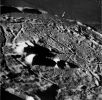
APOLLO 16 AS 16-120-19295~0.jpgAS 16-120-19295 - Gassendi54 visiteThis view into the shallow crater Gassendi shows another strongly fractured crater floor. Gassendi is about 110 Km wide. Dark mare lavas in the distance embay the rim and a little of the interior of Gassendi. They may have entered the crater through the narrow gap partly in shadow below the arrow. Most craters that have fractured floors are near areas of mare flooding. This suggests that the fracturing is a consequence of volcanic activity. An area next to the central peaks of Gassendi was the runnerup choice for a landing site for Apollo 17.
|
|

APOLLO 15 AS 15-9596.jpgAS 15-9596 - Tsiolkovsky54 visiteDrastic enlargement of a panoramic camera frame provides a wealth of detail within the small area outlined in AS 15-9591. Note the many large blocks on the slope. The largest block is about 125 mt wide. Most blocks apparently originated at the discontinuous ledge near the top of the slope. Note also the fillets on the upslope side of many of the blocks. They probably consist of fine-grained debris that was trapped behind the blocks as it moved downslope. The arrows identify what appear to be two craters in the process of being destroyed by erosion. Otherwise, craters are absent on the steeply dipping slope, although numerous craters are present on the gentler slopes above.
|
|

APOLLO 15 AS 15-1541.jpgAS 15-1541 - Archimedes and Aristillus54 visiteThe ejecta blanket and secondary impact craters of the mare-filled crater Archimedes (80 Km in diameter) are visible on the terrain toward the viewer (South) but not on the mare surface to the crater's left and right. Yet at one time ejecta like that to the south must have completely surrounded Archimedes because similar ejecta surrounds craters such as Aristillus (upper right). Thus, the mare lavas, in addition to filling the interior of Archimedes, obviously have covered the eastern and western parts of the ejecta. In turn, ejecta from Archimedes has covered materials of the Imbrium Basin like the rugged hills in the lower left of the picture. These stratigraphic relations prove that time elapsed between formation of the Imbrium basin and its filling by mare-time enough for impacts to create Archimedes, the deeply flooded crater to its right (arrow), and similar "Imbrian-age" craters elsewhere, as was pointed out by Eugene Shoemaker in 1962.
Archimedes has no visible central peak complex. Presumably the complex exists but has been completely inundated by the mare.
|
|

APOLLO 15 AS 15-2510.jpgAS 15-2510 - Humboldt Crater54 visiteThe crater Humboldt, on the east limb of the Moon, as seen from Earth, is 200 km across, a little larger than Tsiolkovsky. This view by the Apollo 15 mapping camera looks southward across Humboldt's ejecta blanket and into the crater. Irregular secondary craters partly covered by the ejecta are in the foreground and a long chain of secondaries extends from Humboldt's rim to the foreground. Humboldt is one of the largest craters known to have a prominent central peak. If the crater is like terrestrial impact structures, the peak may expose rock uplifted about 10% of the crater's width, on the order of 20 Km from beneath the crater floor. This would be an exciting find for future Astronauts. A spider web of cracks on the crater floor suggested to R. B. Baldwin (1968) that the floor was bowed up in the middle. Later, dark mare lavas flooded low areas in the outer part of the floor and covered the cracks. A peculiar "bull's eye" double crater on the crater floor has several counterparts elsewhere on the Moon. The origin of these double craters is a continuing puzzle.
|
|

APOLLO 16-4136-A.jpgAS 16-4136 - Cratered Region near Mandel'shtam (1)54 visiteThis view looks southward near Mandel'shtam on the Lunar Far-Side. Most young lunar craters wider than about 40 Km have flows on their rims that resemble lava flows or mud flows on Earth. The unnamed crater near the top is about 14 Km wide and was recognized by H. J. Moore (1972) as being the smallest crater known to have such flows. Flows in the middle of the picture surged downhill off the high rim of the crater making lobes and tongues and leaving behind drained channels with levees.
In the area to the right of the crater, enlarged in the next frame, are some thin lobate flows that apparently rode over small hills, as if these flows were propelled outward from the crater with sufficient velocity to climb the hills. Ejecta deposits farther than about 1 Km from the rim are radially lineated and are smoother than the ground immediately surrounding the crater. The crisp, blocky zone around the crater is typical of many fresh craters.
|
|

APOLLO 15 AS 15-9287.jpgAS 15-9287 - A "Middle-aged" Crater54 visiteRemarkable detail is shown in this enlargement of a small part of a panoramic camera frame. In most respects, the crater itself is typical of a great many craters its size-about 1,2 Km. Because it does not have rays, it is believed to be older than most other Lunar craters. Its rounded rim crest and slightly raised rim (extending outward to the arrow, on the West side) also point to its greater age. On the other hand, it is young enough that some of the original dunelike texture of the ejecta blanket is preserved (especially to the West), a great many large blocks of ejecta are still visible, and the original depth of the crater has not been greatly lessened by infalling debris. The largest blocks, which are about 30 mt in size, occur near the rim. The terrace (T) extending partly around the wall about 100 mt below the surface probably marks the top of a resistant rock layer. However, if there were other signs of bedrock stratification within this crater, they have been obscured by the movement of debris down the walls. The very smooth floor is the only unusual feature of this crater. It may consist of a solidified pool of rock melted by heat generated from the impact.
|
|

APOLLO 16 AS 16-4559.jpgAS 16-4559 - Kant "P" Crater and its "inner" crater54 visiteKant "P" is a medium-sized crater located in the central highlands on the Moon's Near-Side. About 5,5 Km in diameter, its overall shape is not in the least unusual. However, the younger, small pear-shaped crater on Kant "P"'s North wall is an excellent example of the controlling effect that topographic relief plays on the shape of an impact crater. Because the small crater was formed on a steeply sloping surface, its ejecta was deposited chiefly downslope and formed a broad rim. The original rim and wall on the upslope side have been obliterated by slumping.
The slumping has left a landslide scar and has caused talus and scree to be deposited in the lower part of the crater.
|
|
| 2195 immagini su 183 pagina(e) |
 |
|
|
|
|
173 | |
|
|
|
|





