| Piú viste - MOON |

LRO-0007a-369443main_lroc_apollo16_lrg.jpgDescartes Highlands: the Apollo 16 Landing Site (ctx frame)57 visitenessun commentoMareKromium
|
|

Panoramic-AS12-46-6807-6811.jpgFrom AS 12-46-6807 until 6811 (EVA-1; pre-deployment ALSEP pan)57 visitenessun commentoMareKromium
|
|

Panoramic-AS16-107-17483-17485.jpgFrom AS 16-107-17483 until 17485 (EVA-2; Station 4 Crater)57 visitenessun commentoMareKromium
|
|

LRO-2500-Saha_E_Crater.jpgThe Floor of Crater "Saha E"57 visiteThe lava-like melt produced by impacts on the Moon can have a variety of morphologies.
The polygonal texture you see here is located on the Floor of Crater Saha E, an approx. 28-Km-diameter Impact Crater located East of Mare Smythii.
This texture could be the result of impact melt coating boulders and other deposits on the Floor of the Crater. From the perspective of exploration planning, impact melt deposits are scientifically interesting because they can be used to age-date impacts. Impact melts can also contain geochemical traces of the original impact, and often contain small fragments of the original pre-impact target rocks. LROC will be providing high-resolution images of many other fresh, relatively undegraded craters to document the complex aftermath of impact events as well as to define targets for future human lunar exploration.MareKromium
|
|
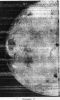
24-Farside-Luna3.jpgThe Far-Side of the Moon from "Luna 3"56 visiteCaption NASA originale:"The Luna 3 spacecraft returned the first views ever of the far side of the Moon. The first image was taken at 03:30 UT on 7 October at a distance of 63,500 km after Luna 3 had passed the Moon and looked back at the sunlit far side. The last image was taken 40 minutes later from 66,700 km. A total of 29 photographs were taken, covering 70% of the far side. The photographs were very noisy and of low resolution, but many features could be recognized. This close up view taken with the narrow angle camera shows the far side has fewer maria (the dark areas) than the near side. The image is centered at 20 N, 95 E and the dark area to the left and just below center is Mare Marginus and below that Mare Smythii, just at the boundary between the near and far sides. The left half of the image shows the near side of the Moon, including the circular Mare Crisium at far left. The Moon is 3475 km in diameter and north is up (Luna 3-27)".
|
|

26-Farside-Luna3.jpgThe first - noisy - close-up of the Moon from "Luna 3"56 visiteCaption NASA originale:"This is the first close-up view of the Moon returned, taken with the narrow angle camera. This image is centered at 20° N, 105° E, the dark region below and left of center is Mare Smythii, the bright crater above and left of center is Giordano Bruno. North is up. (Luna 3-3)".
|
|

27-Farside-Luna3.jpgThe first - noisy - close-up of the Far-Side of the Moon from "Luna 3"56 visiteCaption NASA originale:"This close up view taken with the narrow angle camera shows the far side has fewer maria (the dark areas) than the near side. This image is centered at 17° N, 110° E, the dark region below and left of center is Mare Smythii, the bright crater above and left of center is Giordano Bruno. North is up. (Luna 3-6)".
|
|

27-Farside-Luna3~0.jpgThe first - noisy - close-up of the Far-Side of the Moon from "Luna 3"56 visiteCaption NASA originale:"This close up view taken with the narrow angle camera shows the far side has fewer maria (the dark areas) than the near side. This image is centered at 17° N, 110° E, the dark region below and left of center is Mare Smythii, the bright crater above and left of center is Giordano Bruno. North is up (Luna 3-6)".
|
|

41-Mezentzev Crater.jpgCraters Mezentsev, Niepce and Merril56 visiteThis image was taken by the Advanced Moon Imaging Experiment (AMIE) on 16 May 2006. The imaged area is centred at a Latitude of 73° North and a Longitude of 124° West, on the Far-Side of the Moon.
Normally, the AMIE camera is pointed straight down at the Lunar Surface, in the Nadir pointing mode. In this image, AMIE was pointed towards the horizon, showing the Lunar Surface in an oblique view.
The largest craters in this image are Mezentsev, Niepce and Merrill. Mezentsev is an eroded crater 89 Km in diameter and centred at 72,1° N, and 128,7° W.
A smaller cup-shaped crater resides inside Mezentsev. Niepce and Merrill both have a diameter of 57 Km and are located at 72,7° N-119,1° W and 75,2° N and 116,3° W, respectively.
Mezentsev Crater is named after Yourij Mezentsev, a Soviet engineer (1929 - 1965) who was one of the first people to design rocket launchers, while Joseph Niepce was the French inventor of photography (1765 - 1833); Paul Merrill was an American astronomer (1887 - 1961).
|
|

51-Smart-1_25_August_0815UTC_H.jpgGoing Down56 visiteCaption ESA originale:"This image of the Lunar Surface was taken on 25 August at 10:08 CEST (08:15 UT) by the star tracker (attitude camera) on board ESA’s SMART-1, from a distance of 59 Km above the Moon Surface. The spacecraft was travelling at a speed of 2 Km/sec.
The image is slightly smeared as the spacecraft is moving at high speed and at low altitude. This image was taken as a test, meaning that the spacecraft pointing was not optimised for star tracker imaging.
The Moon features on the photo still have to be identified".
|
|

62-smart-1_data1002887_016_H.jpgSmall craters56 visitenessun commento
|
|

64-smart-1_data1002887_015_H.jpgOld Craters in Mare Tranquillitatis56 visitenessun commento
|
|
| 2195 immagini su 183 pagina(e) |
 |
|
|
|
|
170 | |
|
|
|
|





