| Piú viste - MOON |
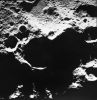
APOLLO_17_AS_17-M-R23-0671.jpgAS 17-M-R23-0671 - De Vries Crater59 visiteCoord.: 19,5° South Lat. and 176,9° West Long.
Lens Focal Length: 3"
Camera Tilt: VERT
Camera Altitude: 118 Km
Sun Elevation (on local horizon): 4°MareKromium
|
|

APOLLO_16_AS_16-M-R28-0995.jpgAS 16-M-R28-0995 - Davy and Davy "Y" Crater Region59 visiteCoord.: 9,3° South Lat. and 8,4° West Long.
Lens Focal Length: 3"
Camera Tilt: VERT
Camera Altitude: 111 Km
Sun Elevation (on local horizon): 3° MareKromium
|
|

APOLLO_15_AS_15-M-R70-2392.jpgAS 15-M-R70-2392 - Langrenus Crater59 visiteCoord.: 8,5° South Lat. and. 61,5° East Long.
Lens Focal Length: 3"
Camera Tilt: VERT
Camera Altitude: 119 Km
Sun Elevation (on local horizon): 52°
Nota: Vi suggeriamo di confrontare la disposizione "terrazzata" delle pareti interne di Langrenus con le medesime "terrazze" (meno regolari, ma sostanzialmente simili a quelle) del più famoso Copernicus.
Per i Lettori più interessati alla questione (annosa) dell'origine dei crateri, suggeriamo di fare una ricerca su quale possa essere quella "meccanica da impatto" capace di creare rilievi terrazzati come quelli che vediamo in questo frame. Il lavoro migliore che riceveremo verrà pubblicato su TruePlanets.
|
|

36-Shackleton_Crater-AMI_EAE3_001775_00002_00020.jpgSchakleton Crater in natural colors59 visiteThe Advanced Moon Imaging Experiment Camera (AMIE) obtained this image on 13 January 2006 - close to the time of Lunar Southern Summer - from a distance of about 646 Km over the surface and with a ground resolution of 60 mt per pixel.
Shackleton crater lies at the Lunar South Pole (89,54° S. Lat. and 0° East Lng.) and has a diameter of approx. 19 Km.
SMART-1 monitored this area almost every orbit. This will allow to produce very high resolution maps of the area as well as illumination maps. The long shadows that surround the crater make it very hard to observe. The analysis of the data obtained allowed a very detailed map of its rim, surrounding ejectas and craters.
SMART-1 also made long repeated exposures to see inside the shadowed areas. The purpose was detecting the very weak reflected light from the crater rims, and therefore study the surface reflection properties (albedo) and its spectral variations (mineralogical composition). These properties could reveal patchy ice surface layers inside the crater.
On the 2-kilometre wide inner edge of the crater ridge, at times barely visible from Earth, astronomers using ground radio-telescopes have recently reported they were not able to detect a distinctive signature of thick deposits of ice in the area. Earlier measurements by NASA's Lunar Prospector reported of hydrogen enhancement over large shadowed areas.
"We still do not know if this hydrogen is due to enhanced trapping of solar wind, or to the water ice brought on the Moon by the bombardment of comets and asteroids," says Bernard Foing, ESA's SMART-1 Project Scientist. "These bodies may have deposited on the Moon patchy layers of ice filling about 1.5 percent of the areas in permanent shadow, down to one metre below the surface."
"We need to analyse all remote sensing data sets consistently. Future lander and rover missions to the Moon will help in the search and characterisation of lunar polar ice, both on the surface and below the subsurface," Foing continues. "In any case, one day we may even be able to simply combine the implanted hydrogen and the oxygen extracted from lunar rocks to produce clean water, like we do in laboratory experiments on Earth.”
The crater is named after Ernest Shackleton (1874-1922), an explorer famous for his Antartic expeditions.
MareKromium
|
|
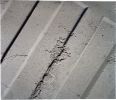
APOLLO_12_AS_12-57-8448_HR.jpgAS 12-57-8448 (HR) - Soil surface disturbed by Astronauts' boots59 visitenessun commento
|
|

APOLLO_12_AS_12-57-8445_HR.jpgAS 12-57-8445 (HR) - Soil surface disturbed by the LM descent engine exhaust59 visitenessun commento
|
|

Z-110-The_Moon-PlaskettCrater-00.jpgThe Spectacular Crater Plaskett59 visiteCaption ESA:"This image, taken by the Advanced Moon Imaging Experiment (AMIE) on board ESA's SMART-1 spacecraft, shows crater Plaskett on the Moon.
This image was taken by SMART-1 from its polar orbit, at an altitude of 3000 Km over the surface and with a ground resolution of 300 mt per pixel.
Plaskett crater sits at 82,1° North and 174,0° East, with its centre just 240 Km away from the Lunar North Pole.
The crater, about 109 Km across, is named after the Canadian astronomer John Stanley Plaskett (1865–1941)".MareKromium
|
|
Kaguya-015-20071128_kaguya_tc03_04_l.jpgDyson Crater Region (3-D)59 visitenessun commentoMareKromium
|
|
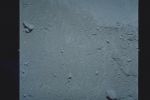
APOLLO_12_AS_12-57-8443_HR-b.jpgAS 12-57-8443 (b) - Soil surface disturbed by the LM descent engine exhaust (coloring: NASA)59 visitenessun commentoMareKromium
|
|
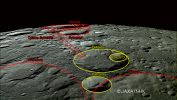
Kaguya-017-hdtv_001_1c_l.jpgSome Lunar Geography from Kaguya: Hermite, Pascal and the Pascal Group and more59 visiteNorth Polar RegionMareKromium
|
|
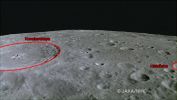
Kaguya-027-hdtv_002_3c.jpgSome Lunar Geography from Kaguya: Craters Kovalevskaya and Hatanaka (FarSide)59 visiteHatanaka Crater - Coord.: 29,7° North Lat. and 121,5° West Long.; Diam.: about 26 Km
Kovalevskaya Crater - Coord.: 30,8° North Lat. and 129,6° West. Long.; Diam.: about 115 Km
MareKromium
|
|

APOLLO_14_AS_14-77-10360a.JPGAS 14-77-10360 (a) - Lunar Bootprint59 visiteAstronaut bootprint; taken at at a location midway between the LM and Station "A".MareKromium
|
|
| 2195 immagini su 183 pagina(e) |
 |
|
|
|
|
166 | |
|
|
|
|





