| Piú viste - MOON |

Kaguya-045-20090619_kaguya_hdtv_L5.jpgThe very final images taken by the HDTV (5)62 visitePicture taken at 03:15 a.m.
Coord.: about 83° South Lat. and approx. 261° East Long.
Spacecraft altitude: 18,4 Km
Relative Position: South of Drygalski CraterMareKromium
|
|
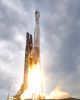
00-LRO-0001.jpgLiftoff...To the Moon!62 visitenessun commentoMareKromium
|
|

LRO-0007a-369443main_lroc_apollo16_lrg.jpgDescartes Highlands: the Apollo 16 Landing Site (ctx frame)62 visitenessun commentoMareKromium
|
|
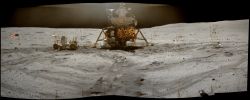
Panoramic-AS16-116-18576-18582.jpgFrom AS 16-116-18576 until 18582 (EVA-3; Up-Sun, with LR and LM)62 visitenessun commentoMareKromium
|
|

Panoramic-AS14-64-9099-9108.jpgFrom AS 14-64-9099 until 9108 (EVA-2; Station C1, Saddle Rock and the Rim of Cone Crater)62 visitenessun commentoMareKromium
|
|

Panoramic-AS14-64-9078-9084.jpgFrom AS 14-64-9078 until 9084 (EVA-2; Station B1 - Up-Sun)62 visitenessun commentoMareKromium
|
|

LRO-1006-392811main_vlcsnap-2009-10-09-04h20m01s95_full.jpgLCROSS impacting the Moon62 visiteThe LCROSS mission operations team initiated power-up of the LCROSS science payload and saw this view of the Moon.MareKromium
|
|

LRO-2500-Marius_Crater.jpgLandslides or unusual Surface-decoloration in Marius Crater?62 visiteImpact Events, Volcanism, and Tectonism form the majority of features found on the Moon. However, Landslides are an important modifier of the landscape at small scales.
Ultimately, the source of Landslides are Seismic Events triggered by Impacts or movements deep inside the Moon. These shaking events cause poorly consolidated material on steep slopes to slide downhill.
In this case the slide spreads out in a complex of narrow finger-like streamers. What controls this distinctive pattern? The process is controlled by the energy of the shaking, the size of particles in the slide, the steepness of the slope, and volume of the source deposit.
Mars also has many Landslide Deposits, so scientists are using the new LROC data to compare with these martian counterparts.
Marius Crater (approx. 41 Km diameter) is located in Oceanus Procellarum (11,9° North and 50,8° West) and is notable for its mare filled floor (unequivocal evidence that it formed before before the surrounding mare basalts flooded the Region).MareKromium
|
|

26-Farside-Luna3.jpgThe first - noisy - close-up of the Moon from "Luna 3"61 visiteCaption NASA originale:"This is the first close-up view of the Moon returned, taken with the narrow angle camera. This image is centered at 20° N, 105° E, the dark region below and left of center is Mare Smythii, the bright crater above and left of center is Giordano Bruno. North is up. (Luna 3-3)".
|
|

27-Farside-Luna3.jpgThe first - noisy - close-up of the Far-Side of the Moon from "Luna 3"61 visiteCaption NASA originale:"This close up view taken with the narrow angle camera shows the far side has fewer maria (the dark areas) than the near side. This image is centered at 17° N, 110° E, the dark region below and left of center is Mare Smythii, the bright crater above and left of center is Giordano Bruno. North is up. (Luna 3-6)".
|
|

24-Mare Humorum-4.jpgMare Humorum (4)61 visitenessun commento
|
|

32-MareHumorum.jpgMare Humorum61 visiteThis mosaic of three images, taken by the advanced Moon Imaging Experiment (AMIE) on board ESA's SMART-1 spacecraft, shows Mare Humorum on the Moon.
AMIE obtained the top frame on 1 January 2006, from a distance of 1087 kilometres from the surface, with a ground resolution of 98 metres per pixel. The remaining two frames were taken on 13 January 2006, from a distance of about 1069 (centre) and 1050 kilometres (bottom) from the surface, with a ground resolution of 97 and 95 metres per pixel, respectively.
The area shown in the top image is centred at a latitude of 40.2º South and longitude 25.9º West; the centre image is centred at a latitude of 40.2º South and longitude 27.3º West; the bottom image is centred at a latitude of 40.2º South and longitude 28.8º West.
Mare Humorum, or 'Sea of Moisture', is a small circular mare on the lunar nearside, about 825 kilometres across. The mountains surrounding it mark the edge of an old impact basin which has been flooded and filled by mare lavas. These lavas also extend past the basin rim in several places. In the upper right are several such flows which extend northwest into southern Oceanus Procellarum.
Mare Humorum was not sampled by the Apollo program, so its precise age could not been determined yet. However, geologic mapping indicates that its age is in between that of the Imbrium and the Nectaris basins, suggesting an age of about 3.9 thousand million years (with an uncertainty of 500 million years).
Humorum is filled with a thick layer of mare basalt, believed to exceed 3 kilometres in thickness at the centre of the basin. On the north edge of Mare Humorum is the large crater Gassendi, which was considered as a possible landing site for Apollo 17.
Mare Humorum is a scientifically interesting area because it allows the study of the relationships among lunar mare filling, mare basin tectonics, and global thermal evolution to the major mascon maria – regions of the moon's crust which contain a large amount of material denser than average for that area (Solomon, Head, 1980).
Past studies (Budney, Lucey) revealed that craters in the mare Humorum sometimes excavate highland material, allowing to estimate the thickness from below the mare cover. Thanks to this, it was also possible to determine that the ‘multiring’ structure of the Humorum basin has a diameter of 425 kilometres (results based on the US Clementine global topography data).
In general, the chronology of lunar volcanism is based on the analysis of landing site samples from the Apollo and Luna missions, from the study of the relationship between the stratigraphy (layering of deposits) in different regions, and from the analysis of lunar craters – how they degraded over time and how their distribution in number and size varies over the Moon’s surface. From crater statistics, in the year 2000 Hiesinger and colleagues found that in Humorum there was a peak of eruptions at about 3.3-3.5 thousand million years ago.
|
|
| 2195 immagini su 183 pagina(e) |
 |
|
|
|
|
162 | |
|
|
|
|





