| Piú viste - MOON |

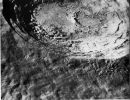
Kaguya-042-20090619_kaguya_hdtv_L2.jpgThe very final images taken by the HDTV (2)63 visitePicture taken at 03:12 a.m.
Coord.: about 77° South Lat. and approx. 261° East Long.
Spacecraft altitude: 25,4 Km
Relative Position: between Boltzmann and Drygalski CraterMareKromium
|
|

Kaguya-041-20090619_kaguya_hdtv_L1.jpgThe very final images taken by the HDTV (1)63 visitePicture taken at 03:11 a.m.
Coord.: about 74° South Lat. and approx. 261° East Long.
Spacecraft altitude: 27,8 Km
Relative Position: near Zeeman "B" and Boltzmann CraterMareKromium
|
|

Kaguya-046-20090619_kaguya_hdtv_L6.jpgThe very final images taken by the HDTV (6)63 visitePicture taken at 03:16 a.m.
Coord.: about 86° South Lat. and approx. 262° East Long.
Spacecraft altitude: 16,2 Km
Relative Position: South of Drygalski CraterMareKromium
|
|

Kaguya-041-20090619_kaguya_hdtv_L1-1.jpgThe "hidden colors" of the Moon (by Dr M. Faccin)63 visiteNote di Marco Faccin:"...stavo guardando queste immagini e, se ci fate caso, presentano una sorta di "disturbo a scalino"; ho quindi pensato di deinterlacciarle e poi ho scoperto che avevano dei "colori nascosti".
Provate anche Voi, con un qualsiasi programma di colorizzazione: aumentate la saturazione colore e vedrete!
Perchè sono state decolorate? Non ne ho idea.
Il problema è che sembra che si sia usato uno standard video diverso dal PAL. E' quindi difficile ricostruire l'esatta matrice del colore originale ripreso però possiamo accontentarci di quel poco che è rimasto...".
Note di Paolo C. Fienga:"La Luna ha dei colori suoi propri, del tutto specifici e peculiari? Si, certo: ovviamente: come TUTTO nell'Universo.
Perchè non li vediamo? Perchè i nostri occhi - ergo la nostra "vista" - per meravigliosi/a che sìano/sia, sono/è limitati/a. E perchè le Agenzie Spaziali "nascondono" i colori?
Ma è ovvio: perchè, come Vi abbiamo dimostrato più e più volte, l'informazione "colore" ci permette l'acquisizione di conoscenze ulteriori e profonde in ordine a quanto osservato (pensate al Cielo ed alla Superficie di Marte, come esempi più eclatanti).
Ed è evidente che l'acquisizione di dette conoscenze "ulteriori" e "profonde", nell'ottica di NASA, ESA, JAXA etc., non deve (ancora?) diventare/essere un "Patrimonio Comune".
E questo è quanto.MareKromium
|
|

00-LRO-0002.jpgLiftoff...To the Moon!63 visitenessun commentoMareKromium
|
|

LRO-0006a-369442main_lroc_apollo15_lrg.jpgMount Hadley: the Apollo 15 Landing Site (ctx frame)63 visitenessun commentoMareKromium
|
|

28-Farside-Luna3.jpgThe Far-Side of the Moon from "Luna 3"62 visiteCaption NASA originale:"This wide-angle view shows the far side of the Moon, comprising most of the image, with the near side making up about one-quarter of the disk at left. The dark patch at upper right is Mare Moscoviense and the dark areas at below and left of center are Mare Marginus and Mare Smythii. These are on the border between the near and far sides. The small dark circle at lower right is the crater Tsiolkovskiy. The image is centered at 15° N, 120° E; North is at 11:30 (Luna 3-phc6)".
|
|

41-Ranger8.jpgMare Tranquillitatis62 visiteCaption NASA originale:"Ranger 8 camera B image of the Moon about 5 seconds before impact. Ranger 8 impact took place on 20 February 1965 at 9:57:37 UT. This picture was taken from a distance of 11 Km. The area is in the Sea of Tranquillity about 2° north of the Apollo 11 landing site. The frame is about 2 Km across and North is up. Features as small as 4 meters across can be seen (Ranger 8, B090)".
Location & Time Information
Date/Time (UT): 1965-02-20 T 09:57:32
Distance/Range (km): 10.98
Central Latitude/Longitude (deg): +02.68, 024.57 E
Orbit(s): Impact - Hard Landing
|
|

29-KeplerCrater.jpgKepler Crater62 visiteCaption ESA originale:"The imaged area is centred at a Latitude of 37,8º South and Longitude 9,0º East. Kepler is a small young crater situated between Oceanus Procellarum and Mare Insularum. It has a diameter of 32 Km and it is 2,6 Km deep.
Kepler displays a ray system that overlaps with rays from other craters and which extends over 300 Km.
The outer wall of Kepler shows a slightly polygonal shape. The interior walls of the crater are slumped and slightly terraced, and descend to an uneven floor and a minor central rise".
|
|

31-Gassendi.jpgGassendi Crater62 visiteCaption ESA originale:"This mosaic of 2 images, taken by the advanced Moon Imaging Experiment (AMIE) on board ESA's SMART-1 spacecraft, shows the inside of crater Gassendi. AMIE obtained these images on 13 January 2006, 1' apart from each other, from a distance of about 1220 Km(top frame) and 1196 Km (bottom frame) from the surface, with a ground resolution of 110 and 108 mt per pixel, respectively.
The area shown in the top image is centred at a Latitude of 16,2º South and Longitude 40,2º West, while the bottom images is centred at a Latitude of 17,9º South and Longitude 40,2º West.
Gassendi is an impact feature located on the Near Side of the Moon, at the Northern Edge of Mare Humorum. The crater is actually much larger than the field of view visible in this image. The hills on the lower right of the mosaic are the central peak of the crater, with a height of roughly 1,2 Km. The crater almost fully visible on the top is called Gassendi A".
|
|
APOLLO 15-0326.jpgAPOLLO 15-0326 - Aristarchus62 visiteAristarchus is a large crater on the edge of a plateau within Northern Oceanus Procellarum. In this scene the crater is viewed obliquely from the North. One of the brightest and youngest craters of its size on the Near-Side of the Moon, Aristarchus is believed to be younger even than Copernicus. The general appearance of Aristarchus and of parts of the plateau around it led Alfred Worden, the Apollo 15 CMP, to describe this part of the Moon as "... probably the most volcanic area that I've seen anywhere on the surface". For many years before the Apollo Missions, Earth-based viewers had reported telescopic sightings of TLP's centered on Aristarchus. These brief, subtle changes in color or in sharpness of appearance have been suggested as evidence for volcanic activity or the venting of gases from the lunar interior. The sightings are controversial, but Aristarchus remains a center of interest.
About 39 Km in diameter, Aristarchus is on the borderline between medium-sized and large- sized craters. We have included it among the large craters because its welldeveloped concentric terraces are characteristic of most large craters that have not been too severely degraded. Its terraced walls, as well as its arcuate range of central peaks, are particularly well shown in this view. The walls and parts of the crater floor are extremely rough and cracked, a characteristic feature of other young impact craters of this size range, such as Tycho and Copernicus. The rough deposits in the floor are probably made up largely of shockmelted material formed at the time of the impact. The inner, rougher portions of the rim show a series of channels, lobate flows, and smooth puddlelike deposits that may represent shock-melted material deposited on the crater rim. The outer, smoother portions show the rhomboidal pattern characteristic of crater ejecta blankets.
|
|

APOLLO 15 AS 15-1030.jpgAS 15-1030 - Tsiolkovsky62 visiteThis vertical view shows the central part of Tsiolkovsky in more detail. From the nature of the boundary between the dark mare lavas and the lighter materials at the base of the walls and in the central peak, we know that the lavas must have lapped upon and embayed the lighter materials. The relatively level areas of lighter material in the southwest and northwest parts of the floor have a distinctly different texture than the coarse blocky materials of slumped wall that surround the floor elsewhere. Finely cracked, furrowed, and hummocky, they closely resemble parts of the floor of the crater King. They probably consist of impact melt that solidified to form the original floor of Tsiolkovsky before it was flooded by mare lavas.
|
|
| 2195 immagini su 183 pagina(e) |
 |
|
|
|
|
160 | |
|
|
|
|





