| Piú viste - MOON |

Spherule_Apollo11.jpgA "Glass Spherule" from the Moon65 visiteCaption NASA:"How did this spherule come to be on the Moon? When a meteorite strikes the Moon, the energy of the impact melts some of the splattering rock, a fraction of which might cool into tiny glass beads. Many of these glass beads were present in lunar soil samples returned to Earth by the Apollo missions.
Pictured above is one such glass spherule that measures only a quarter of a millimeter across. This spherule is particularly interesting because it has been victim to an even smaller impact.
A miniature crater is visible on the upper left, surrounded by a fragmented area caused by the shockwaves of the small impact.
By dating many of these impacts, astronomers can estimate the history of cratering on our Moon".MareKromium
|
|

APOLLO_14_AS_14-66-9286_(HR).jpgAS 14-66-9286 (HR) - Looking for the Blue Flare... (1)65 visiteIl fascino discreto (ma non troppo) della Blue Flare ha colpito ancora e quindi, su richiesta di un nostro Amico Olandese, abbiamo deciso di riproporre in questa Sez. di Lunexit (secondo noi decisamente bella, ma certo poco visitata e dunque...oscura) una panoramica dell'orizzonte lunare che, nei suoi frames AS 14-66-9286, 9297 e 9299 (ben individuati dal Dr Gianluigi Barca, il quale sta riesaminando un enorme quantitativo di frames alla ricerca di "dettagli sfuggiti"), ci mostra la presenza, non molto lontano dagli Astronauti ed in prossimità della superficie, della nostra Fiaccola Blu.
MareKromium
|
|

APOLLO_12_AS_12-57-8444_HR-b.jpgAS 12-57-8444 (b) - Soil surface disturbed by the LM descent engine exhaust (coloring: NASA)65 visitenessun commentoMareKromium
|
|

APOLLO_14_AS_14-77-10364a.JPGAS 14-77-10364 (a) - Thermal Degradation Sample65 visiteThermal Degradation Sample; taken in the vicinity of Station "A".MareKromium
|
|
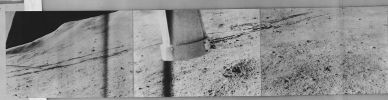
Luna21-Photomosaic-002a.jpgRover Tracks and the distant Inner Rim of LeMonnier Crater65 visitenessun commentoMareKromium
|
|

LRO-1003-392734-MainCabaeus1_full.jpgLCROSS Impact Location65 visitenessun commentoMareKromium
|
|

LRO-2501-Oceanus_Procellarum.jpgLunar Landslide in an Unnamed Crater of Oceanus Procellarum65 visiteA key part of the LROC science investigation is the imaging and analysis of fresh, Copernican-aged Craters (such as Craters younger than 1,1 Billion Years), like this small (6-Km diameter) example at the edge of Oceanus Procellarum, West of Balboa Crater.
The LROC team has seen a variety of landforms related to these important lunar features. For example, a Landslide on the Crater wall partially covers the solidified impact melts on the floor. The Landslide clearly happened after the Crater initially formed; the materials were likely dislodged by seismic shaking from nearby smaller impacts.
These young, fresh craters preserve an vital record of the impact process.
Where does ejecta come from? How much impact melt is produced? How thick is ejecta? What is the importance of self-secondary impacts?
These are only some of the important scientific questions that lunar scientists can address by studying these craters.
As geologic time progresses, the pristine features in fresh craters are worn down by impacts of all sizes. Understanding young craters help geologists piece together the history of ancient degraded craters, an understanding particularly useful for planning future human missions to the Moon. The best way to explore fresh craters like this one, of course, would be with Astronauts.
However, until humans return to the Moon, lunar geologists will analyze images like this for clues, as well as comparing the landforms like the one visible here with other craters on the Moon, Mars, and impact structures on Earth.MareKromium
|
|

23-Farside-Luna3.jpgThe Moon from "Luna 3"64 visiteCaption NASA originale:"The Luna 3 spacecraft returned the first views ever of the far side of the Moon. The first image was taken at 03:30 UT on 7 October 1959 at a distance of 63.500 Km after Luna 3 had passed the Moon and looked back at the sunlit far side. The last image was taken 40 minutes later from 66.700 Km. A total of 29 photographs were taken, covering 70% of the far side. The photographs were very noisy and of low resolution, but many features could be recognized. This close up view taken with the narrow angle camera shows the far side has fewer maria (the dark areas) than the near side. The image is centered at 20° N, 95° E and the dark area to the left and just below center is Mare Marginus and below that Mare Smythii, just at the boundary between the near and far sides. The left half of the image shows the near side of the Moon, including the circular Mare Crisium at far left (Luna 3-26)".
|
|

45-Ranger9.jpgThe rim of Alphonsus and Ptolemaeus Crater64 visiteCaption NASA originale:"Ranger 9 camera B image of the northeast rim of Alphonsus Crater at left and southern rim of Ptolemaeus crater at the top. The image was taken from 700 Km distance about 4,5 minutes before impact in Alphonsus Crater. The intersecting crater rims exhibit a chaotic, mountainous terrain, in sharp contrast to the flat crater floors. The frame is approximately 120 Km across and North is at 12:30. The image is centered at 12° S, 1° W (Ranger 9, B035)".
Location & Time Information
Date/Time (UT): 1965-02-20 T 14:03:48
Distance/Range (km): 703.10
Central Latitude/Longitude (deg): -12.02, 000.76 W
Orbit(s): Impact - Hard Landing
|
|

APOLLO_11_AS_11-37-5440_HR-2.jpgF.M.O. (Fast Moving Object) near Apollo 11 - AS 11-37-5440 (extra-detail mgnf)64 visitenessun commentoMareKromium
|
|

Mare_Imbrium.jpgMare Imbrium64 visiteCaption NASA:"Dark, smooth Regions that cover the Moon's familiar face are called by Latin names for oceans and seas. The naming convention is historical, though it may seem a little ironic to denizens of the space age who recognize the Moon as a mostly dry and airless world, and the smooth, dark areas as lava-flooded impact basins. For example, this elegant lunar vista, a careful mosaic of telescopic images, looks across the expanse of the North-Western Mare Imbrium, or Sea of Rains, into the Sinus Iridum - the Bay of Rainbows. Ringed by the Jura Mountains (montes), the bay is about 250 Km across, bounded at the bottom of the rugged arc by Cape (promontorium) Laplace.
The Cape's sunlit face towers nearly 3000 mt above the bay's surface. At the top of the arc is Cape Heraclides, at times seen as a moon maiden".MareKromium
|
|

APOLLO_15_AS_15-M-R71-2611-2.jpgAS 15-M-R71-2611 - The "Bridge" is NOT a bridge! (context frame - credits: Carlo Contu & Lunexit)64 visiteImage Collection: Mapping (Metric)
Mission: 15
Magazine: M
Revolution: 71
Latitude: 25,5° North
Longitude: 50,5° West
Lens Focal Length: 3"
Camera Tilt: 40°
Camera Azimuth: 180
Camera Altitude: 107 Km
Sun Elevation (on Local Horizon): 15°
Film Type: 3400
Film Width: 5"
Image Width: 4,5"
Image Height: 4,5"
Film Color: black & white
Index Map: http://www.lpi.usra.edu/resources/mapcatalog/apolloindex/apollo15/as15indexmap06/
Features: ARISTARCHUS and HERODOTUSMareKromium
|
|
| 2195 immagini su 183 pagina(e) |
 |
|
|
|
|
158 | |
|
|
|
|





