| Piú viste - MOON |

38-Ranger8.jpgCampanus, Mercator and Gassendi Crater in Mare Cognitum67 visiteCaption NASA originale:"First full-frame image of the Moon taken by the Ranger 8 camera A from a distance of 2.573 km. The image was taken on 20 Feb. 1965 at 09:34 UT with the spacecraft at an altitude of 2510 Km. The central reticle is at 10.65° South Latitude, 22.4° West Longitude, in the Mare Cognitum area of the Moon. North is up and the picture extends 1200 Km across, from about 5° N to 30° S Latitude and from 5° W to 45° W Longitude. The craters Campanus and Mercator are visible at the bottom center. Gassandi crater (101 Km diameter) is the bright circle near the edge of the frame at 8:00. The Apollo 12 landing site is near top center and Apollo 14 slightly to the right of that (Ranger 8, A001)".
Location & Time Information
Date/Time (UT): 1965-02-20 T 09:34:32
Distance/Range (km): 2573.72
Central Latitude/Longitude (deg): -10.65, 22.42 W
Orbit(s): Impact - Hard Landing
|
|

The Moon-00.jpgThe Moon, in natural colors, from Mars Reconnaissance Orbiter (1)67 visitenessun commento
|
|

APOLLO 15 AS 15-0757.jpgAS 15-0757 - Tsiolkovsky67 visiteTsiolkovsky is one of the most prominent features on the Far-Side of the Moon. It is a 1 90-Km- wide impact crater with a large, complex central peak that is offset from the apparent center of the crater. Differences in tone and texture between the central peak, the lava-flooded floor, the terraced walls and the ejecta blanket are dramatically displayed in this oblique view. The ejecta blanket is dominated by a coarse pattern of ridges radiating outward from the crater; superposed on this pattern are many small level pools of smooth material that are much lighter than the otherwise similar smooth dark mare in the floor of Tsiolkovsky. The pools probably originated differently. They may consist of rock that was melted by the heat and pressure generated during the impact event and that flowed into depressions before it hardened.
Cratering experiments on Earth have shown that central peaks consist of bedrock that has been displaced upward by a distance equal to about 1/10th the diameter of the resulting crater. If samples could be obtained from the central peak at Tsiolkovsky, they might be rocks that were 20 km below the Moon's surface before Tsiolkovsky was created.
|
|

00-Libration-250px-Lunar_libration_with_phase2.gifThe "Lunation": such as a full "Lunar Cycle"67 visitenessun commentoMareKromium
|
|

APOLLO_14_AS_14-66-9286_(HR).jpgAS 14-66-9286 (HR) - Looking for the Blue Flare... (1)67 visiteIl fascino discreto (ma non troppo) della Blue Flare ha colpito ancora e quindi, su richiesta di un nostro Amico Olandese, abbiamo deciso di riproporre in questa Sez. di Lunexit (secondo noi decisamente bella, ma certo poco visitata e dunque...oscura) una panoramica dell'orizzonte lunare che, nei suoi frames AS 14-66-9286, 9297 e 9299 (ben individuati dal Dr Gianluigi Barca, il quale sta riesaminando un enorme quantitativo di frames alla ricerca di "dettagli sfuggiti"), ci mostra la presenza, non molto lontano dagli Astronauti ed in prossimità della superficie, della nostra Fiaccola Blu.
MareKromium
|
|
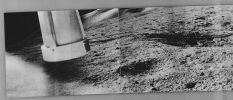
Luna21-Photomosaic-001a.jpgShallow Craters67 visitenessun commentoMareKromium
|
|

APOLLO_15_-_AS15-84-11309_HR.jpgAS 15-84-11309 - The Texture of Hadley67 visite144:47:51 MT - This is the first in a vertical strip of 500mm images of Mt. Hadley taken by Dave Scott from Station 6. Two sets of linear features can be seen on the mountain: a set running diagonally down from the upper right to the lower left and a nearly horizontal set dipping down slightly to the left. The diagonal set is the more prominent when the mountain is viewed as a whole and these are believed to be due to lighting effects. The features in the horizontal set, when viewed from lunar orbit, appear to be benches that may have resulted from slumping on the steep mountain face. A full discussion can be found starting on page 5-11 in the Apollo 15 Preliminary Science Report.MareKromium
|
|
LRO-0002-365424main_nacl000000fd_boxes_small.jpgLocator Image67 visiteThis frame (Locator Image) shows the location of the previous two images in relation to each other. The Locator Image shows an area that is 3.542 meters (2,2 miles) wide by 14.000 meters (8,7 miles) long.
The Lunar coordinates are 34,4° South Lat. and 6,0° West Long.
MareKromium
|
|

LRO-2502-Mare_Imbrium.jpgMare Imbrium67 visitenessun commentoMareKromium
|
|

LRO-2501-Oceanus_Procellarum~0.jpgLunar Landslide in an Unnamed Crater of Oceanus Procellarum (Natural Colors; credits: Dr Paolo C. Fienga - Lunexit Team)67 visitenessun commentoMareKromium
|
|

17-smart20050125a.jpgBrianchon and Pascal66 visiteOriginal caption:"This area of the lunar surface shows the area of the Moon around two large craters. The largest visible in this image is called Brianchon (middle left) and is situated at 75° North Lunar Latitude and 86° West Lunar Longitude. The second largest in this image is called Pascal (middle bottom), at 74° North Lunar Latitude and 70° West Lunar Longitude".
|
|

36-AMI_EAE3_001775_00019_00020_H.jpgCrater Gruithuisen-B and Gruithuisen Montes66 visiteCaption ESA originale:"This image, taken by the Advanced Moon Imaging Experiment (AMIE) on board ESA's SMART-1 spacecraft, shows the Gruithuisen Area on the Moon.
AMIE obtained this image on 1 January 2006, from a distance of about 2154 Km from the surface, with a ground resolution of 195 mt per pixel.
The area shown in the image is centred at a Latitude of 34.8º North and Longitude 40º West.
The prominent bowl-shaped crater close to the left edge of the image is Gruithuisen-B. Gruithuisen itself is just visible at the right edge of the image. The mountains visible in the area are called Montes Gruithuisen.
It is possible to note the large number of similar sized craters to the right of the centre of the image. They are so-called secondary craters, produced by ejecta particles from a large impact which fell back to the Moon".
|
|
| 2195 immagini su 183 pagina(e) |
 |
|
|
|
|
157 | |
|
|
|
|





