| Piú viste - MOON |

The Moon-04.jpgThe Moon, in red filter, from Mars Reconnaissance Orbiter (4)71 visitenessun commento
|
|

24-Mare Humorum-2.jpgMare Humorum (2)71 visite...La voglia di commentare questi poveri frames (poveri da svariati punti di vista...) messi a disposizione dall'ESA è forte ma, dato che il commento, in casi come questo, diventerebbe prima ironia e poi sarcasmo, riteniamo più giusto e saggio tacere.
Anzi no, una cosa va detta: se questi frames (assieme ai pochi altri messi a disposizione del Pubblico da parte dell'Agenzia Spaziale Europea in questi mesi) sono il risultato reale del mapping iper-dettagliato della Luna che SMART-1 avrebbe dovuto eseguire, allora ci tocca dire e ribadire che l'ESA ha ancora tantissima strada da percorrere prima di arrivare a produrre qualcosa di decente.
Se invece questi miseri frames sono solo una porzione del lavoro svolto da SMART-1 (come noi riteniamo), ci piacerebbe allora sapere come mai anche la "pacifica ed indipendente" Agenzia Spaziale Europea "gioca a nascondino" con le immagini che arrivano dallo Spazio.
Domande, domande, domande...
|
|

26-Lunar Highlands.jpgLunar Highlands71 visiteThese two images, taken by the advanced Moon Imaging Experiment (AMIE) on board SMART-1, show the difference between lunar highlands and a mare area from close by.
The image on the left, showing highlands, was obtained by AMIE on 22 January 2006, from a distance of about 1112 kilometres from the surface, with a ground resolution of 100 metres per pixel. The imaged area is centred at 26° South and 157° West.
The image on the right, showing a mare, was taken on 10 January 2006, from a distance of about 1990 kilometres and with a ground resolution of 180 metres per pixel. The imaged area is centred at 27.4° North and 0.8° East.
Already when looking at the Moon with the naked eye, it can be seen that there are bright and dark areas on its surface. Centuries ago, the dark areas were called 'maria', presumably assuming that the observer would be seeing water oceans. Today we know that there is no liquid water on our satellite. However, telescopic observations showed that the maria are very flat, and are very different from the so-called highlands. The highlands are heavily cratered and mountainous.
We have learned that the maria are relatively young areas on the Moon which were generated after very large impacts penetrated the lunar crust and excavated basins. During later volcanic episodes, liquid magma came to the surface and filled these basins. When it cooled down and solidified, it formed the large flat areas we can still see today. As this happened in comparatively recent times, the number of impact craters is far less than in the highland areas.
From the two images it is possible to see how highlands present a very irregular topography and many craters, while the mare area is comparatively flat and shows a much smaller number of craters.
The images are raw data and no flat field or other corrections have been applied.
|
|

Z-101-b_Impact_flash_865170.jpgLunar Flash! (detail mgnf)71 visitenessun commento
|
|

Kaguya-040-hdtv_057_l.jpgPythagoras Crater71 visiteCaption JAXA:"Here is a snapshot around the Central Peak of Pythagoras Crater (the center is located at about 63,5° North and 63° West; D = approx. 142 Km), obtained by HDTV-TELE at 2008/12/12 08:36:00 (UT)".MareKromium
|
|
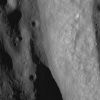
LRO-0007-375109main_lroc_20090730_burgcrater_full.jpgInside Bürg Crater71 visiteBürg is a 40-Km (about 25 miles) diameter, Copernican-aged, complex crater located within Lacus Mortis (the Lake of Death), on the Near-Side of the Moon.
Complex craters, like this one, have terraced walls and a Central Peak (not shown here). The Rim of the crater is along the right side and the walls slope down towards the left of the image.
The terrace is about 3,5 Km (about 2,2 miles) wide and is pockmarked with smaller craters. Terraces form as sections of the Crater wall slump downward after the impact (image width: about 7,9 Km across, roughly 4,9 miles).
Note that there are very few impact craters on the wall of the Crater. Usually fewer craters indicate a surface is younger, however in this case it's simply that material slides down the crater wall's steep slopes, erasing craters.
Note also that LROC, LRO's camera, is powerful enough to see a shadow cast by a boulder about 8 mt wide (about 26 feet) at the contact between the wall and the terrace near the top of the figure.MareKromium
|
|

40-Ranger8.jpgMare Tranquillitatis and Sabine Crater70 visiteCaption NASA originale:"Ranger 8 image of the Mare Tranquillitatis (Sea of Tranquillity) area of the Moon taken from 511 Km about 4 minutes before surface impact. The 30 Km diameter Sabine crater is at upper left. Note the two linear features at the center of the frame and rugged region at the bottom. The frame is about 95 Km across and North is up. The Apollo 11 landing site is about 30 Km to the right of this area (Ranger 8, B045)".
Location & Time Information
Date/Time (UT): 1965-02-20 T 09:53:42
Distance/Range (km): 511.27
Central Latitude/Longitude (deg): +00.38, 021.03 E
Orbit(s): Impact - Hard Landing
|
|

42-Ranger8.jpgImpact of Ranger 8: the last images70 visiteCaption NASA originale:"Final pictures taken by the Ranger 8 P-camera about 1/2 second before impact. Impact occurred on 20 February 1965 at 9:57:36.256 UT. The images are ordered (clockwise from upper left) P3, P4, P2, P1. Impact occurred before transmission of the image P4 was complete, hence the static over most of the image. The areas shown are in Mare Tranquillitatus (Sea of Tranquillity) about 60 km north of the Apollo 11 landing site. Image P3 was taken 0,489 seconds before impact, from a distance of 1,09 Km. The image is about 140 meters across. Image P1 was taken 0,689 seconds before impact from 1,52 Km and is 60 meters across. Image P2 was taken 0,289 seconds prior to impact from 640 meters. The frame is 30 meters across. North is up on all images (Ranger 8, P020)".
Notate la straordinaria somiglianza fra questi ultimi frames prima dell'impatto della Sonda Ranger 8 sulla Luna e gli ultimi frames prima dell'impatto della Sonda NEAR-Shoemaker sull'Asteroide Eros!
|
|

APOLLO 14 AS 14 68-9398.jpgAS 14-68-9398 - Moonscape70 visitenessun commento
|
|

APOLLO 16-M-0989.jpgAPOLLO 16 AS 16-M-0989 - Old Crater...70 visitenessun commento
|
|

000-Kaguya.jpgThe Kaguya (SELENE) Probe70 visiteThe SELenological and ENgineering Explorer "KAGUYA"(SELENE), Japan’s 1st large Lunar Explorer, was launched by the H-IIA rocket on September 14, 2007 (JST). The mission, which is the largest Lunar Mission since the Apollo Program, is being keenly anticipated by many countries.
The major objectives of the Mission are to understand the Moon’s origin and evolution and to observe the Moon in various ways in order to utilize it in the future. The Lunar Missions that have been conducted so far have gathered a large amount of information on the Moon, but the mysteries of its origin and evolution have been left unsolved.
KAGUYA will investigate the entire Moon in order to obtain information on its elemental and mineralogical composition, geography, surface and sub-surface structure, the remnant of its magnetic field and its gravity field.
The results are expected to lead to a better overall understanding of the Moon’s evolution. At the same time, the observation equipment installed on the orbiting satellite will observe plasma, the electromagnetic field and high-energy particles. The data obtained in this way will be of great scientific importance for exploring the possibility of using the moon for human endeavors.MareKromium
|
|

Kaguya-010-20071113.gifRelative locations of the KAGUYA Probe, the Moon, and the Earth70 visitenessun commentoMareKromium
|
|
| 2195 immagini su 183 pagina(e) |
 |
|
|
|
|
154 | |
|
|
|
|





