| Piú viste - MOON |
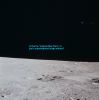
APOLLO_14_AS_14-66-9297_(HR).jpgAS 14-66-9297 (HR) - Looking for the Blue Flare... (9)78 visitenessun commentoMareKromium
|
|

APOLLO_11_AS_11-37-5439_HR-1.jpgF.M.O. (Fast Moving Object) near Apollo 11 - AS 11-37-5439 (context frame)78 visitenessun commentoMareKromium
|
|
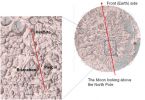
Kaguya-001-20071107.jpgThe View on Map: North Polar Region78 visiteThe area around the North Pole shot by the first image taking (encircled by a blue line) and KAGUYA's orbit (red arrow)
MareKromium
|
|
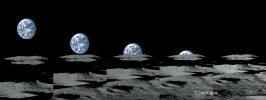
Kaguya-009-20071113.jpgThe setting "Blue Marble", from Lunar Orbit (full sequence - Kaguya is near the Lunar South Pole)78 visiteCaption JAXA:"These images are the Earth setting to the horizon near the Moon's South Pole.
It took about 70 seconds from the left image to the right image (complete setting)". MareKromium
|
|

Kaguya-007-20071113.jpgThe rising "Blue Marble", from Lunar Orbit (Kaguya is near the Lunar North Pole)78 visiteCaption JAXA:"The Japan Aerospace Exploration Agency (JAXA) and NHK (Japan Broadcasting Corporation) have successfully performed the world's first high-definition image taking of an Earth-rise* by the Lunar Explorer "KAGUYA" (SELENE,) which was injected into a lunar orbit at an altitude of about 100 km on October 18, 2007 (Japan Standard Time. Following times and dates are all JST.)
The Apollo project was the first mission to take images of Earth rising over the Moon. The KAGUYA successfully shot high-definition images of the Earth-rise showing an impressive image of the blue Earth which was the only floating object in pitch-dark space.
These are the World's first high-definition earth images taken from about 380.000 Km away from the Earth in space.
The image taking was performed by the KAGUYA's onboard High Definition Television (HDTV) for space use developed by NHK. The moving image data acquired by the KAGUYA was received at the JAXA Usuda Deep Space Center, and processed by NHK.
The satellite was confirmed to be in good health through telemetry data received at the Usuda Station".
* Note: we use the expression "Earth-rise" in this press release, but the Earth-rise is a phenomenon seen only from satellites that travel around the Moon, such as the KAGUYA and the Apollo Class spaceships.
The Earth-rise cannot be observed by a person who is on the Moon as they can always see the Earth at the same position.
This still image was cut out from a moving image (wide shot) taken by the HDTV onboard the KAGUYA at 02:52 p.m. on November 7, 2007 (JST) then sent to the JAXA Usuda Deep Space Center.
In the image, the Moon's surface is near the North Pole, and the Arabian Peninsula and Indian Ocean can be observed on the Earth disc.MareKromium
|
|
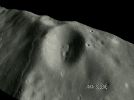
Kaguya-012-20071128_kaguya_tc02_03_l.jpgDyson Crater (1)78 visiteCaption JAXA:"The Terrain Camera (TC) can observe the Moon surface during the day-time of the Moon using 2 cameras that respectively face the slightly diagonal forelooking and afterlooking of the satellite. It can take 3-D (stereo) images of the Moon's globe with a world's first Super High Definition (SHD) of 10 meters.
3-D terrain images acquired by TC HighRes Stereo-Pair Cameras are important data to study the evolution process of the Moon's unique terrain.
With detailed investigation of the crater distribution, we can estimate more precisely when each area of the Moon has been formed and can study more details of when the Moon was born and how its inside and surface have been changing.
Furthermore, data acquired by the TC is expected to be useful for studying topographical characteristics and illumination map to determine the best location for a future Moon base and to consider manned activities on the Moon".MareKromium
|
|
APOLLO_17_-_AS_17-137-20925-0.jpgAS 17-137-20925 - Hiding in the Darkness... (ctx frame)78 visiteUn frame "chiave" per la corretta e completa lettura dell'Epopea Apollo...MareKromium
|
|

Panoramic-AS14-64-9169-9173.jpgFrom AS 14-64-9169 until 9173 (EVA-2; Station G) 78 visitenessun commentoMareKromium
|
|

Luna-00.jpgVon Kármán Crater78 visiteThe Chinese "Chang'E-4" (CE-4) spacecraft achieved the first successful soft landing on the Floor of the Von Kármán Impact Crater located in the Nort-Eastern portion of the South Pole-Aitken (SPA) Basin on the Moon (Far-Side). Here, through analysis and processing of the dual-channel Lunar Penetrating Radar (LPR) data, the shallow regolith structure and deep Geological Strata below the Landing Site are exposed. The high-frequency data (CH-2, 500 MHz) show that the Von Kármán Crater underwent remodeling because of ejecta from multiple craters within a thickness of about 40 meters.
Nota: questa Galleria è dedicata agli Appassionati dell'Esplorazione Spaziale (ivi: Lunare) e non intende essere un "tributo" alla Cina ed alla sua Agenzia di Bandiera. Il motivo è semplice: i risultati delle Missioni Spaziali Cinesi sono sempre avvolti in coltri di fitta nebbia, le immagini sono difficili da reperire e quelle "(diciamo) pubbliche" sono scadenti e sostanzialmente insignificanti. Probabilmente anche la "Propaganda" ha dei limiti...palesi.
Note: this Gallery is dedicated to the Space (here: Lunar) Exploration "lovers" and does not mean at all to be a "tribute" whatsoever to the Republic of China and its Space Agency (CSA). The reason of this premise is very simple: the results of the Missions carried out by the CSA are always wrapped in a thick cloud of fog; the images (frames) are hard to find (unless the CSA releases them "willingly"...) and the ones, let's say, "public" are shoddy and meaningless. We therefore believe that even the "propaganda" must have its own undisguised limits...MareKromium
|
|

APOLLO 14 AS 14 67-9371 HR.jpgAS 14-67-9371 - Suprathermal Ion Detector Experiment - HR77 visiteOriginal caption:"117:21:31 MT. Close-up of the Suprathermal Ion Detector Experiment (SIDE).
This is one of the few ALSEP documentation photos taken during all of Apollo that shows a "level bubble" with any clarity. It is a large bubble, being about half the diameter of the dome that contains it.
Note that there is some dirt on the top of the SIDE, although not covering a large percentage of the surface".
|
|

65-smart-1_data1002887_007_H.jpgCraters and Highlands77 visitenessun commento
|
|

Z-100-observation_SMART-1_hawaii_H.jpgImpact Time (the sequence)!77 visiteCaption ESA originale:"This impressive sequence of SMART-1 impact images was captured by the 3,6-meter optical/infrared Canada-France-Hawaii Telescope (CFHT), Hawaii, 3 September 2006.
The CFHT observed the projected impact area between 07:00 - 08:44 CEST (05:00 06:44 UT). The impact flash lasted only about 1 millisecond. It may have been caused by the thermal emission from the impact itself or by the release of spacecraft volatiles, such as the small amount of hydrazine fuel remaining on board".
|
|
| 2195 immagini su 183 pagina(e) |
 |
|
|
|
|
149 | |
|
|
|
|





