| Piú viste - MOON |

APOLLO 17 AS 17-147-22526.jpgAS 17-147-22526 - Lunar Rover and S.L.O.79 visitenessun commento
|
|

APOLLO 15-M-0757.jpgAPOLLO 15 AS 15-M-0757 - Flying over Tsiolkovsky Crater (HR)79 visitenessun commento
|
|

APOLLO_16_AS_16-121-19423_3D-MF.jpgAS 16-121-19423 - Lunar Limb (High-Def-3D - credits: Dr M. Faccin)79 visiteImage Collection: 70mm Hasselblad
Mission: 16
Magazine: 121
Magazine Letter: PP
Latitude: 30,4° South
Longitude: 94,7° East
Film Type: SO-368
Film Width: 70 mm
Film Color: color
Main Features: Curie and Sklodowska Crater
MareKromium
|
|

Luna-10.jpgThe "Dark Side of the Moon": the Surface79 visitePoco più di un anno fa, la sonda cinese Chang'e 4 è diventata la prima ad atterrare sul lato della Luna non visibile dal nostro pianeta: per celebrare questo anniversario, la Cina ha rilasciato una serie di dati scientifici e immagini catturate dal veicolo spaziale. Dal suo atterraggio il Rover ha in realtà percorso poco più di 350 metri studiando le formazioni rocciose del nostro satellite, e grazie a una "Terrain Camera" montata nella parte superiore del Lander ha fornito scatti ad altissima definizione, come potete vedere nelle foto di questa Gallery. La speciale macchina fotografica, morta alla fine del primo giorno lunare (circa 29,5 giorni terrestri), era in grado di ruotare di 360° e ha fornito dettagliati e interessanti materiali di studio per gli scienziati.MareKromium
|
|

06-Oceanus Procellarum.jpgOceanus Procellarum78 visiteCaption NASA originale:"Northward oblique view of the Marius Hills and Oceanus Procellarun on the Moon taken by LO 2. The hills are named after the 41 Km diameter crater Marius, at the upper right at 11,8°N, 50,8° W and are thought to be volcanic domes, plugs and cones. Note the wrinkle ridges which also stretch across the image (Lunar Orbiter 2, frame M-213)".
Location & Time Information
Date/Time (UT): 1966-11-25 T 14:16
Distance/Range (km): 139
Central Latitude/Longitude (deg): +07.96/307.23
|
|

17-Mare Imbrium.jpgAlpine Valley and Mare Imbrium78 visiteCaption NASA originale:"Obique view looking west of Alpine Valley and Mare Imbrium on the Moon taken by Lunar Orbiter 5. Alpine Valley is a sinuous rille, about 150 Km long and 8 Km wide running vertically through the center of the image. Mare Imbrium is the dark, flat feature at the top. North is at 4:00 (Lunar Orbiter 5, frame M-102)".
Location & Time Information
Date/Time (UT): 1967-08-14 T 09:38:23
Distance/Range (km): 302
Central Latitude/Longitude (deg): +48.22/001.08
|
|

Kane Crater - Light Ray (1).jpgLight rays inside Kane Crater (1)78 visitenessun commento
|
|

The Moon - North Pole - Galileo.JPGThe North-Pole of the Moon, from Galileo78 visitenessun commento
|
|

ZZ-ZZ-ZZ-ZZ-ZZ-ZZ-ZZ-ZZ-The Moon-1.jpgThe Moon from Galileo78 visiteCaption NASA originale:"The Moon's surface is covered with craters, scars of frequent impacts during the early history of the Solar System. Now, recent results from the Lunar Prospector spacecraft support the idea that the Moon itself formed from the debris of a giant impact of a Mars-sized planetary body with the Earth nearly 4,5 BY ago. The impact theory of lunar origin can explain why Moon rocks returned by the Apollo missions have the same isotopic ratios as Earth rocks while the Moon seems deficient in heavy elements like iron. It can also explain a critical finding of the Lunar Prospector experiments - that the Moon's core is proportionally very small. If the Moon formed simply as a Sister World, its origin paralleling Earth's formation from the primordial Solar Nebula, it should have similar iron content and relative core size. But material blasted from the surface of Earth by an impacting body would lack the iron and heavy elements which had settled to the Earth's core yet retain similar ratios of chemical isotopes. A fraction of this debris cloud would remain in Earth orbit ultimately forming the Moon".
|
|

35-Lomonosov Crater-AMI_EAE3_001856_00042_00038.jpgLomonosov Crater78 visiteCaption ESA originale:"This image, taken by the Advanced Moon Imaging Experiment (AMIE) on board ESA’s SMART-1 spacecraft, shows crater Lomonosov, on the Moon’s Far (or "Dark") Side.
AMIE obtained the image on 30 January 2006 from a distance of about 2100 Km from the surface, with a ground resolution of 190 mt per pixel. The imaged area is centred at a Latitude of 27,8º North and a Longitude of 98,6º East.
Crater Lomonosov is a nice example for a large crater (92 Km of diameter) which was filled by lava after the impact, thus exhibiting a flat floor. The terraced walls indicate 'slumping', that is sliding of the rocks downwards due to gravity after the end of the impact. The small craters inside Lomonosov are the result of impacts into this lava floor which happened after the formation of Lomonosov".
|
|

APOLLO 11 AS 11-40-5949 HR.jpgAS 11-40-5949 - Working on the Moon (HR)78 visiteCaption NASA originale:"Neil took this picture not long after taking 5948. He moved to his left between frames and this may be the moment when he goes out of the TV field-of-view. This picture gives us a good view of the split boulder that is between the two experiments. In the background, we can see the LM, the U.S. flag, and the TV camera. Note the footprints at the lower right. The astronaut who made them seems to have been moving from right to left. The rightmost footprint made with his left boot has a very deep toe imprint while the rightmost imprint made by his right boot is relatively flat and uniform. While bringing his left foot forward for the next step, he seems to have been dragging his heel, a clear indication that he was walking flat-foot, rather then hopping or running. The next left-boot toe print is deep while above it, we see that he was also scuffing his right heel along the surface. Note that the next prints made by both boots indicate that he turned to his right".
|
|
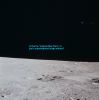
APOLLO_14_AS_14-66-9297_(HR).jpgAS 14-66-9297 (HR) - Looking for the Blue Flare... (9)78 visitenessun commentoMareKromium
|
|
| 2195 immagini su 183 pagina(e) |
 |
|
|
|
|
148 | |
|
|
|
|





