| Piú viste - MOON |

34-Apollo 11 LS-1888_40L_Hi.jpgThe "Apollo 11 Landing Site"81 visiteCaption ESA originale:"This image, taken by the Advanced Moon Imaging Experiment (AMIE) on board ESA’s SMART-1 spacecraft, shows the Apollo 11 Landing Site in the Mare Tranquillitatis Region of the Moon.
AMIE obtained the image on 5 February 2006 from a distance of 1764 Km from the surface, with a ground resolution of 159 mt per pixel.
The imaged area is centred at a Long. of 23,9º East, close to the Moon Equator, at 1,7º North Latitude.
The area is close to crater Moltke (outside the field of view of this image) in the Mare Tranquilitatis Region. The arrow shows the Landing Site of Apollo 11, where the first men from Earth set foot on another object in our Solar System, on 20 July 1969. The two prominent craters nearby are named after two of the Apollo 11 Astronauts. The first man on the Moon, Armstrong, has a crater named after him outside the field of this image".
|
|
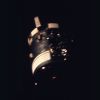
U-APOLLO 13 AS 13 58-8461.jpgAS 13-58-8461 - Odyssey (HR-2)81 visitenessun commento
|
|

Kaguya-006-20071107.jpgWhere the first two pictures were taken...81 visitenessun commentoMareKromium
|
|

Kaguya-008-20071113.jpgThe setting "Blue Marble", from Lunar Orbit (Kaguya is near the Lunar South Pole)81 visiteCaption JAXA:"This still image was cut out from a moving image (tele shot) taken by the HDTV onboard the KAGUYA at 12:07 p.m. on November 7, 2007 (Japan Standard Time, JST,) then sent to the JAXA Usuda Deep Space Center.
In the image, the Moon's surface is near the South Pole, and we can see the Australian Continent (center left) and the Asian Continent (lower right) on the Earth.
(In this image, the upper side of the Earth is the Southern Hemisphere, thus the Australian Continent looks upside-down)".MareKromium
|
|

00-SMART1.jpgSMART-1 and the Moon80 visiteSMART-1's science payload, with a total mass of some 15 Kg, features many innovative instruments and advanced technologies. These are:
- AMIE, a miniaturised HR camera for Lunar Surface imaging;
- SIR, a Near-Infrared Point-Spectrometer for Lunar mineralogy investigation;
- D-CIXS, a very compact X-ray Spectrometer with a new type of detector and micro-collimator which will provide fluorescence spectroscopy and imagery of the Moon's surface elemental composition;
- XSM, an X-ray monitor to support D-CIXS by providing measurements of solar X-ray emission for calibration:
- KaTE, an experiment aimed at demonstrating deep-space telemetry and telecommand communications in the X and Ka-bands;
- RSIS, a Radio-Science Experiment relying on KaTE. It monitors the electric propulsion by means of tracking techniques. In lunar orbit it will, with AMIE, also study the Moon's libration.
|
|

ZZ-ZZ-ZZ-ZZ-ZZ-ZZ-ZZ-ZZ-The Moon.jpgMare Imbrium, from Galileo80 visiteCaption NASA originale:"Checking out the Galileo spacecraft's cameras during its December 1992 fly-by of Earth's Moon, controllers took this dramatically illuminated picture through a violet filter. The view looks down on the Moon's North Polar Region with the Sun shining from the left at a low angle and the direction toward the Moon's North Pole toward the lower right.
Across the image upper left stretches the smooth volcanic plain of the Mare Imbrium. Pythagoras crater, 65 miles wide, is near the center of the image -- mostly in shadow, its central peak just catches the sunlight (...)".
|
|

U-APOLLO 13 AS 13 58-8459.jpgAS 13-58-8459 - Odyssey (HR-1)80 visitenessun commento
|
|

APOLLO 15-M-0757.jpgAPOLLO 15 AS 15-M-0757 - Flying over Tsiolkovsky Crater (HR)80 visitenessun commento
|
|

Kaguya-003-20071107.jpgThe Western Side of the Oceanus Procellarum80 visiteCaption JAXA:"This is a still image taken out from the second moving image shooting when the KAGUYA Probe flew from the South to the North, on the Western Side of the "Oceanus Procellarum".
The dark part on the right of the above image is the Ocean and the light area on the left is called the "highland".
The moving image was taken at 05:51 a.m. on Oct. 31st, 2007 (JST) by eight-fold speed intermittent shooting (eight minutes is converged to one minute) from the KAGUYA, and the data was received at the JAXA Usuda Deep Space Center on the same day". MareKromium
|
|
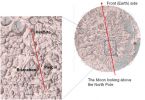
Kaguya-001-20071107.jpgThe View on Map: North Polar Region80 visiteThe area around the North Pole shot by the first image taking (encircled by a blue line) and KAGUYA's orbit (red arrow)
MareKromium
|
|

Kaguya-007-20071113.jpgThe rising "Blue Marble", from Lunar Orbit (Kaguya is near the Lunar North Pole)80 visiteCaption JAXA:"The Japan Aerospace Exploration Agency (JAXA) and NHK (Japan Broadcasting Corporation) have successfully performed the world's first high-definition image taking of an Earth-rise* by the Lunar Explorer "KAGUYA" (SELENE,) which was injected into a lunar orbit at an altitude of about 100 km on October 18, 2007 (Japan Standard Time. Following times and dates are all JST.)
The Apollo project was the first mission to take images of Earth rising over the Moon. The KAGUYA successfully shot high-definition images of the Earth-rise showing an impressive image of the blue Earth which was the only floating object in pitch-dark space.
These are the World's first high-definition earth images taken from about 380.000 Km away from the Earth in space.
The image taking was performed by the KAGUYA's onboard High Definition Television (HDTV) for space use developed by NHK. The moving image data acquired by the KAGUYA was received at the JAXA Usuda Deep Space Center, and processed by NHK.
The satellite was confirmed to be in good health through telemetry data received at the Usuda Station".
* Note: we use the expression "Earth-rise" in this press release, but the Earth-rise is a phenomenon seen only from satellites that travel around the Moon, such as the KAGUYA and the Apollo Class spaceships.
The Earth-rise cannot be observed by a person who is on the Moon as they can always see the Earth at the same position.
This still image was cut out from a moving image (wide shot) taken by the HDTV onboard the KAGUYA at 02:52 p.m. on November 7, 2007 (JST) then sent to the JAXA Usuda Deep Space Center.
In the image, the Moon's surface is near the North Pole, and the Arabian Peninsula and Indian Ocean can be observed on the Earth disc.MareKromium
|
|

APOLLO_16_AS_16-121-19423_3D-MF.jpgAS 16-121-19423 - Lunar Limb (High-Def-3D - credits: Dr M. Faccin)80 visiteImage Collection: 70mm Hasselblad
Mission: 16
Magazine: 121
Magazine Letter: PP
Latitude: 30,4° South
Longitude: 94,7° East
Film Type: SO-368
Film Width: 70 mm
Film Color: color
Main Features: Curie and Sklodowska Crater
MareKromium
|
|
| 2195 immagini su 183 pagina(e) |
 |
|
|
|
|
147 | |
|
|
|
|





