| Piú viste - THE LUNAR EXPLORER ARCHIVES |

SOL2190-GB-PCF-LXXT2.jpgHeavily Disturbed Terrain - Sol 2190 (Absolute Natural Colors; credits for the additional process. and color.: Drr Gianluigi Barca & Paolo C. Fienga - Lunexit Team)60 visitenessun commentoMareKromium
|
|

SOL2190-GB-PCF-LXTT1.jpgRover Tracks and heavily disturbed Terrain - Sol 2190 (Absolute Natural Colors; credits for the additional process. and color.: Drr Gianluigi Barca & Paolo C. Fienga - Lunexit Team)60 visitenessun commentoMareKromium
|
|

Craters-Unnamed_South_Polar_Crater-2.jpgBuried and frozen (2)59 visitenessun commento
|
|

South_Polar_Features-Swiss_Cheese_Terrain-02.jpgSummertime at the South Pole (2)59 visitenessun commento
|
|

Craters-Galle_Crater-3D.jpgLayers of Galle Crater (3D - credits: NASA/JPL/MSSS)59 visiteCaption NASA:"This is a 3-D stereo anaglyph showing layers in Galle Crater. This anaglyph uses two MGS-MOC images acquired at slightly different viewing angles: MOC images E22-01557 and M14-02055. Owing to the specifics of the viewing geometry, the image is tilted on its side, relative to the mosaic shown in the 15 June 2006 release. In other words, in this image, North is toward the right and West is up. This anaglyph, when viewed in conjunction with the 15 June 2006 mosaic of these layers, provides a more complete sense of the cross-cutting relations between layers in the mound located in southern Galle (Happy Face) Crater. The layers are part of a mound of sedimentary rock in southern Galle — a remnant of a once more-extensive deposit of sedimentary material in this south mid-latitude impact basin.
Location near: 52,3° South Lat. and 30,1° West Long.
Image width: ~7,3 Km (~4,5 mi)
Illumination from: upper right
Anaglyph from MOC images: E22-01557 and M14-02055
|
|

North_Polar_Features-Unconformity-MGS-01.jpgNorth Polar "Unconformity" (Original NASA/MGS/MSSS b/w Frame)59 visiteCaption NASA originale:"This MGS-MOC image shows layered material exposed on a slope in the North Polar Region.
An "unconformity" is visible in the middle/lower left of the image, where layers are abruptly truncated. Unconformities are indicators of drastic change in the Region — the lower layers were deposited first, then eroded, then the upper layers were deposited".
Location near: 81,1° North Lat. and 75,2° West Long.
Image width: ~3 Km (~1,9 mi)
Illumination from: lower left
Season: Northern Spring
|
|

North_Polar_Features-Unconformity-02.jpgNorth Polar "Minor Unconformity" (Original NASA/MGS/MSSS b/w Frame)59 visiteCaption NASA originale:"This MGS-MOC image shows Layers exposed in a Trough in the Martian North Polar Region. At the time the picture was acquired, the entire scene was covered by seasonal Carbon Dioxide Frost. By late Spring and into Summer, these Layers would appear darker, once the CO2 Frost sublimes away".
Location near: 84,9° North Lat. and 263,3° West Long.
Image width: ~3 Km (~1,9 mi)
Illumination from: lower left
Season: Northern Spring
|
|

North_Polar_Features-Dunes-MGS-07.jpgNorth Polar Dunes (Original NASA/MGS/MSSS b/w Frame)59 visiteCaption NASA originale:"This MGS-MOC image shows dunes in the Martian North Polar Region. The dunes are composed of dark, coarse (--> ruvido, di tessitura grossolana) sand. The white areas around the dunes are the last remaining areas of seasonal CO2 frost cover.
The solid CO2 accumulates during the Autumn and Winter and sublimes (goes from solid to gas) away in the Spring.
This image was taken near the end of the Northern Spring".
Location near: 78,0° North; 244,5° West
Image width: ~3 Km (~1,9 mi)
Illumination from: lower left
Season: Northern Spring
|
|

Original lunar orbiter frames-lo2-61h2-004.jpgOriginal Lunar Orbiter - Frame LO2-61h2-00459 visitenessun commento
|
|

Titan-PIA08427.jpgDown to Titan!59 visiteThis poster shows a flattened (Mercator) projection of the view from the Descent Imager/Spectral Radiometer on the European Space Agency's Huygens probe at four different altitudes. The images were taken on Jan. 14, 2005.
The Huygens probe was delivered to Saturn's moon Titan by the Cassini spacecraft, which is managed by NASA's Jet Propulsion Laboratory, Pasadena, Calif. NASA supplied two instruments on the probe, the Descent Imager/Spectral Radiometer and the Gas Chromatograph Mass Spectrometer.
|
|
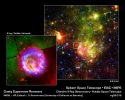
N76-PIA08516-2.jpgThe "N 76 Nebula"59 visiteThe supernova remnant1E0102.2-7219 sits next to the Nebula N76 in a bright, Star-Forming Region of the Small Magellanic Cloud, a satellite galaxy to our Milky Way galaxy located about 200.000 LY from Earth. A Supernova Remnant is made up of the messy bits and pieces of a massive star that exploded, or went Supernova. This image shows glowing dust grains in three wavelengths of infrared radiation: 24 microns (red) measured by the Multiband Imaging Photometer aboard NASA's Spitzer Space Telescope; and 8.0 microns (green) and 3.6 microns (blue) measured by Spitzer's infrared array camera. The red bubble is a dust envelope around the supernova remnant E0102, which is being heated by the shock wave created in the explosion of the remnant's massive progenitor star some 1,000 years ago. Most of the blue stars are in the Small Magellanic Cloud, though some are in our own galaxy.
|
|

vo1_mf31s343.jpgMars: according to Viking 1 Orbiter59 visite
|
|
| 3220 immagini su 269 pagina(e) |
 |
|
|
|
|
264 | |
|
|
|
|





