| Piú viste - THE LUNAR EXPLORER ARCHIVES |
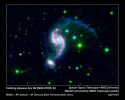
NGC-2535-PIA09106.jpgNGC 2535 and NGC 2536 (alias Arp 82)60 visiteA pair of interacting galaxies might be experiencing the galactic equivalent of a mid-life crisis. For some reason, the pair, called Arp 82, didn't make their stars early on as is typical of most galaxies. Instead, they got a second wind later in life -- about 2 billion years ago -- and started pumping out waves of new stars as if they were young again.
Arp 82 is an interacting pair of galaxies with a strong bridge and a long tail. NGC 2535 is the big galaxy and NGC 2536 is its smaller companion. The disk of the main galaxy looks like an eye, with a bright "pupil" in the center and oval-shaped "eyelids." Dramatic "beads on a string" features are visible as chains of evenly spaced star-formation complexes along the eyelids. These are presumably the result of large-scale gaseous shocks from a grazing encounter. The colors of this galaxy indicate that the observed stars are young to intermediate in age, around 2 million to 2 billion years old, much less than the age of the universe (13.7 billion years).
The puzzle is: why didn't Arp 82 form many stars earlier, like most galaxies of that mass range? Scientifically, it is an oddball and provides a relatively nearby lab for studying the age of intermediate-mass galaxies.
This picture is a composite captured by Spitzer's infrared array camera with light at wavelength 8 microns shown in red, NASA's Galaxy Evolution Explorer combined 1530 and 2310 Angstroms shown in blue, and the Southeastern Association for Research in Astronomy Observatory light at 6940 Angstroms shown in green.
|
|

as09-23-3521.jpgAS 09-23-3521 - Red Lands, Blue Waters and White Clouds60 visitenessun commento
|
|

as09-23-3533.jpgAS 09-23-3533 - Mars-like Earth60 visitenessun commento
|
|

as10-29-4256.jpgAS 10-29-4256 - Lunar Limb60 visitenessun commento
|
|

as10-30-4340.jpgAS 10-30-4340 - Looking Down to the Moon...60 visitenessun commento
|
|

as14-66-9253.jpgAS 14-66-9253 - The (fragile-looking) Lunar Module60 visitenessun commento
|
|
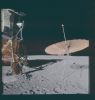
as14-66-09256.jpgAS 14-66-9256 - The (fragile-looking) Lunar Module and the Antenna60 visitenessun commento
|
|

as10-31-4528.jpgAS 10-31-4528 - Maria and Highlands (perspective LS for Apollo 11)60 visitenessun commento
|
|

Spectrum-PIA09196.jpgHow to get a Spectrum of an Alien World60 visiteThis diagram illustrates how astronomers using NASA's Spitzer Space Telescope can capture the elusive spectra of hot-Jupiter planets. Spectra are an object's light spread apart into its basic components, or wavelengths. By dissecting light in this way, scientists can sort through it and uncover clues about the composition of the object giving off the light.
To obtain a spectrum for an object, one first needs to capture its light. Hot-Jupiter planets are so close to their stars that even the most powerful telescopes can't distinguish their light from the light of their much brighter stars.
But, there are a few planetary systems that allow astronomers to measure the light from just the planet by using a clever technique. Such "transiting" systems are oriented in such a way that, from our vantage point, the planets' orbits are seen edge-on and cross directly in front of and behind their stars.
In this technique, known as the secondary eclipse method, changes in the total infrared light from a star system are measured as its planet transits behind the star, vanishing from our Earthly point of view. The dip in observed light can then be attributed to the planet alone.
To capture a spectrum of the planet, Spitzer must observe the system twice. It takes a spectrum of the star together with the planet (first panel), then, as the planet disappears from view, a spectrum of just the star (second panel). By subtracting the star's spectrum from the combined spectrum of the star plus the planet, it is able to get the spectrum for just the planet (third panel).
This ground-breaking technique was used by Spitzer to obtain the first-ever spectra of two planets beyond our solar system, HD 209458b and HD 189733b. The results suggest that the hot planets are socked in with dry clouds high up in the planet's stratospheres. In addition, HD 209458b showed hints of silicates, indicating those high clouds might be made of very fine sand-like particles.
|
|

as10-27-3872.jpgAS 10-27-3872 - Docking Time60 visitenessun commento
|
|
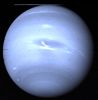
vg2_1124347.jpgNeptune (natural colors - elab. Lunexit)60 visitenessun commento
|
|

Animazione_SOL794-2F196852267EFFAQDIP1290L0M1.gifRolling in the Sand (GIF-Movie from frames taken during Sol 794; credits: Dr Gianluigi Barca)60 visiteEd anche in questo GIF-Movie si vede BENE che la ruota anteriore Dx del MER Spirit è bloccata e che la traccia da essa lasciata (rispetto a quella della "Left Front Wheel" che è chiara, regolare e decisamente "leggera") è profonda e non ci lascia vedere (se non vagamente) il "battistrada" che la caratterizza.MareKromium
|
|
| 3220 immagini su 269 pagina(e) |
 |
|
|
|
|
263 | |
|
|
|
|





