| Piú viste - THE LUNAR EXPLORER ARCHIVES |

ra7_a001.jpgThe Moon from Ranger-7: Mare Cognitum (1)60 visiteLa Storia del Programma di Ricognizione Lunare "Ranger" (il quale ebbe luogo negli Anni 1961-1965) è una storia fatta da 9 Missioni: sei di esse (i "Ranger" da 1 a 6) costiturono dei fiaschi clamorosi - che poi Vi proporremo in scaletta); le ultime tre, invece (I "Ranger" 7, 8 e 9), furono uno storico successo. Attenzione però: noi parliamo di successo "storico" ma, in fondo, si trattava "solo" di spedire un veicolo verso la Luna il cui unico scopo era quello di "scattare delle fotografie" (quante più possibili) e quindi di schiantarsi sulla superficie del nostro Satellite (proprio come ha fatto la Sonda ESA "SMART-1" lo scorso mese di Settembre - 2006). Questa maniera - veramente "pionieristica" - di approcciare la Luna, oggi, ci fa sorridere ma, 45 anni fa, quello che i Ranger-7, 8 e 9 ottennero fu, in fondo, il vero "viatico" per la nascita del Programma Apollo: l'individuazione di uno "spot for a - relatively -safe landing".
Missione Compiuta, ovviamente.MareKromium
|
|

ra8_a001.jpgThe Moon from Ranger-8: Mare Tranquillitatis (1)60 visiteCaption NASA:"First full-frame image of the Moon taken by the Ranger 8 camera A from a distance of 2573 Km. The image was taken on 20 Feb. 1965 at 09:34 UT with the spacecraft at an altitude of 2510 Km. The central reticle is at 10,65° South Latitude, 22,4° West Longitude, in the Mare Cognitum area of the Moon. North is up, and the picture extends 1200 Km across, from about 5° North to 30° South Lat. and from 5° West to 45° West Longitude. The craters Campanus and Mercator are visible at the bottom center. Gassandi crater (101 Km diameter) is the bright circle near the edge of the frame at 8:00. The Apollo 12 Landing Site is near top center and Apollo 14 slightly to the right of that (Ranger 8, A001)".MareKromium
|
|

ra7_p100.jpgThe Moon from Ranger-7: Mare Cognitum (8)60 visitenessun commentoMareKromium
|
|

ra7_p001.jpgThe Moon from Ranger-7: Mare Cognitum (7)60 visiteCaption NASA:"First P-camera images taken by Ranger 7. The images are numbered by camera (clockwise from upper left) P3, P4, P2, P1. All images were taken from a distance of about 1870 Km about 13,5' before impact. Frame P3 shows Guericke crater (diameter 63 Km) at the upper right.
P4 also shows Guericke at right center. Image P1 is 41 Km across and shows the floor of Mare Nubium north of Opelt crater. The bottom of frame P2 overlaps the upper right corner of P1. P2 is about 40 Km across. North is at 12:30 in all four images (Ranger 7, P001)".MareKromium
|
|

ra7_b200.jpgThe Moon from Ranger-7: Mare Cognitum (6)60 visiteMareKromium
|
|

ra8_p010.jpgThe Moon from Ranger-8: Mare Tranquillitatis (8)60 visiteCaption NASA:"These four images were the first taken by the Ranger 8 P-series cameras. The images are ordered (clockwise from upper left) P3, P4, P2, P1. The P3 and P4 cameras had 6,3° fields of view (~135 Km across) and show 164-Km-diameter Ptolemaeus Crater to the right and the Davy Crater Chain, a white line running S-WW to N-EE at left middle in P3 and lower left in P4. The P1 and P2 cameras had 2,1° fields of view (45 Km across). P1 shows a close-up of the crater Davy Y at the upper right. Image P2 shows the area just East of P1. North is up for all images (Ranger 8, P001)".MareKromium
|
|

ra8_a030.gifThe Moon from Ranger-8: Mare Tranquillitatis (2) - LR60 visiteCaption NASA:"Ranger 8 image of the Moon from 302 Km. The image was taken on 20 February 1965 and 9:55 UT, 2,5 minutes before the spacecraft impacted on the Lunar Surface. The two large craters at upper center are Ritter (above left) and Sabine, each about 30 Km in diameter. The Apollo 11 Landing Site is just off the right edge of the image at about 4:00. The image is about 130 Km across and North is up (Ranger 8, A030)".MareKromium
|
|
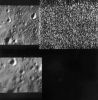
ra9_p012.jpgThe Moon from Ranger-9: Alphonsus Crater (9)60 visiteCaption NASA:"This image shows the last two pictures taken by Ranger 9 before impact onto the Lunar Surface. The images show the floor of Alphonsus Crater at 12,84° South Lat. and 2,39 West Long.
North is at 1:00 in both images. The top image was taken by camera P3 at a distance of 600 mt just 0,25" before impact. The frame is about 70 mt across. The lower frame is from camera P1. It includes most of the area on the left of the P3 frame and was taken from 1,2 Km, 4,5" prior to impact.
The image is approximately 50 mt across.
Part of the P3 frame is missing because Ranger 9 did not finish transmitting before impact. These were the last images from the Ranger programme, which ended with this mission (Ranger 9, P012)".MareKromium
|
|

ra9_p001.jpgThe Moon from Ranger-9: Alphonsus Crater (7)60 visiteCaption NASA:"Four images of the floor of Alphonsus crater taken by the Ranger 9 P-series cameras about 10 seconds before impact on 24 March 1965. The images are ordered by camera (clockwise from upper left) P3, P4, P2, P1. Image P3 was taken from a distance of 25,5 Km and is about 2,9 Km across. P4 was taken from 24,4 Km and extends about 2,8 Km. Image P1 is about 1,1 Km across and was taken from 25,9 Km. Image P2, taken from a distance of 24,7 Km, is about 1 Km across (Ranger 9, P001)".MareKromium
|
|
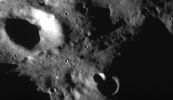
Phobos_from_Mgs-009.jpgPhobos, from MGS (Original NASA/MGS/MSSS Full Frame n. 3)60 visiteLett. E: il secondo (più piccolo, ma certo non meno inesplicabile) Monolito di Phobos.
Nota: nella parte superiore del frame sono visibili anche altri rilievi colonnari - riconoscibili a causa delle ombre assolutamente peculiari che proiettano in condizioni di illuminazione radente - ancora più piccoli.
Le "Colonne di Phobos" e le "Cuspidi di Blair": potrebbe esistere una connessione? Questi rilievi possono essere il frutto di processi geologici simili?
Che ne pensate?MareKromium
|
|
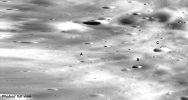
Phobos_from_Mgs-007.jpgPhobos, from MGS (Original NASA/MGS/MSSS Full Frame n. 1)60 visiteLett. A: grappolo di boulders a forma "colonnare" (si direbbe un gruppo di tre boulders allineati secondo un ordine dimensionale coerente ed un ulteriore rilievo, anch'esso di apparenza colonnare, posto nelle immediate vicinanze del primo gruppo).
Lett. B: rilievo anomalo, decisamente alto (a giudicare dall'ombra che proietta), posto sul versante interno di un cratere di modeste diomensioni, a circa mezza altezza della murata.
Lett. C: gruppo di rilievi anomali (si direbbe 3 o 4) - concettualmente molto simili al grappolo di boulders evidenziato sub lett. A - posti sul ciglio di un cratere di medie dimensioni.MareKromium
|
|

Noachis_Terra-M1501427-PCF-LXTT-01.jpgNoachis Panorama (EDM - Enhanced and Saturated Natural Colors; credits for the additional process. and color.: Dr Paolo C. Fienga - Lunexit Team)60 visitenessun commento
|
|
| 3220 immagini su 269 pagina(e) |
 |
|
|
|
|
262 | |
|
|
|
|





