| Piú viste - THE LUNAR EXPLORER ARCHIVES |

as17-147-22601.JPGAS 17-147-22601 - ALSEP Panorama (1)61 visiteALSEP pan. Up-Sun.MareKromium
|
|
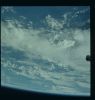
as17-148-22654.JPGAS 17-148-22654 - The Blue Planet is there... (3)61 visitenessun commentoMareKromium
|
|

as17-148-22655.JPGAS 17-148-22655 - The Blue Planet is there... (4)61 visitenessun commentoMareKromium
|
|

HD_189733b-PIA09715_01.jpgExoplanet HD 189733b61 visiteCaption NASA:"This plot of data from NASA's Spitzer Space Telescope (SST) tells astronomers that a toasty gas exoplanet, or a planet beyond our Solar System, contains water vapor.
Spitzer observed the Planet, called HD 189733b, cross in front of its star at three different infrared wavelengths: 3,6; 4,5 and 8 microns (see lime-colored dots). For each wavelength, the Planet's Atmosphere absorbed different amounts of the starlight that passed through it. The pattern by which this absorption varies with wavelength matches known signatures of water, as shown by the theoretical model in blue".MareKromium
|
|
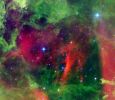
NGC-2237_and_NGC-2244.jpgHot Stars in the Rosette Nebula61 visiteWinds and radiation from massive hot stars in the Rosette Nebula have cleared the natal gas and dust from the center of the nearby star-forming region. They also pose a danger to planet forming disks around young, cooler stars in the neighborhood. This Spitzer Space Telescope (SST) infrared image of dust clouds near the Rosette's central region, shows the cleared-out cavity.
The view spans about 45 LY at the the nebula's estimated distance of 5.200 LY. MareKromium
|
|

as09-23-3568.JPGAS 09-23-3568 - Small Cities on the Coast-line61 visitenessun commentoMareKromium
|
|
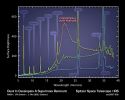
SN-Cassiopeia_A_-PIA10207.jpgCassiopeia "A": Dissecting the Wake of a Supernova Explosion61 visiteThe elements and molecules that flew out of the Cassiopeia A star when it exploded about 300 years ago can be seen clearly for the first time in this plot of data, called a Spectrum, taken by NASA's SST.
The Spectrum, which was created by splitting light into its basic components, reveals the composition of gas and dust that were synthesized in the explosion. It also provides some of the best evidence yet that stellar explosions, called Supernovae, were a significant source of fresh dust in the very young universe.
Prior to these observations, nobody was certain where this early dust — the same dust that ultimately made its way into future stars, planets and people — came from.
One of the most interesting features of the plot is a bump labeled Cassiopeia A Dust Feature. This bump is actually the signature of a collection of dust composed of proto-silicates, Silicon Dioxide and Iron Oxide. The Spectrum reveals that the brightness of the dust feature is correlated to that of Argon gas (yellow vertical line at left), known to have been expelled and synthesized during the star's explosion. The fact that the dust is associated with the expelled gas, or ejecta, tells astronomers that this Supernova manufactured new dust.
Each of the 3 lines of this plot represents a different layer of the Supernova remnant, with the top yellow and red line being the outermost layer.
Similar correlations between gas and dust are also seen in the middle layer (green line). For example, neon gas correlates with dust composed of Carbon and Aluminum Oxide.MareKromium
|
|

Sun-UnSun-OPP-SOL1082-83.gifSun or UnSun?61 visiteChe ne dite? Sole o "Non Sole"? Eclisse parziale (magari cagionata dal transito di una curiosa Nave Spaziale "squadrata"...) o semplice effetto ottico determinato da un tipo di ripresa particolare?
I frames arrivano dal MER Opportunity; la loro elaborazione è opera del Grande Dr Faccin.
Buona riflessione e...Un suggerimento: l'apparenza inganna...spesso!MareKromium
|
|
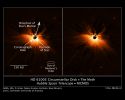
HD_61005.jpgCircumstellar Dust Takes Flight in 'The Moth'61 visiteWhat superficially resembles a giant moth floating in space is giving astronomers new insight into the formation and evolution of planetary systems.
This is not your typical flying insect. It has a wingspan of about 22 billion miles. The wing- like structure is actually a dust disk encircling the nearby, young star HD 61005, dubbed "The Moth." Its shape is produced by starlight scattering off dust.
Dust disks around roughly 100-million-year-old stars like HD 61005 are typically flat, pancake-shaped structures where planets can form. But images taken with NASA's Hubble Space Telescope of "The Moth" are showing that some disks sport surprising shapes.
"It is completely unexpected to find a dust disk with this unusual shape," said senior research scientist Dean Hines of the Space Science Institute, New Mexico Office in Corrales, New Mexico, and a member of the Hubble team that discovered the disk. "We think HD 61005 is plowing through a local patch of higher-density gas in the interstellar medium, causing material within HD 61005's disk to be swept behind the star. What effect this might have on the disk, and any planets forming within it, is unknown."
Hines called this possible collision "unusual, because we don't expect very much interstellar material to be in the solar neighborhood. That's because the area through which our Sun is moving was evacuated within the past few million years by at least one supernova, the explosion of a massive star. Yet, here's evidence of dense material that's very close, only 100 light-years away."
Astronomers have found evidence that the environment in which a star forms influences its prospects for planet formation. Hubble has actually seen that young planet-forming disks can be affected directly by their environment. The harsh stellar radiation from the Trapezium stars in the Orion Nebula has altered some disks. It is unclear, however, what effect passage through a cloud similar to the one in which HD 61005 finds itself would have on planet formation. Researchers have speculated that passage through dense regions of the interstellar medium could impact the atmospheres of evolving planets.
The Moth is part of a survey of Sun-like stars that Hines and collaborators observed with Hubble's Near-Infrared Camera and Multi-Object Spectrometer (NICMOS) and NASA's Spitzer Space Telescope to study the formation and evolution of planetary systems. Under the lead of Michael Meyer of the University of Arizona in Tucson, the team initially used Spitzer to look for heat radiation—the tell-tale sign of dust warmed by the star—to identify interesting star systems.
Hines then teamed with Glenn Schneider of the University of Arizona to use Hubble's high- contrast imaging capability of the NICMOS coronagraph to image these disks and reveal where the dust detected by Spitzer resides. The NICMOS coronagraph blocked out the starlight so that astronomers could see details in the surrounding disk.
"These symbiotic capabilities, uniquely implemented in NASA's Great Observatories, provide astronomers with the powerful observational tools to study the circumstellar environments of potentially planet-forming systems," Schneider said.
Added Meyer: "Combining observations from these two spacecraft gives us information about the composition of the dust grains, whether they're icy or sandy, or whether they're like the sooty smoke particles rising from a chimney. The composition and sizes of the dust can tell us a lot about the dynamics and evolution of a solar system. In our solar system, for example, astronomers have evidence of rocks smashing into each other and generating dust, as in the asteroid and Kuiper belts. We're seeing these same processes unfold in other planetary systems."
MareKromium
|
|

SOL067-GIF.gifDusty Sunset... (credits: Dr M. Faccin)61 visiteUn Sole lontano si spegne, creando fantastici effetti ottici con i suoi ultimi raggi che incontrano le polveri in sospensione nella tenue Atmosfera Marziana.
Splendido.MareKromium
|
|

Animazione_SOL626.gifLevitation? (GIF-Movie from frames taken during Sol 626; credits: Dr Gianluigi Barca)61 visite...Succede che Spirit continua a cercare il suo "vantage point" e, per farlo, continua a "spingere in avanti" (to push forward) ma...Le sue ruote anteriori restano perfettamente IMMOBILI.
Che ne pensate?
CONGRATULAZIONI al Dr Gianluigi Barca per l'occhio, la splendida intuizione e la provocazione: ma Spirit "levita", di quando in quando?!?...
E per gli Amici "scettici", che volessero controllare di persona, eccoVi i seriali dei frames usati per il GIF-Movie in questione (estratti dall'Archivio "Front Haz-Cam", per il "Sol 626" del "MER Spirit" - http://marsrovers.jpl.nasa.gov/gallery/all/spirit_f626_text.html):
2F181938396EFFAEUWP1205L0M1.JPG
2F181938455EFFAEUYP1206L0M1.JPG
2F181938816EFFAEV4P1206L0M1.JPG
2F181939108EFFAEV6P1206L0M1.JPG
2F181939506EFFAEVCP1205L0M1.JPG
2F181939798EFFAEVEP1206L0M1.JPG
2F181940195EFFAEVKP1206L0M1.JPG
2F181940480EFFAEVLP1206L0M1.JPG
2F181940831EFFAEVOP1214L0M1.JPGMareKromium
|
|
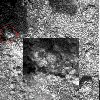
Animazione-SOL1198-2M232718905EFFATB4P2936M2M1-2.gifJust a "Light-Trick"... (version n. 2 - by Dr G. Barca)61 visiteSe il "Gioco di Luce" (light-trick) Vi fosse sfuggito nella prima sequenza, ora potete vedere meglio: non ci sono "fori" che si aprono o chiudono sulla superficie di Marte (o almeno NON in questa sequenza!...), ma solo una piccola area a forma vagamente quadrata e di colore leggermente diverso rispetto al terreno che la circonda la quale, all'arrivo dell'ombra, cambia leggermente tonalità, scurendosi (e quindi ingenerando la sensazione che qualcosa si sia mosso sulla superficie inquadrata).
Scherzi della Luce, si: ma quanto individuato dal Dr Barca è comunque un qualcosa di molto importante per tutti noi.
E' un altro (un NUOVO, diremmo) "Strumento Didattico". E ricordate bene quello che Vi diciamo ora (e che abbiamo detto già tante volte in passato, purtroppo invano...): alle volte NON E' importante stabilire che cosa un rilievo rappresenta (perchè una tale impresa è, quasi sempre impossibile); alle volte è IMPORTANTISSIMO arrivare a stabilire che cosa un rilievo NON E'!
Proprio come in questo caso: SEMBRAVA un "movimento", ERA un gioco di luce.
Complimenti e Congratulazioni al Dr Barca (perchè è in questo modo - e SOLO in questo modo - che si costruisce la "Comprensione!).MareKromium
|
|
| 3220 immagini su 269 pagina(e) |
 |
|
|
|
|
257 | |
|
|
|
|





