| Piú viste - THE LUNAR EXPLORER ARCHIVES |

vg2_1130449.jpgThe "Bright Eye" of Neptune (natural colors, according to Lunexit)61 visitenessun commento
|
|

Troughs-Tharsis_Region-PIA04103-002.jpgWhat's inside the Trough? (EDM n.2 - Enhanced Natural Colors; credits for the additional process. and color.: Dr Paolo C. Fienga - Lunexit Team)61 visitenessun commento
|
|

OPP-SOL108-1NN108EFF23CYL00P1981L000M1-B110R1-00.jpgEarly morning on Mars (after a sand storm)61 visiteInterpretazione di fantasia sul come dovrebbe apparire Marte (Regione di Meridiani Planum, prossimità del Cratere Endurance) nelle prime luci dell'alba e subito dopo la fine di una tempesta di polveri.MareKromium
|
|

M-016-PIA09109.jpgM 16 - The "Eagle Nebula"61 visiteThis image composite highlights the pillars of the Eagle Nebula, as seen in infrared light by NASA's Spitzer Space Telescope (bottom) and visible light by NASA's Hubble Space Telescope (top insets).
The top right inset focuses on the 3 famous pillars, dubbed the "Pillars of Creation", which were photographed by Hubble in 1995. Hubble's optical view shows the dusty towers in exquisite detail, while Spitzer's infrared eyes penetrate through the thick dust, revealing ghostly transparent structures. The same effect can be seen for the pillar outlined in the top left box.
In both cases, Spitzer's view exposes newborn stars that were hidden inside the cocoon-like pillars, invisible to Hubble. These stars were first uncovered by the European Space Agency's Infrared Satellite Observatory. In the Spitzer image, two embedded stars are visible at the tip and the base of the left pillar, while one star can be seen at the tip of the tallest pillar on the right.
|
|

Thaumasia_Region-The_Electric_Dunes-05.jpgThe "Bright Dunes" of Thaumasia (CTX Frame - Enhanced Natural Colors; credits for the additional process. and color.: Dr Paolo C. Fienga - Lunexit Team)61 visiteLe "Dune Luminose" di Thaumasia: per una Scuola di Pensiero si tratta di tubazioni, un tempo interrate, le quali sono state poi riportate alla luce dalla combinazione di azioni geologiche (da un lato) e meteorologiche (dall'altro). Tubazioni metalliche i cui scopi sono un mistero che, probabilmente, è destinato a rimanere tale.
Per altri Ricercatori, invece, si potrebbe trattare di spezzoni visibili di tunnel traparenti i quali, sempre a causa del concorso fra azioni geologiche (sismi, subsidenze, fratture tettoniche etc.) ed azioni meteorologiche (piogge torrenziali, alluvioni, venti et sim.), sono "emersi" dalle profondità del Pianeta Rosso sino a rendersi, in parte, visibili.
Per altri ancora, infine, si potrebbe trattare delle strutture che reggevano i tunnels di cui sopra (diciamo gli scheletri di queste ipotetiche costruzioni).
Per la NASA, si tratta di "ripples", ossìa di dune costituite da sabbie rapprese e, nel tempo, divenute simili a rocce (ancorchè - relativamente - fragili).
L'ESA è d'accordo con questa costruzione ma - e diremmo "ovviamente" - nè la NASA, nè l'ESA spiegano il motivo di questa albedo così inusuale per delle strutture rocciose.
Noi, come Gruppo di Ricerca Indipendente, riteniamo che queste strutture sìano, di fatto, dei rilievi naturali. Il motivo della loro "luminosità", come Geologia e Razionalità ci suggeriscono, dovrebbe essere ricercato - prima di lasciarsi andare a teorizzazioni esotiche (e prive di fondamenta) - nella composizione di questi rilievi. Svariate aree di Marte "brillano" e, come Spirit stesso ha già evidenziato, la superficie di Marte è ricca di sali e di sostanze aventi una natura ed una struttura cristallina.
Forse, prima di pensare a "tubi" e "tunnel", varrebbe la pena di pensare anche a sali, quarzi, superfici vetrificate e - perchè no? - ghiaccio.
|
|
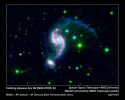
NGC-2535-PIA09106.jpgNGC 2535 and NGC 2536 (alias Arp 82)61 visiteA pair of interacting galaxies might be experiencing the galactic equivalent of a mid-life crisis. For some reason, the pair, called Arp 82, didn't make their stars early on as is typical of most galaxies. Instead, they got a second wind later in life -- about 2 billion years ago -- and started pumping out waves of new stars as if they were young again.
Arp 82 is an interacting pair of galaxies with a strong bridge and a long tail. NGC 2535 is the big galaxy and NGC 2536 is its smaller companion. The disk of the main galaxy looks like an eye, with a bright "pupil" in the center and oval-shaped "eyelids." Dramatic "beads on a string" features are visible as chains of evenly spaced star-formation complexes along the eyelids. These are presumably the result of large-scale gaseous shocks from a grazing encounter. The colors of this galaxy indicate that the observed stars are young to intermediate in age, around 2 million to 2 billion years old, much less than the age of the universe (13.7 billion years).
The puzzle is: why didn't Arp 82 form many stars earlier, like most galaxies of that mass range? Scientifically, it is an oddball and provides a relatively nearby lab for studying the age of intermediate-mass galaxies.
This picture is a composite captured by Spitzer's infrared array camera with light at wavelength 8 microns shown in red, NASA's Galaxy Evolution Explorer combined 1530 and 2310 Angstroms shown in blue, and the Southeastern Association for Research in Astronomy Observatory light at 6940 Angstroms shown in green.
|
|

as09-19-2909.jpgAS 09-19-2909 - The Lunar Module in its "Nest"...61 visitenessun commento
|
|
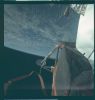
as09-20-3063.jpgAS 09-20-3063 - A Postcard from Space61 visitenessun commento
|
|

as09-23-3521.jpgAS 09-23-3521 - Red Lands, Blue Waters and White Clouds61 visitenessun commento
|
|
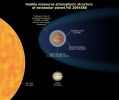
HD-209458b-01.jpgExtra-Solar Planet HD-209458b (2)61 visiteAlthough HD 209458b does not have a twin in our Solar System, it has plenty of relatives beyond our Solar System. About 10 to 15% of the more than 200 known extrasolar planets are hot Jupiters. A recent HST survey netted 16 hot Jupiter candidates in the central region of our Milky Way Galaxy, suggesting that there may be billions of these gas-giant star huggers in our galaxy.
HD 209458b is one of the most intensely studied extrasolar planets because it is one of the few known alien worlds that can be seen passing in front of, or transiting, its star, causing the star to dim slightly. In fact, the gas giant is the first such alien world discovered to transit its star.
HD 209458b is 150 LY from Earth, in the Constellation of Pegasus.
The planet's transits allow astronomers to analyze the structure and chemical makeup of the gas giant's atmosphere by sampling the starlight that passes through it. The effect is similar to finding fingerprints on a window by watching how sunlight filters through the glass.
Previous HST observatoins revealed Oxygen, Carbon and Sodium in the planet's atmosphere, as well as a huge Hydrogen upper atmosphere with a comet-like tail. These landmark studies provided the first detection of the chemical makeup of an extrasolar planet's atmosphere.
Additional observations by NASA's SST captured the infrared glow from the planet's hot atmosphere.
The new study by Ballester and her team is based on an analysis of archival observations made in 2003 with HST's Imaging Spectrograph by David Charbonneau of the Harvard-Smithsonian Center for Astrophysics in Cambridge, Mass. Ballester's team analyzed spectra from hot hydrogen atoms in the planet's upper atmosphere, a region not studied by Charbonneau's group.
|
|

as10-30-4340.jpgAS 10-30-4340 - Looking Down to the Moon...61 visitenessun commento
|
|

as14-66-9253.jpgAS 14-66-9253 - The (fragile-looking) Lunar Module61 visitenessun commento
|
|
| 3220 immagini su 269 pagina(e) |
 |
|
|
|
|
256 | |
|
|
|
|





