| Piú viste - THE LUNAR EXPLORER ARCHIVES |
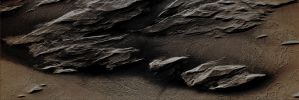
Volcanic_Regions-Rocky_Outcrops-MGS-01.jpgStreamlined Rocky Outcrops near Olympus Mons (Enhanced Absolute Natural Colors; credits for the additional process. and color.: Dr Paolo C. Fienga - Lunar Explorer Italia) 249 visiteCaption NASA originale:"This MGS-MOC image shows wind-eroded "Streamlined" Rocky Outcrops overlying Lava Flow Surfaces located to the West of Olympus Mons. Outcrops with this appearance are also called Yardangs. Yardangs typically form in Sedimentary Rock or Volcanic Ash that contains some amount of Sand. The weathering of the Rock due to the Aeolian action cause the release of sand-sized particles from the Outcrops and, in time, such a form of erosion slowly shape the rock into the classic, inverted boat hull-like shapes of Yardangs".
Location near: 13,2° North Lat. and 160,1° West Long.
Image width: ~3 Km (~1,9 mi)
Illumination from: lower left
Season: Northern SpringMareKromium
|
|
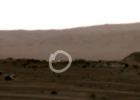
W-Possible_UFO_on_Mars-153861023_5401826013191553_8165356506997056401_n.jpgVERY interesting! (EDM)248 visitenessun commentoMareKromium
|
|

Utopia_Planitia-Smoke-A-M0202863-PCF-LXTT.jpgControversial Surface Feature in Utopia Planitia (Absolute Natural Colors; credits for the additional process. and color.: Dr Paolo C. Fienga - Lunexit Team)247 visiteSiamo all'interno di un grande cratere da impatto nella parte occidentale della Regione di Utopia. Sul bordo interno del cratere, che vedete a centro immagine, ci sono dei cracks (--->fratture) piuttosto evidenti. Nei due detail mgnf che seguiranno, potrete vedere come da uno di questi cracks sembra che stia uscendo un denso fumo nero.
Prima di sposare l'ipotesi del fumo che fuoriesce dalla frattura o prima di rigettarla seccamente, ricordate che siamo a circa 380 Km di distanza dal fenomeno - qualunque esso sia - e che Marte, più passa il tempo e più cerchiamo di indagarlo e studiarlo, più ci appare indecifrabile... MareKromium
|
|

North_Polar_Features-Polygons-PIA07354-1.jpgNorth Polar "Polygons" (Absolute Natural Colors; credits for the additional process. and color.: Dr Paolo C. Fienga - Lunexit Team)246 visitenessun commentoMareKromium
|
|

SOL858-2P202552105EFFAS00P2669L4M1-01.jpgSunset over Gusev Crater - Sol 858 (by Dr Paolo C. Fienga - Lunar Explorer Italia)246 visitenessun commentoMareKromium
|
|

Craters-Louth_Crater-FHA00989.jpgLouth Crater (Absolute Natural Colors; credits for the additional process. and color.: Dr Paolo C. Fienga - Lunexit Team)245 visiteLongitude of image center: 258,32° West
Latitude of image center: 70,58° North
Scaled pixel width: 270,95 meters
Scaled image width: 132,28 Km
Scaled image height: 117,97 Km
Solar Longitude (Ls): 111,09°
Local True Solar Time: 13,96 decimal hours
Emission Angle: 5,68°
Incidence Angle: 50,22°
Phase Angle: 46,39°
North Azimuth: 96,97°
Sun Azimuth: 313,08°
Spacecraft Altitude: 429,28 Km
Slant Distance: 431,16 KmMareKromium
|
|

Vastitas_Borealis-M0306518.jpgThick Cloud-Front over Vastitas Borealis244 visiteLongitude of image center: 23,58° West
Latitude of image center: 71,21° North
Scaled pixel width: 268,79 meters
Scaled image width: 130,93 Km
Scaled image height: 114,11 Km
Solar Longitude (Ls): 181,47°
Local True Solar Time: 14,20 decimal hours
Emission Angle: 3,73°
Incidence Angle: 74,99°
Phase Angle: 72,60°
North Azimuth: 97,66°
Sun Azimuth: 312,21°
Spacecraft Altitude: 430,36 Km
Slant Distance: 431,17 KmMareKromium
|
|

Craters-Unnamed_Defrosting_Crater-PIA03921-01.jpgUnnamed Defrosting Crater (Absolute Natural Colors; credits for the additional process. and color.: Dr Paolo C. Fienga - Lunexit Team)244 visiteCaption NASA originale:"This MGS-MOC image shows a Surface in the South Polar Region, covered by CO2 Frost. In this springtime scene, the Frost has begun to sublime so that Sandy Surfaces exhibit an abundance of Dark Spots. The circular depression is probably the remains of an Impact Crater. In summer, the Spotted Surfaces in this image would be darker than their surroundings, because they are patches of Windblown Sand".
Location near: 67,6° South Lat. and 254,3° West Long.
Image width: ~3 Km (~1,9) mi
Illumination from: upper left
Season: Southern SpringMareKromium
|
|

OPP-SOL1214-1N235959742EFF85QLP0673R0M1.jpgSunshine over Victoria (a Martian Fantasy by Dr Paolo C. Fienga - Lunexit Team)243 visitenessun commentoMareKromium
|
|

North_Polar_Cap-M0303936-PCF-LXTT-1.jpgFrame M0303936 - The North Polar Cap (Absolute Natural Colors; credits for the additional process. and color.: Dr Paolo C. Fienga - Lunexit Team)242 visitenessun commentoMareKromium
|
|

UFO-001N00055961.gifIn-transit Unidentified Flying Object near or behind Enceladus (GIF-Movie - credits: Dr M. Faccin)241 visiteEra inevitabile: osservando l'Universo (specie allorchè ci si trova in posizioni "privilegiate", così come lo sono quelle delle nostre Sonde), prima o poi ci si imbatte nell'osservazione di fenomeni i quali sembrano sfuggire - o, di fatto, sfuggono - alla Umana Capacità di Razionalizzare e/o di comprendere (fatta eccezione per qualche Astronomo e per quasi tutti gli Astronauti i quali, da ieri e da sempre - e nonostante la loro professione - sembra che non riescano mai a vedere oltre il proprio naso...).
Ironia e sarcasmo a parte, Lunar Explorer Italia NON è nata come Associazione Ufologica e non è nostra intenzione snaturarla (anche perchè le nostre competenze, in materia di OVNI, sono limitate); tuttavia, dato che ci è capitato, ci sta capitando e CERTAMENTE ci capiterà ancora in futuro di imbatterci in eventi la cui connotazione razionale non ci è possibile (o non siamo capaci di) attuarla, abbiamo deciso di creare questo nuovo album il quale conterrà GIF-movies o stills di oggetti non identificati i quali sìano stati intercettati e ripresi dalle nostre Sonde nello Spazio Profondo.
Il nostro unico auspicio è che questa collezione di immagini possa essere di aiuto non solo a chi si occupa professionalmente di Ufologia, ma anche a tutti quegli Appassionati di Spazio e di Mistero che, purtroppo, oggi vengono costantemente bombardati da bufale e scemenze vere e proprie (a volte talmente ben "impacchettate e servite" da sembrare quasi credibili...) e che quindi si trovano sempre più in difficoltà nell'interpretazione di quelli che sono anche chiamati e conosciuti come i "Segni dal Cielo".
WARNING: TUTTO IL MATERIALE USATO E' "NASA - ORIGINAL". NOI, COME LUNAR EXPLORER ITALIA - ED A SECONDA DEI CASI - NON ABBIAMO FATTO ALTRO CHE ASSEMBLARLO (CREANDO DEI "GIF-MOVIES") O PROPORVELO "AS IT IS" (SENZA ADDITIONAL PROCESSING ED IN FOTOGRAMMI SEMPLICI O "STILLS"). UN GRAZIE DI CUORE AGLI AUTORI DELLA RICERCA E DELLE ELABORAZIONI, I NOSTRI ECCEZIONALI AMICI E COLLEGHI, DRR GIANLUIGI BARCA E MARCO FACCIN.MareKromium
|
|

Craters-Unnamed_Crater-PIA07202-PCF-LXTT.jpgUnnamed Crater with Pedestal (Absolute Natural Colors; credits for the additional process. and color.: Dr Paolo C. Fienga - Lunar Explorer Italia)241 visiteThis Mars Global Surveyor (MGS) Mars Orbiter Camera (MOC) image shows an Unnamed Impact Crater, a little over 2 Km (> 1,2 mi) in diameter, located in Noachis Terra near 50,4° South and 14,3° West. The Crater's Bouldery Ejecta Blanket has protected underlying material from being eroded away by wind, leaving the Ejecta up on a low Pedestal. This picture covers an area about 3 Km (approx. 1,9 miles) across, and is illuminated by sunlight from the lower left.MareKromium
|
|
| 3220 immagini su 269 pagina(e) |
 |
|
|
|
|
19 | |
|
|
|
|





