| Piú viste |

Rhea-PIA08986.jpgRhea, in the Saturnshine (natural colors - elab. Lunexit)67 visiteCaption NASA:"The night side of Rhea shines softly in reflected light from Saturn. A similar effect, called Earthshine, can often be seen dimly illuminating the dark side Earth's Moon.
Background stars make short, dim trails across the black sky. The sunlit terrain on Rhea is so much brighter than the part lit by Saturn that the former is completely overexposed in this view, which took more than 30" to acquire.
This view looks toward the Leading Hemisphere on Rhea. North is up and rotated 28° to the left.
The image was taken in visible light with the Cassini spacecraft narrow-angle camera on June 11, 2007. The view was obtained at a distance of approx. 364.000 Km (such as about 226.000 miles) from Rhea and at a Sun-Rhea-spacecraft, or phase, angle of 154°. Image scale is roughly 4 Km (about 3 miles) per pixel".MareKromium
|
|

A-Phoenix-004.jpgThe Landing Phase: Parachute and Landing "Nest"67 visitenessun commentoMareKromium
|
|

as16-113-18366.JPGAS 16-113-18366 - LR and the ALSEP Area67 visitenessun commentoMareKromium
|
|

Comets-Comet_Holmes-UW.jpgComet 17-P-Holmes is getting Bigger!67 visiteCaption NASA, da "NASA - Picture of the Day", del 5 Novembre 2007:"Comet Holmes continues to be an impressive sight to the unaided eye. The comet has diminished in brightness only slightly, and now clearly appears to have a larger angular extent than stars and planets.
Astrophotographers have also noted a distinctly green appearance to the comet's coma over the past week.
Pictured above over Spain in 3 digitally combined exposures, Comet 17P/Holmes now clearly sports a tail. The blue ion tail is created by the solar wind impacting ions in the coma of Comet Holmes and pushing them away from the Sun. Comet Holmes underwent an unexpected and dramatic increase in brightness starting only two weeks ago. The detail visible in Comet Holmes' tail indicates that the explosion of dust and gas that created this dramatic brightness increase is in an ongoing and complex event.
Comet Holmes will move only slightly on the sky over the next month (such as December 2007)".MareKromium
|
|

LLQ-Itokawa-ST_2482160259_v-3.jpgRectangular Surface Feature on Itokawa? (extra-detail mgnf)67 visiteAllora, fermiamoci ai fatti: il "rettangolo" esiste (e si vede bene) ed alla sua base c'è effettivamente qualcosa che non può essere altro che una apertura.
Questo rilievo - che solo un occhio attento al dettaglio poteva individuare - rientra, a nostro parere, nella Classe delle Singolarità Superficiali.
E' un rilievo affascinante, suggestivo, decisamente curioso: certo. Ma quali elementi abbiamo per poter anche solo supporre una sua origine NON naturale?
Nessuno.
L'intero Asteroide Itokawa è un campionario di Singolarità, le quali vanno dalla mancanza di crateri alla presenza, su un buon 75% della sua superficie, di una sorta di "squamatura rocciosa" (si tratta di mini-boulders a forma appuntita ed inclinati - leggermente - rispetto al piano dell'asteroide).
Itokawa (al pari di Phobos, o di 1-Ceres, o di 433-Eros, o al pari delle "unexplainable surface features" di Marte, di Giapeto, di Callisto ed Europa e così via), è una Meraviglia della Natura: è unico, è lontano, è affascinante e, per noi, è largamente inesplicabile.
Parlare di "intervento intelligente" (come sinonimo di "NON naturale") allorchè si analizzano rilievi come questo (o come quelli relativi agli altri Corpi Celesti sopra menzionati), vuol dire - a nostro parere - NEGARE la Capacità Creativa della Natura e, di fatto, significa rifiutarsi di vedere l'Universo per quello che è davvero: una Meravigliosa Opera la quale, per il suo 99,99%, era, è e - probabilmente - rimarrà uno splendido enigma per gli Uomini.
Un enigma che dovrebbe invogliarci a studiare di più e meglio, a capire di più e meglio e ad essere un pochino più umili e consapevoli dei nostri limiti e della attuale nostra incapacità di razionalizzare tutto quello che vediamo e quindi di sussumere l'Ignoto all'interno di Classi di Conoscenza ancora largamente e profondamente imperfette.
Un profondo ringraziamento all'Amico e Collega, Dr Gianluigi Barca, per l'eccezionale "occhio" e per la splendida provocazione che ha lanciato: provocazione che ci ha offerto un eccellente spunto per esprimere un pensiero che, in tanti ormai, avevamo da tempo voglia di tradurre in parole.MareKromium
|
|
OPP-SOL1354-1P248384257ESF8788P2538L7M1.jpgObservations... (natural colors; elab. Lunexit)67 visitenessun commentoMareKromium
|
|

SOL687-01.jpgMartian Night-Sky (negative - credits: Dr Marco Faccin) - Sol 68767 visitenessun commentoMareKromium
|
|

as08-14-2420.jpgAS 08-14-2420 - Old Crater on the Far-Side of the Moon (1 - MULTISPECTRUM; credits: Lunexit)67 visiteCoord.: 10° South Lat. and 175° West Long.MareKromium
|
|

Mare_Imbrium.jpgMare Imbrium67 visiteCaption NASA:"Dark, smooth Regions that cover the Moon's familiar face are called by Latin names for oceans and seas. The naming convention is historical, though it may seem a little ironic to denizens of the space age who recognize the Moon as a mostly dry and airless world, and the smooth, dark areas as lava-flooded impact basins. For example, this elegant lunar vista, a careful mosaic of telescopic images, looks across the expanse of the North-Western Mare Imbrium, or Sea of Rains, into the Sinus Iridum - the Bay of Rainbows. Ringed by the Jura Mountains (montes), the bay is about 250 Km across, bounded at the bottom of the rugged arc by Cape (promontorium) Laplace.
The Cape's sunlit face towers nearly 3000 mt above the bay's surface. At the top of the arc is Cape Heraclides, at times seen as a moon maiden".MareKromium
|
|

OPP-SOL165-B_P2394_L257atc-1.jpgThe Rim of Endurance and the Sky above - Sol 165 (composite - credits: NASA & Lunexit)67 visitenessun commentoMareKromium
|
|

as15-86-11641.jpgAS 15-86-11641 - Gnomon & Bootprint (1)67 visiteCaption NASA:"144:25:45 MT - While waiting for Jim (Irwin) to join him at the upslope rim of the Station 6 Crater, Dave Scott took this cross-Sun "before" from the south of the trench site".MareKromium
|
|
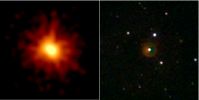
GRB-080319b_Swift_2panel.jpgGRB-080391B67 visite"...Habet et musca splenem et formica bilem..."
(Binder)
"...Anche le creature più piccole hanno i loro istanti di grande collera..." (trad. libera)MareKromium
|
|
| 25353 immagini su 2113 pagina(e) |
 |
|
|
|
|
996 | |
|
|
|
|





