| Piú viste |

Atlas-N00084635.jpgAtlas (3)67 visitenessun commentoMareKromium
|
|

ZZ-ColorMars-08-KL-V03689003color.jpgMars from Orbit, as a "Human" would see it...by Keith Laney (2)67 visitenessun commentoMareKromium
|
|
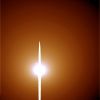
OPP-SOL1224-1P236858280EFF85R9P2682L5M1.jpgThe Sun through the dust - Sol 122467 visiteBoth MERs take daily measurements estimating the amount of dust in the atmosphere. The less dust the better, because it means more sunlight reaches the MERs' Solar Panels, which power the vehicles. In the last week, Opportunity has broken its dust record, with the Opacity level rising from 1.0 to 3.3.
Solar array energy on Opportunity dropped from 765 watt-hours to 402 watt-hours over the same period of time.
"While this only represents enough dust to coat the Planet to about the thickness of a human hair, it is enough to decrease the brightness of the noon sun by 96% compared to a completely clear atmosphere" said Steve Squyres, Principal Investigator, Cornell University, Ithaca, N.Y.
"Of course, the solar arrays also receive light that is scattered from the dust, so the decrease in power is not nearly that great".MareKromium
|
|
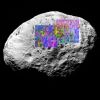
Hyperion-PIA09214.jpgWhat's all over Hyperion? (context image)67 visiteCaption NASA:"Hyperion, the eighth largest of Saturn's nearly 60 known moons, is covered in craters and landslides. Sprinkled over the icy surface is a thin layer of organic dust, which has somehow been concentrated in the bottoms of some of the craters, forming a reddish/black deposit.
This new color map shows the composition of a portion of Hyperion's surface determined with the Visual and Infrared Mapping Spectrometer aboard the Cassini spacecraft. The new composition map is overlaid onto a previously released Cassini image of Hyperion, taken with the Imaging Science Subsystem.
(...) Discovered in 1848, Hyperion held its secrets until the Cassini spacecraft flew close in September 2005, revealing its icy and organic composition.
Hyperion is irregular in shape, tumbles chaotically, and takes 21 days to orbit Saturn. It is 300 Km (about 180 miles) in its longest dimension".MareKromium
|
|

Saturn-PIA08982.jpgIn the Night...67 visiteCaption NASA:"Graceful giant Saturn poses with a few of the small Worlds it holds close. From this viewpoint the Cassini Spacecraft can see across the entirety of the Planet's shadow on the Rings, to where the Ring-Plane emerges once again into Sunlight.
Tethys shines large and bright near the bottom of the scene. Pandora sits outside the F-Ring, below center. Epimetheus is a speck on the far side of the Ring-Plane, immediately to the right of Saturn's limb. Most of the other bright specks near the Rings are background stars.
This view looks toward the unilluminated side of the Rings from about 8° above the Ring-Plane. The image has been brightened to enhance the appearance of the small moons.
The image was taken with the Cassini spacecraft wide-angle camera on June 2, 2007 using a spectral filter sensitive to wavelengths of infrared light centered at 918 nanometers.
The view was obtained at a distance of approx. 2,2 MKM (such as about 1,4 MMs) from Saturn.
Image scale is roughly 131 Km (about miles) per pixel".MareKromium
|
|

Craters-Unnamed_Crater_with_Pedestal-MGS.jpgAnother "Pedestal Crater" (Enhanced Natural Colors; credits for the additioanl process. and color.: Dr Paolo C. Fienga - Lunexit Team)67 visitenessun commentoMareKromium
|
|

Rhea-PIA08986.jpgRhea, in the Saturnshine (natural colors - elab. Lunexit)67 visiteCaption NASA:"The night side of Rhea shines softly in reflected light from Saturn. A similar effect, called Earthshine, can often be seen dimly illuminating the dark side Earth's Moon.
Background stars make short, dim trails across the black sky. The sunlit terrain on Rhea is so much brighter than the part lit by Saturn that the former is completely overexposed in this view, which took more than 30" to acquire.
This view looks toward the Leading Hemisphere on Rhea. North is up and rotated 28° to the left.
The image was taken in visible light with the Cassini spacecraft narrow-angle camera on June 11, 2007. The view was obtained at a distance of approx. 364.000 Km (such as about 226.000 miles) from Rhea and at a Sun-Rhea-spacecraft, or phase, angle of 154°. Image scale is roughly 4 Km (about 3 miles) per pixel".MareKromium
|
|

A-Phoenix-004.jpgThe Landing Phase: Parachute and Landing "Nest"67 visitenessun commentoMareKromium
|
|

as16-113-18366.JPGAS 16-113-18366 - LR and the ALSEP Area67 visitenessun commentoMareKromium
|
|

Comets-Comet_Holmes-UW.jpgComet 17-P-Holmes is getting Bigger!67 visiteCaption NASA, da "NASA - Picture of the Day", del 5 Novembre 2007:"Comet Holmes continues to be an impressive sight to the unaided eye. The comet has diminished in brightness only slightly, and now clearly appears to have a larger angular extent than stars and planets.
Astrophotographers have also noted a distinctly green appearance to the comet's coma over the past week.
Pictured above over Spain in 3 digitally combined exposures, Comet 17P/Holmes now clearly sports a tail. The blue ion tail is created by the solar wind impacting ions in the coma of Comet Holmes and pushing them away from the Sun. Comet Holmes underwent an unexpected and dramatic increase in brightness starting only two weeks ago. The detail visible in Comet Holmes' tail indicates that the explosion of dust and gas that created this dramatic brightness increase is in an ongoing and complex event.
Comet Holmes will move only slightly on the sky over the next month (such as December 2007)".MareKromium
|
|

LLQ-Itokawa-ST_2482160259_v-3.jpgRectangular Surface Feature on Itokawa? (extra-detail mgnf)67 visiteAllora, fermiamoci ai fatti: il "rettangolo" esiste (e si vede bene) ed alla sua base c'è effettivamente qualcosa che non può essere altro che una apertura.
Questo rilievo - che solo un occhio attento al dettaglio poteva individuare - rientra, a nostro parere, nella Classe delle Singolarità Superficiali.
E' un rilievo affascinante, suggestivo, decisamente curioso: certo. Ma quali elementi abbiamo per poter anche solo supporre una sua origine NON naturale?
Nessuno.
L'intero Asteroide Itokawa è un campionario di Singolarità, le quali vanno dalla mancanza di crateri alla presenza, su un buon 75% della sua superficie, di una sorta di "squamatura rocciosa" (si tratta di mini-boulders a forma appuntita ed inclinati - leggermente - rispetto al piano dell'asteroide).
Itokawa (al pari di Phobos, o di 1-Ceres, o di 433-Eros, o al pari delle "unexplainable surface features" di Marte, di Giapeto, di Callisto ed Europa e così via), è una Meraviglia della Natura: è unico, è lontano, è affascinante e, per noi, è largamente inesplicabile.
Parlare di "intervento intelligente" (come sinonimo di "NON naturale") allorchè si analizzano rilievi come questo (o come quelli relativi agli altri Corpi Celesti sopra menzionati), vuol dire - a nostro parere - NEGARE la Capacità Creativa della Natura e, di fatto, significa rifiutarsi di vedere l'Universo per quello che è davvero: una Meravigliosa Opera la quale, per il suo 99,99%, era, è e - probabilmente - rimarrà uno splendido enigma per gli Uomini.
Un enigma che dovrebbe invogliarci a studiare di più e meglio, a capire di più e meglio e ad essere un pochino più umili e consapevoli dei nostri limiti e della attuale nostra incapacità di razionalizzare tutto quello che vediamo e quindi di sussumere l'Ignoto all'interno di Classi di Conoscenza ancora largamente e profondamente imperfette.
Un profondo ringraziamento all'Amico e Collega, Dr Gianluigi Barca, per l'eccezionale "occhio" e per la splendida provocazione che ha lanciato: provocazione che ci ha offerto un eccellente spunto per esprimere un pensiero che, in tanti ormai, avevamo da tempo voglia di tradurre in parole.MareKromium
|
|
OPP-SOL1354-1P248384257ESF8788P2538L7M1.jpgObservations... (natural colors; elab. Lunexit)67 visitenessun commentoMareKromium
|
|
| 25353 immagini su 2113 pagina(e) |
 |
|
|
|
|
995 | |
|
|
|
|





