| Piú viste |

as09-19-2951.jpgAS 09-19-2951 - Floating Away...67 visitenessun commento
|
|
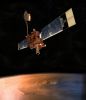
00-A-Mars_Global_Surveyor.jpgMars Global Surveyor67 visiteMars Global Surveyor was launched in 1996 on a mission designed to study Mars from orbit for two years. It accomplished many important discoveries during nine years in orbit. On Nov. 2, 2006, the spacecraft transmitted information that one of its arrays (---> pannelli) was not pivoting (--> ruotando) as commanded.
Loss of signal from the MGS Orbiter began on the following orbit.
Mars Global Surveyor has operated longer at Mars than any other spacecraft in history and for more than four times as long as the prime mission originally planned.
NASA has recently formed an internal review board to look more in-depth into why NASA's Mars Global Surveyor went silent in November 2006 and recommend any processes or procedures that could increase safety for other spacecraft.
|
|

NGC-4449.jpgNGC 4449 - Irregular Galaxy67 visite"...Insegnare qualcosa di giusto a qualcuno è enormemente più facile del mettere in pratica, noi stessi, quel medesimo insegnamento.
E ricordare a qualcuno che il Futuro lo si costruisce solo guardando verso di esso e dimenticando il passato è pure un insegnamento giusto e saggio ma, ahinoi, spesso impraticabile..."
P.C. Floegers - "Conversations for Tomorrow"MareKromium
|
|
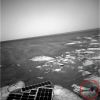
OPP-SOL1173-1N232319876EFF82__P1911L0M1-00.jpgThe "Martian Ace-of-Spades" (1) - context image - Sol 117367 visiteUn nuovo dettaglio della Superficie Marziana, davvero bizzarro ed estremamente intrigante, è stato individuato ed evidenziato anche oggi dal nostro ottimo Dr Gianluigi Barca su ben 2 distinti frames Opportunity.
Come certo saprete, la verifica dell'esistenza di un rilievo "bizzarro" attraverso frames diversi (consecutivi o non) è fondamentale per distinguere la semplice illusione ottica/svista dalla effettiva presenza di un qualcosa che, in ogni caso, vale la pena esaminare.
In questo frangente, come vedete, la Singolarità è data dalla presenza di un rilievo il quale ci ricorda (molto bene, diremmo!) un Asso di Picche.
Fantasia sfrenata? Illusione ottica? Svista? O magari "segnale" in codice?...
Questo non lo sa nessuno, ovviamente.
Ciò che sappiamo, invece, è che il nostro "Asso" si vede molto bene in 2 frames e quindi non è una svista nè un'illusione ottica determinata dal fatto che la ripresa è stata effettuata da un particolare angolo visuale.
Cosa resta, quindi? Resta la "Fantasia Sfrenata", il "Segnale in Codice" e, last but not least, la presenza di un rilievo superficiale curioso il quale, come ovvio, non è certo rappresentativo di un Asso di Picche (almeno nel senso terrestre del termine…).
Ecco: grazie al Dr Gianluigi Barca, anche in questo caso possiamo distinguere la realtà (il rilievo bizzarro, ma genuino - che si vede in frames differenti) dalla fantasia e dalla pura speculazione (l'Asso di Picche).
La differenza fra i Privati Ricercatori ed i cialtroni, a questo punto, la fa l'Onestà Intellettuale.
Quella stessa Onestà che ci fa dire, adesso come mille altre volte, che ciò che si vede in questi frames SEMBRA un Asso di Picche e noi, per sorridere, ci scherziamo sopra pur sapendo benissimo che il solo parlare di "Asso di Picche Marziano" è una (simpatica e leggera) sciocchezza.
Peccato che, come dice il nostro Amico, Collega e Socio - Dr A. Feltri - "il Buon Senso, la Razionalità ed il Pragmatismo, in questo Mondo, non paghino il becco di un quattrino"...
MareKromium
|
|

The_Sun-PIA09322.jpgClose-up View of an Active Region of the Sun (March 23, 2007)67 visitenessun commentoMareKromium
|
|

MarteARTE-09.jpgFunny-looking Rock!67 visitePotevamo battezzare - scherzosamente, come ovvio - questo rilievo come "roccia-croissant" o "roccia-tubero": entrambe le definizioni a noi sembrano assolutamente calzanti, ma se Voi aveste una idea migliore...Scrivetecela!MareKromium
|
|

Atlas-N00084635.jpgAtlas (3)67 visitenessun commentoMareKromium
|
|

ZZ-ColorMars-08-KL-V03689003color.jpgMars from Orbit, as a "Human" would see it...by Keith Laney (2)67 visitenessun commentoMareKromium
|
|
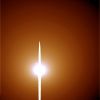
OPP-SOL1224-1P236858280EFF85R9P2682L5M1.jpgThe Sun through the dust - Sol 122467 visiteBoth MERs take daily measurements estimating the amount of dust in the atmosphere. The less dust the better, because it means more sunlight reaches the MERs' Solar Panels, which power the vehicles. In the last week, Opportunity has broken its dust record, with the Opacity level rising from 1.0 to 3.3.
Solar array energy on Opportunity dropped from 765 watt-hours to 402 watt-hours over the same period of time.
"While this only represents enough dust to coat the Planet to about the thickness of a human hair, it is enough to decrease the brightness of the noon sun by 96% compared to a completely clear atmosphere" said Steve Squyres, Principal Investigator, Cornell University, Ithaca, N.Y.
"Of course, the solar arrays also receive light that is scattered from the dust, so the decrease in power is not nearly that great".MareKromium
|
|
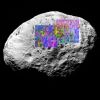
Hyperion-PIA09214.jpgWhat's all over Hyperion? (context image)67 visiteCaption NASA:"Hyperion, the eighth largest of Saturn's nearly 60 known moons, is covered in craters and landslides. Sprinkled over the icy surface is a thin layer of organic dust, which has somehow been concentrated in the bottoms of some of the craters, forming a reddish/black deposit.
This new color map shows the composition of a portion of Hyperion's surface determined with the Visual and Infrared Mapping Spectrometer aboard the Cassini spacecraft. The new composition map is overlaid onto a previously released Cassini image of Hyperion, taken with the Imaging Science Subsystem.
(...) Discovered in 1848, Hyperion held its secrets until the Cassini spacecraft flew close in September 2005, revealing its icy and organic composition.
Hyperion is irregular in shape, tumbles chaotically, and takes 21 days to orbit Saturn. It is 300 Km (about 180 miles) in its longest dimension".MareKromium
|
|

Saturn-PIA08982.jpgIn the Night...67 visiteCaption NASA:"Graceful giant Saturn poses with a few of the small Worlds it holds close. From this viewpoint the Cassini Spacecraft can see across the entirety of the Planet's shadow on the Rings, to where the Ring-Plane emerges once again into Sunlight.
Tethys shines large and bright near the bottom of the scene. Pandora sits outside the F-Ring, below center. Epimetheus is a speck on the far side of the Ring-Plane, immediately to the right of Saturn's limb. Most of the other bright specks near the Rings are background stars.
This view looks toward the unilluminated side of the Rings from about 8° above the Ring-Plane. The image has been brightened to enhance the appearance of the small moons.
The image was taken with the Cassini spacecraft wide-angle camera on June 2, 2007 using a spectral filter sensitive to wavelengths of infrared light centered at 918 nanometers.
The view was obtained at a distance of approx. 2,2 MKM (such as about 1,4 MMs) from Saturn.
Image scale is roughly 131 Km (about miles) per pixel".MareKromium
|
|

Craters-Unnamed_Crater_with_Pedestal-MGS.jpgAnother "Pedestal Crater" (Enhanced Natural Colors; credits for the additioanl process. and color.: Dr Paolo C. Fienga - Lunexit Team)67 visitenessun commentoMareKromium
|
|
| 25353 immagini su 2113 pagina(e) |
 |
|
|
|
|
991 | |
|
|
|
|





