| Piú viste |

Titan-PIA08188.jpgMellow Yellow...67 visiteCaption NASA originale:"Saturn's largest moon, Titan, peaks out from under the Planet's Rings of ice.
This view looks toward Titan from slightly beneath the Ring-Plane. The dark Encke Gap (325 Km, or 200 miles wide) is visible here, as is the narrow F-Ring.
Images taken using red, green and blue spectral filters were combined to create this natural color view.
The images were taken with the Cassini spacecraft narrow-angle camera on April 28, 2006 at a distance of approximately 1,8 MKM (such as 1,1 MMs) from Titan. Image scale is approx. 11 Km (about 7 miles) per pixel on Titan".
|
|
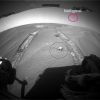
OPP-SOL846-1R203290455EFF7278P1305R0M1.jpgPanorama with "something" (2) - Sol 84667 visitevedi i commenti svolti per il frame precedente
|
|

OPP-SOL004-1P128547857EFF0205P2366R1M1.jpgEarly "sparks" in Meridiani Planum (2) - Sol 467 visitenessun commento
|
|
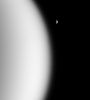
Rhea and Titan-PIA08204-br500.jpgOff the "smog"...67 visiteDuring a recent flyby of Titan, the Cassini spacecraft looked beyond the utterly overcast moon and spied clear, distant Rhea in the blackness.
Titan (5,150 kilometers, or 3,200 miles across) is two-and-a-half times smaller than Earth and much less massive. This circumstance causes its atmosphere to extend to much higher altitudes above the surface than does Earth's. The Cassini spacecraft is unable to fly much closer than about 1000 kilometers (600 miles) above Titan's surface -- much closer, and the spacecraft would experience excessive torques from the atmosphere that could interfere with its ability to track the target. By contrast, the International Space Station orbits Earth at an altitude of about 350 kilometers (220 miles).
The bright, fresh crater on Rhea (1,528 kilometers, or 949 miles across) appears near the center of the moon's crescent.
The image was taken in visible-light with the Cassini spacecraft wide-angle camera on May 20, 2006, at a distance of approximately 53,000 kilometers (33,000 miles) from Titan and 873,000 kilometers (543,000 miles) from Rhea. Image scale is 320 meters (1,050 feet) per pixel on Titan and 5 kilometers (3 miles) per pixel on Rhea.
|
|

OPP-SOL855-PIA08565-2.jpgBeagle Crater (stretched version) - Sol 85567 visiteCaption NASA originale:"When scientists using orbital data calculated that they should be able to detect Victoria's rim in Rover images, they scrutinized frames taken in the direction of the crater by the PanCam. To positively characterize the subtle horizon profile of the crater and some of the features leading up to it, researchers created this vertically-stretched image. The stretched image makes mild nearby dunes look like more threatening peaks, but that is only a result of the exaggerated vertical dimension. This vertical stretch technique was first applied to Viking Lander 2 panoramas by Philip Stooke, of the University of Western Ontario, Canada, to help locate the Lander with respect to orbiter images. Vertically stretching the image allows features to be more readily identified by the MER Science Team".
|
|

Hyperion-N00063147-1.jpgHyperion and a "Bright Companion" (1 - context image)67 visiteUn'immagine bella ed ambigua: Hyperion, the "tumbling moon", sembra essere in compagnia di un altro oggetto il quale, forse perchè molto (si direbbe "troppo", a giudicare dal risultato fotografico ottenuto) luminoso, è stato "washed away".
Ma attenzione: il washing è stato solo parziale! Qualcosa, infatti, sembra che la si riesca a vedere...
|
|

Atlas from Voyager2.jpgAtlas, from Voyager 2 (extra detail mgnf)67 visiteUn buon super detail-mgnf per evidenziare la forma (curiosa) della mini-luna Saturniana Atlas, sino ad ora mai ripresa in maniera soddisfacente dalle Sonde che sono passate (o sono tuttora in transito) nello Spazio di Saturno.
Il frame è stato portato a stretch estremi dal nostro Tecnico delle Immagini ed il risultato è più che decoroso; tuttavia, proprio perchè lo stretch estremo crea o concorre nella creazione di anomalìe ed artefatti, non commentiamo i dettagli "strani" che questo frame ora pare evidenziare.
O meglio: li commenteremo se anche Voi li vedrete e chi chiederete conto di essi...
|
|
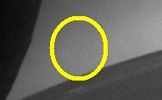
OPP-SOL869-1R205336007EFF73U6P1311L0M1 detail mgnf.jpgLittle light in the sky (extra detail mgnf)67 visiteUn nuovo Star-like Object (diurno) fa la sua apparizione nel Cielo di Marte e nella Front Haz-Cam di Opportunity.
Lo sapete: davanti a questo tipo di fenomeno (ricorrente) noi possiamo solo evidenziare l'assenza di elementi i quali ci potrebbero far pensare al photoartifact.
Per il resto: solo immaginazione, speculazione ed intuizione...ma nulla di certo nè di verificabile.
|
|
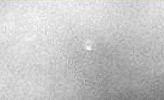
Craters-Unnamed_Crater_with_Clouds-02.jpgSpring Clouds...and something else! (EDM n.2)67 visiteIn questo stretching estremo (almeno per i mezzi di cui disponiamo), il Corpo Anomalo individuato dal Sig. Granzo si mostra in tutta la sua stranezza: diremmo, in buona sostanza, che ha una forma irregolare (o vagamente rotondeggiante), un'albedo molto alta e, anche se qui ci muoviamo nell'ambito della mera interpretazione delle immagini, ci pare che esso proietti ombra sul suolo del Pianeta.
Le ipotesi che ci sentiamo di fare al riguardo sono due:
1) si potrebbe trattare di un oggetto che crea turbolenza e che sta attraversando le nuvole o
2) l'oggetto E' in se stesso una turbolenza.
L'ipotesi limite - escluso l'OVNI, almeno per il momento - è che questo oggetto sia un Dust Devil di grandi dimensioni il quale sta passando su una zona libera da nuvole o con copertura nuvolosa minima. Le analogie visuali fra questo Corpo Anomalo ed i DD ripresi da Sonde in orbita (MGS ed Odyssey), a nostro parere, esistono e sono evidenti.
Non possiamo dire di più.
Congratulazioni - di cuore - a Massimo Granzo!
|
|
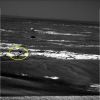
OPP-SOL873-1P205688604EFF735TP2442R2M1-1.jpgMartian "Menhir" and "Impossible Rock" (context image) - Sol 87367 visiteUna nuova interessante ed intrigante segnalazione del Dr Gianluigi Barca sulle "rocce impossibili": in un frame PanCam che, inter alia, ritrae la sempre più enigmatica "Menhir Rock", nella Cerchiatura Gialla si vede una (diremmo ormai classica) "situazione di superficie assurda".
Il successivo detail mgnf non risolverà ma, di certo, Vi darà maggiori idee e spunti sul significato di "rilievo superficiale impossibile" (o quasi...).
|
|

vo1_250a13-1.jpgA streak in the Sky (extra detail mgnf)67 visiteDettaglio ad elevato stretching della striscia di luce visibile in alto a Dx nel frame che segue. Si tratta di un artefatto fotografico davvero molto simile a quanto visibile anche nel frames (famosissimi) ottenuti, guarda caso sempre nelle vicinanze di Phobos, dalla Sonda Sovietica Phobos-2?
La coincidenza è forte, la somiglianza fra le due "strisce" è enorme; noi, però, vogliamo e dobbiamo essere pragmatici: non ci è possibile, infatti, fare alcuna speculazione sulla possibile causa e natura della Striscia di Luce in oggetto. UFO? Stella sullo sfondo che risulta mossa a causa della esposizione adottata dalla Sonda Viking 1 per ottenere questo frame?
O semplice photoartifact?
Ancora una volta (sorry...) dovete decidere Voi.
|
|

SOU-SOL022.jpgEnd of the day, time to "rest"... - Sol 2267 visiteCaption NASA originale:"An End-Of-Sol Soujourner image. This was taken on Sol 22 after the Rover had placed its APXS in the dark soil surrounding the rock named Lamb".
|
|
| 25353 immagini su 2113 pagina(e) |
 |
|
|
|
|
982 | |
|
|
|
|





