| Piú viste |
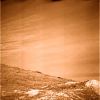
OPP-SOL957-1P213145911EFF76LJP2394R1M1.jpgVictoria Crater (9) - Sol 95768 visiteCaption NASA:"Right PanCam Non-linearized Full frame EDR acquired on Sol 957 of Opportunity's mission to Meridiani Planum at approximately 13:53:46 MLT, camera commanded to use Filter 1 (436 nm)".
|
|

ExoPlanet-00.jpgIn-transit...68 visite"...Vipera in veprecula est..."
(Pomponio)
"...La vipera sta fra gli sterpi..." (oggi diremmo: "qui c'è sotto qualcosa...")
|
|
OPP-SOL961-1P213498003ESF76POP2591L5M1.jpg"Scraping" Victoria - Sol 96168 visitenessun commento
|
|
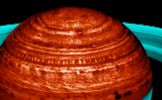
Saturn-PIA01941.jpgInfrared Saturn68 visiteIn this image, Saturn's fascinating meteorology manifests itself in a "string of pearls" formation, spanning over 60.000 Km (about 37.000 miles). Seen in new images acquired by Cassini's VIMS (Visual and Infrared Mapping Spectrometer) and lit from below by Saturn's internal thermal glow, the bright "pearls" are actually clearings in Saturn's deep cloud system. More than two dozen occur at 40° North Latitude. Each clearing follows another at a regular spacing of some 3,5° in Longitude.
This is the first time such a regular and extensive train of cloud-clearings has been observed. The regularity indicates that they may be a manifestation of a large planetary wave. Scientists plan to take more observations of this phenomenon over the next few years to try to understand Saturn's deep circulation systems and meteorology. This image was taken on April 27, 2006.
|
|

TRA_000827_1875_IRB.jpgCerberus' River68 visiteThe prominent trough in this sub-image (of HiRISE image TRA_000827_1875_IRB ) is a segment of the Cerberus Fossae rift system. In geological terminology the trough is known as a graben, or down-dropped region bounded by faults. In this location the graben is about 300 m wide and 90 m deep. Bright, dust-covered, cratered plains surround the graben, and darker sediments blanket much of its floor. Dunes that vary in size and spacing occur within the darker sediments, and their shapes suggest that the wind typically blows from east to west. Light-toned, angular boulders pepper the darker sediments. They have broken away from the rocky walls of the graben and tumbled downhill. Over time this mass wasting has caused the cliffs to retreat, widening the trough. The somewhat lighter patches of cratered terrain on the graben floor were once level with the surrounding plains, but have since been lowered by faulting. Over time they may become obscured or buried by the darker sediments. High-standing ridgesÑremnants of the former surfaceÑcast jagged shadows on the floor of the graben that reveal the rugged nature of the landscape in this region of Mars.
Image TRA_000827_1875 was taken by the High Resolution Imaging Science Experiment (HiRISE) camera onboard the Mars Reconnaissance Orbiter spacecraft on September 29, 2006. The complete image is shown below, centered at 7.4 degrees latitude, 168.5 degrees East longitude. The range to the target site was 275 km (171 miles). At this distance the image scale is 55 cm/pixel (with 2 x 2 binning) so objects ~165 cm across are resolved. The image shown below has been map-projected to 50 cm/pixel and north is up. The image was taken at a local Mars time of 3:26 PM and the scene is illuminated from the west with a solar incidence angle of 51.9 degrees, thus the sun was about 38.1 degrees above the horizon. At a solar longitude of 113.7 degrees, the season on Mars is Northern Summer / Southern Winter.
|
|

088-SOL932-McMurdo_L257F-A814R1_cbr2-01.jpgMc Murdo Panorama (2)68 visiteCaption NASA originale:"Spirit has stayed busy at Winter Haven during the past six months even without driving.
In addition to acquiring this spectacular panorama, the Rover Team has also acquired significant new assessments of the elemental chemistry and mineralogy of rocks and soil targets within reach of the rover's arm. The team plans soon to have Spirit drive to a very nearby spot on Low Ridge to access different rock and soil samples while maintaining a good solar panel tilt toward the Sun for the rest of the Martian Winter.
Despite the long span of time needed for acquiring this 360° view - a few images at a time every few Soles over a total of 119 Soles because the available power was so low -- the lighting and color remain remarkably uniform across the mosaic".
|
|

ORIGINAL NASA APOLLO 14 - AS14-70-9835.jpgAS 14-70-9835 - Transient Lunar Phoenomoena? (1)68 visitenessun commento
|
|

APOLLO 11 AS 11-44-6689HR.jpgAS 11-44-6689 (HR)68 visite
|
|
APOLLO 14 AS 14-67-9388HR.jpgAS 14-67-9388 (HR)68 visite
|
|
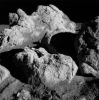
APOLLO 14 AS 14-68-9452HR.jpgAS 14-68-9452 (HR)68 visite
|
|

m10_aom_21.jpgThe "burning" Caloris Basin (HR)68 visiteThe largest basin on Mercury (about 1300 Km - or 800 miles across) was named Caloris (Latin for "heat") because it is one of the two areas on the Planet that face the Sun at perihelion.
The Image Processing Lab at NASA's Jet Propulsion Laboratory produced this photomosaic using computer software and techniques developed for use in processing planetary data.
The Mariner 10 spacecraft imaged this Region during its initial flyby of the Planet.
|
|

SOL1016-2N216557626EFFAS07P0170L0M1.jpgRover tracks and old salt... (1) - Sol 101668 visitenessun commentoMareKromium
|
|
| 25353 immagini su 2113 pagina(e) |
 |
|
|
|
|
971 | |
|
|
|
|





