| Piú viste |

Venus-South Pole-PioneerVenus_South%20PoleVortex_H.jpgThe South Pole of Venus (again)68 visiteThese two images of Venus’s South Pole were taken by NASA’s Mariner 10 (during a Venus fly-by on its way to Mercury) and Pioneer Venus Missions during the early 1970s and 1980s, respectively.
The images provided the first glimpses about a stormy atmospheric behaviour at the south pole of the planet.
|
|
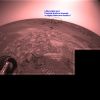
OPP-SOL423-1F165742153EFF52GKP1215L0M1~0.jpgLittle Bright Spot (1) - context image, false colors - Sol 42368 visitenessun commento
|
|
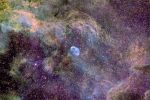
NGC-6888-03.jpgNGC 6888 - The "Bubble Nebula"68 visite"...Keep me as the apple of Your eye; hide me under the shadow of Your wings..."
Psalm 17:8
|
|
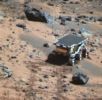
SOU-SOL030.jpgSoujourner rolls over "Mermeid Dune" - Sol 3068 visitenessun commento
|
|

OPP-SOL881-1P206393606EFF74AZP2550R1M1.jpgShell-Rock - Sol 88168 visiteSelezionata dal Dr Barca, un'immagine splendida, ricca di dettagli e di spunti di riflessione: Shell Rock, una delle infinite - ma sempre intriganti ed affascinanti - "pseudo-rocce" Marziane.
|
|

UMBRIEL-vg2_p29502-A.jpgUmbriel's extremely unusual surface feature (HR - context image)68 visiteIl rilievo (che definire "fortemente anomalo" è riduttivo) che caratterizza il versante prossimo al Polo Nord di Umbriel è, almeno dalle immagini che sono in nostro possesso, del tutto inesplicabile.
Alcuni Ricercatori (anche nel Gruppo Lunar Explorer Italia) ipotizzano che si tratti di una montagna dalle dimensioni davvero incredibili (almeno in rapporto al corpo celeste a cui essa accede - immaginate come il Monte Everest apparirebbe dallo spazio se fosse alto 70 o più Km e largo 300, tanto per rendere l'idea...), mentre altri Studiosi ritengono che quello che si vede in questa immagine è solo il risultato di una deformazione del frame la quale potrebbe essere imputabile ad un vizio di trasmissione e/o di ricevimento ed elaborazione dati (il che equivarrebbe a dire che il rilievo in questione non esiste).
Altri ancora interpretano questo rilievo come una "plume" vulcanica (?) o una gigantesca formazione nuvolosa.
Purtroppo, il mistero non sarà risolto tanto facilmente...
|
|

Rings-PIA08241.jpgDifferent Light, Different Brightness, Different Motion...68 visiteCaption NASA:"This close-up view of the inner A-Ring shows intriguing variations in brightness along the direction of the Ring motion - from top to bottom. Close examination reveals dark regions that appear to widen and then narrow, and thin bright regions that disappear altogether.
Variations in brightness are to be expected in the direction of increasing orbital distance from Saturn, but variations along the azimuthal (or circumferential) direction are unusual, as they should be smoothed out quickly by ring particle motion.
Note: the faint "doughnut" left of center and the dark area in the lower right corner are imaging artifacts.
The image was taken in visible light with the Cassini spacecraft narrow-angle camera on July 23, 2006 at a distance of approx. 285.000 Km (about 177.000 miles) from Saturn. Image scale is about 1 Km (0,6 mile) per pixel".
|
|
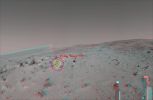
SOL391-A-site_AA3_navcam_180_cyp_A-A391R1-A~0.jpg3D or not 3D? That is the question... (1) - Sol 39168 visiteDa una segnalazione davvero unica - perchè il dettaglio in questione era quasi del tutto impercettibile - del Dr Gianluigi Barca, abbiamo finalmente l'occasione di dire un paio di cose sui frames tridimensionali. C'è chi li ama e chi - diciamo così... - non li apprezza; c'è chi li ritiene fondamentali per qualsiasi ricerca (come il nostro grande Amico, il Dr Alessio Feltri) e chi, come il Presidente di Lunar Explorer Italia e buona parte della STAFF, li reputa - invece e semplicemente - "interessanti, belli e decorativi", ma ben lungi dall'essere decisivi ed inoltre - spesso - fuorvianti.
Chi ha ragione? Come sapete, la "vista" - e su questo diamo ampiamente ragione al Dr Feltri - è un senso "ingannevole", ma è pur vero che una vista "allenata e pragmatica" è sicuramente di grande aiuto nel cammino di qualsiasi Studioso (o anche solo Appassionato) di Scienze Planetarie e di Ricerca delle Anomalìe.
|
|

APOLLO 15 AS 15-0757.jpgAS 15-0757 - Tsiolkovsky68 visiteTsiolkovsky is one of the most prominent features on the Far-Side of the Moon. It is a 1 90-Km- wide impact crater with a large, complex central peak that is offset from the apparent center of the crater. Differences in tone and texture between the central peak, the lava-flooded floor, the terraced walls and the ejecta blanket are dramatically displayed in this oblique view. The ejecta blanket is dominated by a coarse pattern of ridges radiating outward from the crater; superposed on this pattern are many small level pools of smooth material that are much lighter than the otherwise similar smooth dark mare in the floor of Tsiolkovsky. The pools probably originated differently. They may consist of rock that was melted by the heat and pressure generated during the impact event and that flowed into depressions before it hardened.
Cratering experiments on Earth have shown that central peaks consist of bedrock that has been displaced upward by a distance equal to about 1/10th the diameter of the resulting crater. If samples could be obtained from the central peak at Tsiolkovsky, they might be rocks that were 20 km below the Moon's surface before Tsiolkovsky was created.
|
|

Europa-HR.jpgEuropa (full disk - HR)68 visitenessun commento
|
|
OPP-SOL923-1F210121681ESF758ZP1298R0M1-2.jpgA possible answer to the "greenish" color of Meridiani (2) - Sol 92368 visiteLa materia è interessante e complessa e quindi, con ogni probabilità, dedicheremo (pubblicandolo su TruePlanets) un piccolo articolo a questa specifica problematica.
Ad ogni modo (in capi ultra-sommari), anche se l'articolo pubblicato da Science fa specifico riferimento alla Regione di Gusev Crater, alcune estrapolizioni valide anche per Meridiani Planum possono essere fatte. Su tutte, una: esistono e si verificano su Marte, effettivamente (ed in determinate condizioni), delle precipitazioni.
Ma il concetto di "precipitazione", per Marte, pare acquisire un significato diverso, poichè non si tratta di pioggia, bensì di neve o brina (snow or frost). Questo produce la formazione di uno strato sottile (una micro-lastra di pochi mm) di ghiaccio d'acqua sulla superficie. Uno strato che, in condizioni ottimali di irraggiamento ed umidità relativa dell'atmosfera, fonde, producendo una "pellicola d'acqua" la quale copre, letteralmente, ampie regioni di Marte per periodi di tempo variabili: dai pochi minuti, alle svariate ore.
|
|
OPP-SOL931-1N210838794EFF75__P0685L0M1.jpgPanorama (4): Emma Dean Crater - Sol 93168 visitenessun commento
|
|
| 25353 immagini su 2113 pagina(e) |
 |
|
|
|
|
960 | |
|
|
|
|





