| |
| Piú viste |

Saturn-PIA12825.jpgSaturnian Storm (False Colors; credits: NASA/JPL-Caltech/Space Science Institute)70 visiteCaption NASA:"These false-color images from NASA's Cassini Spacecraft chronicle a day in the life of a huge storm that developed from a small spot that appeared 12 weeks earlier in Saturn's Northern Mid-Latitudes.
This storm is the largest and most intense observed on Saturn by NASA's Voyager or Cassini Spacecraft. The storm is still active. As seen in these and other Cassini images, the storm encircles the Planet - whose circumference at these latitudes is approx. 186.000 miles (about 300.000 Km).
From North to South, it covers a distance of about 9000 miles (approx. 15.000 Km), which is one-third of the way around the Earth. It encompasses an area of about 1,5 BSMs (Billion Square Miles - such as approx. 4 BSKM), or eight times the surface area of Earth. This storm is about 500 times the area of the biggest of the Southern Hemisphere storms observed by Cassini.
The highest clouds in the image are probably around 100 millibars pressure, or 60 miles (approx. 100 Km) above the regular undisturbed clouds. These false colors show clouds at different altitudes. Clouds that appear blue here are the highest and are semitransparent, or optically thin. Those that are yellow and white are optically thick clouds at high altitudes. Those shown green are intermediate clouds. Red and brown colors are clouds at low altitude unobscured by high clouds, and the deep blue color is a thin haze with no clouds below. The base of the clouds, where lightning is generated, is probably in the water cloud layer of Saturn's Atmosphere. The storm clouds are likely made out of Water Ice covered by crystallized Ammonia.
Taken about 11 hours -- or one Saturn day -- apart, the two mosaics in the lower half of this image product consist of 84 images each. The mosaic in the middle was taken earlier than the mosaic at the bottom. Both mosaics were captured on Feb. 26, 2011, and each of the two batches of images was taken over about 4,5 hours.
Two enlargements from the earlier, middle mosaic are shown at the top of this product. The white lines below the middle mosaic identify those parts of the mosaic that were enlarged for these close-up views. The enlargement on the top left shows the head of the storm, and that on the top right shows the turbulent middle of the storm. Cassini observations have shown the head of the storm drifting West at a rate of about 2,8° of Longitude each Earth day (28 meters per second, or 63 miles per hour). The central latitude of the storm is the site of a Westward jet, which means that the clouds to the North and South are drifting Westward more slowly or even drifting eastward. In contrast, clouds at Saturn's Equator drift Eastward at speeds up to 450 meters per second (about 1000 miles per hour).
Both of the long mosaics cover an area ranging from about 30° to 51° North Latitude. The views stretch from about 138° (on the left) to 347° West Longitude (on the right), passing through 360/0° West Longitude near the far right of the mosaics.
The images were taken with the Cassini Spacecraft narrow-angle camera using a combination of spectral filters sensitive to wavelengths of Near-InfraRed light. The images filtered at 889 nanometers are projected as blue. The images filtered at 727 nanometers are projected as green, and images filtered at 750 nanometers are projected as red.
The views were acquired at a distance of approx. 1,5 MMs (such as about 2,4 MKM) from Saturn and at a Sun-Saturn-Spacecraft Angle (i.e.: Phase Angle) of 62°. Both the top and bottom images are simple cylindrical map projections, defined such that a square pixel subtends equal intervals of Latitude and Longitude. At higher Latitudes, the pixel size in the North-South direction remains the same, but the pixel size in the East-West direction becomes smaller. The pixel size is set at the Equator, where the distances along the sides are equal. The images of the long mosaics have a pixel size of 33 miles (53,108 Km) at the Equator, and the two close-up views have a pixel size of 6 miles (9,656 Km) per pixel at the equator".MareKromium
|
|
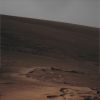
OPP-SOL2840-1P380322738EFFBR43P2443L1M1-PCF-LXTT.jpgPanorama from "Greeley Haven" - Sol 2840 (Absolute Natural Colors; credits for the additional process. and color.: Dr Paolo C. Fienga - Lunexit Team)70 visitenessun commentoMareKromium
|
|

SOL0003-ML0000034000E1_DXXX-0003ML0000039000E1_DXXX-GB-PCF-LXTT-2.jpgGale's Horizon, part II - Sol 3 (an Image Mosaic in Calibrated Natural Colors; credits for the additional process. and color.: Dr Gianluigi Barca - Lunar Explorer Italia/Italian Planetary Foundation)70 visitenessun commentoMareKromium
|
|
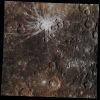
ZZ-Mercury-Craters-Mena_and_Cezanne_Crater-PIA16341-PCF-LXTT-IPF.jpgMena and Cezanne Crater (Absolute Natural Colors; credits for the additional process. and color.: Dr Paolo C. Fienga/Lunar Explorer Italia/Italian Planetary Foundation)70 visiteIn this Image-Mosaic, the Bright Rays of Mena Crater and the distinctive color difference of Cezanne Crater (with the surrounding area) are well highlighted. These two distinctive Impact Features provide beautiful contrast to this Absolute Natural Color image, giving the viewer more insight into reflectance variations (---> Albedoes) on Mercury's Surface. Also note the extremely old, degraded and larger, infilled Unnamed Crater visible on the center right of the frame, which is crossed by at least three major Crater Chains.
Date acquired: June 04, 2012
Image Mission Elapsed Time (MET): 247336883, 247336875, 247336879
Image ID: 1955368, 1955366, 1955367
Instrument: Wide Angle Camera (WAC) of the Mercury Dual Imaging System (MDIS)
WAC filters: 9, 7, 6 (996, 748, 433 nanometers) in red, green, and blue
Center Latitude: 3,78° South
Center Longitude: 235,8° East
Resolution: 552 meters/pixel
Scale: Cezanne Crater, such as the Crater in the bottom center, is about 67 km (approx. 41 miles) in diameter.
Solar Incidence Angle: 55,6° (meaning that the Sun was about 34,4° above the imaged Local Horizon at the time the pictures were taken)
Emission Angle: 0,0° (meaning that the MESSENGER Spacecraft, at the time that the pictures were taken, was absolutely perpendicular to the Mercurian Surface visible in the center of the frame)
Sun-Mercury-MESSENGER (or "Phase") Angle: 55,6°MareKromium
|
|

Fractures-Nili_Fossae-PIA16328-PCF-LXTT-IPF.jpgFeatures of Nili Fossae (Absolute Natural Colors; credits for the additional process. and color.: Dr Paolo C. Fienga/Lunar Explorer Italia/Italian Planetary Foundation)70 visiteOrbit Number: 47309
Latitude: 22,6009° North
Longitude: 78,9741° East
Instrument: VIS
Captured: August, 13, 2012MareKromium
|
|
Craters-Trouvelot_Crater-PIA16641-PCF-LXTT-IPF.jpgThe Dunefield inside Trouvelot Crater (Absolute Natural Colors; credits for the additional process. and color.: Dr Paolo C. Fienga/Lunar Explorer Italia/Italian Planetary Foundation)70 visiteOrbit Number: 47874
Latitude (centered): 16,1118° North
Longitude (East): 346,733°
Instrument: VIS
Captured: September, 29th, 2012MareKromium
|
|
Aeolian_Features-Windstreaks-AM-PIA16513-PCF-LXTT-IPF.jpgWindstreaks on the S/W Flank of Alba Mons (Absolute Natural Colors; credits for the additional process. and color.: Dr Paolo C. Fienga/Lunar Explorer Italia/IPF)70 visiteOrbit Number: 47653
Latitude (centered): 34,8278° North
Longitude (East): 241,838°
Instrument: VIS
Captured: September, 9th, 2012MareKromium
|
|

Titan-N00200168-752-EB-MF-LXTT-IPF.jpgColourful Titan (Superdefinition and Extremely Enhanced Natural Colors; credits for the additional process. and color.: Elisabetta Bonora and Marco Faccin/Lunar Explorer Italia/Italian Planetary Foundation) 70 visitenessun commentoMareKromium
|
|

ZZ-Mercury-Craters-Pahinui_Crater-PIA16903-PCF-LXTT-IPF.jpgPahinui Crater (Absolute Natural Colors - Credits for the additional process. and color.: Dr Paolo C. Fienga/Lunar Explorer Italia/Italian Planetary Foundation)70 visiteOne of 9 (nine) newly named Mercurian Impact Craters, Pahinui, has intriguing Collapse-looking Pits surrounding its Central Peak. Pahinui Crater ha been so named after the Hawaiian musician Gabby Pahinui, a key figure in the 1970s Hawaiian Renaissance and master of the "slack-key guitar", a style that originated in Hawaii.
This image was acquired by the NASA - MESSENGER Spacecraft as part of the Mercury Dual Imaging System (MDIS)'s High-Resolution Surface Morphology Base Map. The Surface Morphology Base Map covers more than 99% of Mercury's Surface with an average resolution of 200 meters/pixel. Images acquired for the Surface Morphology Base Map typically are obtained at off-vertical Sun Angles (i.e.: high Solar Incidence Angles and therefore low Sun shining over the imaged Local Horizon) and have visible Shadows so as to reveal clearly the Topographic Form of many Geologic Features.
Date acquired: July, 31st, 2011
Image Mission Elapsed Time (MET): 220635824
Image ID: 575089
Instrument: Narrow Angle Camera (NAC) of the Mercury Dual Imaging System (MDIS)
Center Latitude: 28,30° South
Center Longitude: 146,90° East
Resolution: 139 meters/pixel
Solar Incidence Angle: 77,3° (meaning that the Sun, at the time that the picture was taken, was about 12,7° above the imaged Local Mercurian Horizon)
Emission Angle: 22,5°
Sun-Mercury-Messenger (or "Phase") Angle: 99,9°
This picture (which is an Original NASA - MESSENGER Spacecraft b/w frame published on the NASA - Planetary Photojournal with the ID n. PIA 16903) has been additionally processed and then colorized in Absolute Natural Colors (such as the colors that a human eye would actually perceive if someone were onboard the NASA - MESSENGER Spacecraft and then looked down, towards the Surface of Mercury), by using an original technique created - and, in time, dramatically improved - by the Lunar Explorer Italia Team. Different colors, as well as different shades of the same color, mean, among other things, the existence of different Elements (Minerals) present on the Surface of Mercury, each having a different Albedo (---> Reflectivity) and Chemical Composition.MareKromium
|
|

ZZ-Mercury-Craters-Tyagaraja_Crater-PIA17051-PCF-LXTT-IPF-2.jpgTyagaraja Crater (EDM - Absolute Natural Colors; credits for the additional process. and color.: Dr Paolo C. Fienga/Lunar Explorer Italia/Italian Planetary Foundation)70 visiteThis colorful picture of Tyagaraja Crater (which is about 97 Km - such as approx. 60,23 miles - in diameter) and its surroundings shows us many different types of Material that exist on the Surface of Mercury. For instance, the very bright, white areas visible on the Floor of the Crater (in particular to the North/East, at about 3 o'clock) are the very "famous" (and common, on Mercury) Hollows; as a matter of fact, they are so much brighter than the surrounding Areas that they appear slightly over-saturated in this particular image.
The yellow/red/orangish spots located near the center of the Crater are, most likely, Volcanic Materials which surround a Pyroclastic Vent. Last, but not least, the very Dark Material (almost black) that is visible all around Tyagaraja Crater (and, particularly, towards the South/Western Regions surrounding Tyagaraja - such as the areas located in the lower left (Sx) side of the frame) is Low Reflectance Material (LRM).
Just out of curiosity, if you look carefully at the outline of Tyagaraja Crater, you may notice that its shape is quite unusual for a Primary Impact Crater: in fact, its shape it is not a "circle", but rather an (almost regular, on its Western side) "hexagon". Also, the Inner Slopes of the Crater show clear evidence of multiple Layers (and such a circumstance, at least for the time being, is really hard, for Planetary Scientists, to fully understand and explain).
Date acquired: April 25th, 2013
Images Mission Elapsed Time (MET): 9232956, 9232948, 9232944
Images ID: 3950118, 3950116, 3950115
Instrument: Wide Angle Camera (WAC) of the Mercury Dual Imaging System (MDIS)
Center Latitude: 3,94° North
Center Longitude: 211,20° East
Resolution: 22 meters/pixel
Solar Incidence Angle: 13,4° (meaning that the Sun, at the time that the picture was taken, was about 76,6° above the imaged Local Mercurian Horizon)
Emission Angle: 18,0°
Sun-Mercury-Messenger (or "Phase") Angle: 31,5°
This picture (which is an Original NASA - MESSENGER Spacecraft Map Projected false color image-mosaic published on the NASA - Planetary Photojournal with the ID n. PIA 17051) has been additionally processed, cropped, contrast enhanced, magnified and then re-colorized in Absolute Natural Colors (such as the colors that a human eye would actually perceive if someone were onboard the NASA - MESSENGER Spacecraft and then looked down, towards the Surface of Mercury), by using an original technique created - and, in time, dramatically improved - by the Lunar Explorer Italia Team. Different colors, as well as different shades of the same color, mean, among other things, the existence of different Elements (Minerals) present on the Surface of Mercury, each having a different Albedo (---> Reflectivity) and Chemical Composition.MareKromium
|
|

Chasmas-Coprates_Chasma-PIA17224-PCF-LXTT-IPF.jpgFeatures of Coprates Chasma (Absolute Natural Colors; credits for the additional process. and color.: Dr Paolo C. Fienga/Lunar Explorer Italia/Italian Planetary Foundation)70 visiteIn this VIS image, taken by the NASA - Mars Odyssey Orbiter on March, 11, 2013 and during its 49.862nd orbit around the Red Planet, we can see that a large Landslide Deposit fills a portion of the Floor of Coprates Chasma: a huge and extremely long Canyon located the Coprates Quadrangle of Mars, at 13,4° South Latitude and 61,4° West Longitude. Coprates Chasma (---> the Abyss of Coprates) is part of the enormous Valles Marineris Canyon System and its length is of approx. 966 Km (such as about 599,88 miles).
Latitude (centered): 12,850° South
Longitude (centered): 293,254° East
Instrument: VIS
This frame (which is an Original Mars Odyssey Orbiter b/w frame published on the NASA - Planetary Photojournal with the ID n. PIA 17224) has been additionally processed, magnified, contrast enhanced and then colorized in Absolute Natural Colors (such as the colors that a human eye would actually perceive if someone were onboard the NASA - Mars Odyssey Orbiter and then looked down, towards the Surface of Mars), by using an original technique created - and, in time, dramatically improved - by the Lunar Explorer Italia Team.MareKromium
|
|

ZZ-Mercury-Craters-Neruda_Crater-PIA17515-PCF-LXTT-IPF-0.jpgNeruda Crater (CTX Frame - Absolute Natural Colors; credits for the additional process. and color.: Dr Paolo C. Fienga/Lunar Explorer Italia/Italian Planetary Foundation)70 visiteThis frame features the Mercurian Impact Crater named "Neruda", after the Chilean poet Pablo Neruda (born on July, 12, 1904 in Parral - Chile - and died on September, 23, 1973 in the Chilean State's Capital, Santiago). As you can see, this Impact Crater (whose diameter is approx. 112 Km - such as about 69,55 miles) exhibits several Central Peaks punctuated by a few more recent, small Craters, resulting in a rugged Surface mostly made of ups and downs (and now think how difficult it would be if one hypothetical Astronaut decided - or just needed - to traverse the whole Crater's highly irregular Floor...). Similarly, the Crater's namesake Pablo Neruda experienced a number of ups and downs in his life, from success as a poet, through poverty, war and ultimately alleged poisoning.
Date acquired: July, 24th, 2012
Image Mission Elapsed Time (MET): 251577944
Image ID: 2256593
Instrument: Narrow Angle Camera (NAC) of the Mercury Dual Imaging System (MDIS)
Center Latitude: 52,20° South
Center Longitude: 125,30° East
Solar Incidence Angle: 80,4° (meaning that the Sun, at the time that the picture was taken, was about 9,6° above the imaged Local Mercurian Horizon)
Emission Angle: 2,4°
Sun-Mercury-Messenger (or "Phase") Angle: 78,0°
This picture (which is an Original NASA - MESSENGER Spacecraft's b/w and Map-Projected image published on the NASA - Planetary Photojournal with the ID n. PIA 17515) has been additionally processed, contrast enhanced, magnified and then colorized in Absolute Natural Colors (such as the colors that a human eye would actually perceive if someone were onboard the NASA - MESSENGER Spacecraft and then looked down, towards the Surface of Mercury), by using an original technique created - and, in time, dramatically improved - by the Lunar Explorer Italia Team. Different colors, as well as different shades of the same color, mean, among other things, the existence of different Elements (Minerals) present on the Surface of Mercury, each having a different Albedo (---> Reflectivity) and Chemical Composition.MareKromium
|
|
| 25353 immagini su 2113 pagina(e) |
 |
|
|
|
|
949 | |
|
|
|
|
|
|





