| Piú viste |
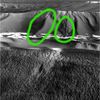
OPP-SOL644-1P185354383EFF6444P2567R7M1.jpgThe incredible "Dunes" around Erebus Crater (2) - Sol 64469 visiteOriginal caption:"Right Pan-Cam Non-linearized Full frame EDR acquired on Sol 644 of Opportunity's mission to Meridiani Planum at approximately 11:21:46 MLT. Camera commanded to use Filter 7 (1009 nm)".
|
|
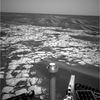
OPP-SOL645-1N185448956EFF64BNP1605L0M1.jpgThe big "dunes" near Erebus Crater - Sol 64569 visitenessun commento
|
|

Itokawa-05.jpgOrbiting around Itokawa (2)69 visiteHayabusa is a technology demonstration spacecraft focusing on key technologies that are required for future large-scale sample and return missions, yet is also making new scientific observations and discoveries. The technology demonstration component of the mission consists of 5 goals:
1) ion engine propulsion in interplanetary cruise;
2) ion engine propulsion in combination with an Earth gravity assist;
3) autonomous guidance and navigation using optical measurements;
4) collection of surface samples in an ultra-low gravity environment and
5) the direct recovery of these samples on the ground after its return from interplanetary flight.
To date the Hayabusa project has accomplished these demonstrations up through
the third goal.
|
|

Supernova1987A-03-05.jpgSupernova 1987A69 visite"...Language is a system of interdependent terms in which the value of each term results solely from the simultaneus presence of the others..."
Ferdinand de Saussure (1857-1913) - "Course in General Linguistics"
|
|
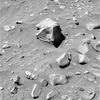
SOL672-2P186025811EFFAJQVP2260L5M1.jpgUnusual-looking stone - Sol 67269 visitenessun commento
|
|

Pandora-PIA07647.jpgPandora and the F-Ring69 visiteThis dramatic image shows Saturn's craggy (---> rocciosa, colma di dirupi) moon Pandora skimming (to skim---> rasentare, sfiorare) along the F-Ring's outer edge.
Pandora orbits about 1.000 Km (approx. 620 miles) exterior to the Ring, but, in this view, is projected onto the Ring.
The moderately high-resolution of the image reveals the moonlet's odd shape.
The image was acquired from less than 1 degree below the Ring-Plane and taken in visible light with the Cassini spacecraft narrow-angle camera on Oct. 29, 2005, at a distance of approx. 455.000 Km (roughly 283.000 miles) from Pandora. The image scale is 3 Km (about 2 miles) per pixel.
|
|

OPP-SOL669-1P187594729EFF64KCP2426L4M1.jpgHuge waves of sand! - Sol 66969 visiteOriginal caption:"Left Pan-Cam Non-linearized Full frame EDR acquired on Sol 669 of Opportunity's mission to Meridiani Planum at approx. 17:02:37 MLT.
Camera commanded to use Filter 4 (601 nm)".
|
|

Syrius.jpgSirius A and Sirius B69 visite"…Nel corso della mia vita ho conosciuto tante persone e con molte di queste, i rapporti sono stati tali da non farmele restare estranee nel ricordo, eppure, non ho memoria di un dispiacere vero e profondo quando mi è giunta notizia che una di queste persone era morta. E' piuttosto la notizia a lasciarmi per qualche attimo pensieroso, non il dolore.
Non posso fare a meno di prendere le distanze dall’idea della Morte come atto distruttivo e conclusivo, che fa piangere la sorte di chi ha perso la sua battaglia con la Vita.
Comprendo il dolore che nasce dalla consapevolezza che un pezzo di noi si è staccato e lasciati per sempre, ma credo che piangiamo in maggior misura la nostra condizione di orfani, le nostre paure, i nostri rimorsi ed il nostro egoismo..."
Giuseppe Spina - "L'Altra Vita"
|
|

Craters-Airy_Crater-The_Prime_Meridian-0.JPGMars' Prime Meridian, such as: Longitude "0" (1 - Original NASA/MGS/MSSS CTX b/w Frame)69 visiteOn Earth, the Longitude of the Royal Observatory in Greenwich, England is defined as the "Prime Meridian" or the 0 point of Longitude. Locations on Earth are measured in degrees East or West from this position.
The Prime Meridian was defined by an International Agreement in 1884 as the position of the Transit Circle: a large telescope located in the Observatory's Meridian Building. The Transit Circle was built by Sir George Biddell Airy, the 7th Astronomer Royal, in 1850. While visual observations with Transit were the basis of navigation until the space age, it is interesting to note that the current definition of the Prime Meridian is in reference to orbiting satellites and Very Long Baseline Interferometry (VLBI) measurements of distant radio sources such as quasars.
However, said "International Reference Meridian" is now about 100 mt East of the Transit Circle at Greenwich.
For Mars, the Prime Meridian was first defined by German astronomers W. Beer and J. H. Mädler in 1830-32.
|
|

SOL589.gifFlat-Face is winkin' at us? - Sol 58969 visiteUna bellissima interpretazione di una Roccia Marziana "mutante", come sempre operata dal Dr Feltri.
Nota: tutte le ricostruzioni operate dal Dr Feltri (come da qualsiasi altro Ricercatore) che vengono pubblicate sul Sito Lunar Explorer Italia, sono ottenute con frames NASA originali NON elaborati nè digitalmente riveduti e/o corretti (diciamo "migliorati").
Questo significa che le cose "strane" che vedete, sono "strane" in Natura, su Marte, e non sono il risultato di una qualche elaborata ricostruzione realizzata usando dei super-softwares o quant'altro. Che poi la NASA, l'ESA e tanti altri Scienziati che operano in questo campo "non riescano a vedere niente di strano"...Beh, questo è un problema loro, non nostro.
Non credete?!?...
|
|
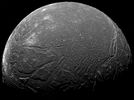
Ariel.jpgAriel (HR)69 visiteLa tormentata superficie di Ariel si rivela in tutto il suo (comunque grande) fascino.
Una serie di impressionanti fratture tettoniche (forse un raffreddamento troppo rapido?) caratterizza l'Est e l'Ovest di questo mondo lontano; svariati mega-canyons, lunghi e profondi, passano attraverso l'equatore di Ariel, frammentandosi e ramificandosi poi in centinaia di crepacci minori; distese simili ai "mari" della Luna contraddistinguono una buona parte della sua superficie la quale, inoltre, sembra avere delle aree (alla Vostra Sx - Eastern limb) la cui albedo (alta) appare molto diversa rispetto al resto del Pianeta.
Da notare che, a differenza di quanto accade per le altre lune di Urano (come per la maggior parte delle lune dei quattro Giganti Gassosi), non riusciamo a distinguere che un modesto numero di crateri da impatto e questa circostanza è sicuramente strana: che Ariel sia passata, magari, attraverso una parziale e "recente" (in senso geologico) ridefinizione della sua superficie?
|
|

OPP-SOL710-1P191228320ESF64KSP2584L6M1.jpgSparks in the outcrop - Sol 71069 visiteCerchiatura Rossa: il tipico photo-artifact (che abbiamo chiamato "goccia di luce" - light-drop) che riscontriamo tutte le volte in cui viene ripreso un rilievo altamente riflettente (p.e.: una parte metallica del Rover; l'Heat-Shield o delle rocce contenenti - probabilmente - dei minuscoli cristalli).
|
|
| 25353 immagini su 2113 pagina(e) |
 |
|
|
|
|
946 | |
|
|
|
|





