| Piú viste |
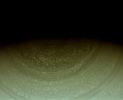
Saturn-PIA10568.jpgNorth Polar Hues (possible Natural Colors; credits: Lunar Explorer Italia)70 visiteCpation NASA:"Cassini imaging scientists have waited years for the Sun to reveal the Hexagonal Wave Pattern (a.k.a.: The Hexagon) in the clouds of Saturn's North Pole, part of which can be seen at the top of this image from the Cassini Spacecraft. This mosaic combines four separate near-InfraRed images to show one full side of the Hexagon and two partial sides cut off by shadow.
When the Spacecraft arrived in 2004, Winter darkened the North Pole. As the Planet continues its 29-year orbit, the Sun sheds more light on northern features and uncovers more of this strange, long-lived formation first observed in Voyager images of the illuminated Northern Pole from the early 1980's.
False color images made from data collected by Cassini's Visual and InfraRed Mapping Spectrometer (VIMS) have previously captured the full six-sided pattern in the IR Light. (See PIA09188)
South of the Hexagon at least five large storm systems can be seen spinning in a sea of smaller storms.
The image was taken with the Cassini Spacecraft wide-angle camera on Dec. 1, 2008 using a spectral filter sensitive to wavelengths of near-iIR Light centered at 752 nanometers. The view was obtained at a distance of approx. 712.000 kilometers (442,000 miles) from Saturn and at a Sun-Saturn-spacecraft, or phase, angle of 69 degrees. Image scale is 39 Km (such as about 24 miles) per pixel".MareKromium
|
|

SOL483-2N169237348ESFAAB2P1560L0M1.jpgGusev Skyline - Sol 483 (Natural Colors; credits: Lunar Explorer Italia)70 visitenessun commentoMareKromium
|
|
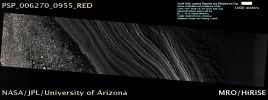
PSP_006270_0955_RED_abrowse~0.jpgSouth Polar Layered Deposits and Residual Ice Cap (natural colors; credits: Lunexit)70 visiteA wide variety of South Polar Terrains are on display in this spectacular HiRISE image. The reddish material on the left of the image is the SPLD. These deposits are a stack of layered, dusty water ice. Scientists believe that these layers record previous climatic conditions on Mars, much like terrestrial ice-sheets provide a record of climate change on the Earth.
This image shows the face of one of the many scarps or shallow cliffs that cut into the SPLD. These scarps expose the internal layers within the SPLD. You can see these climate-recording layers in the last2/3rds of the image, left side, running from lower-left to upper-right.
The terrain in the last third of the image is quite different in both appearance and composition. The bright, white-ish material is a thin covering of CO2 ice draped over the flat areas of the SPLD. This covering of CO2 is being eroded away by expanding flat-floored pits. Parts of the floors of these pits show the reddish brown coloring of the underlying SPLD.
These pits have eroded the CO2 ice layer to such an extent that only isolated mesas remain today and even these shrink in extent by a few meters each year.
These mesas also have several layers within them, indicting that they likely contain a climatic record, albeit a much shorter one than preserved in the SPLD.
Most of the isolated mesas have white-ish tops; however, some (near the foot of the SPLD scarp) have reddish tops. This may either be due to bright CO2 ice thinning to reveal the older (and darker) CO2 ice that makes up the main body of the mesa, or perhaps dust has settled out of the atmosphere to cover the brighter frost.
Remember that there was a large Martian Dust Storm earlier this year which could have caused either effect.MareKromium
|
|

Neptune-StrechedNaturalColors.JPGNeptune and a few of His Moons (Voyager 2 - Natural, but enhanced, Colors; credits: NASA)70 visiteCaption NASA:"Voyager 2 was the first spacecraft to observe the planet Neptune and its two satellites: Triton, the largest, and Nereid.
The most obvious feature of the Planet is its blue color, the result of Methane in the Atmosphere. Research continues on Neptune's two largest satellites and the additional 6 that were discovered by Voyager 2's investigation". MareKromium
|
|

Prometheus-PIA10593.jpgStreamer Channel (Natural Colors; credits: Lunar Explorer Italia)70 visiteCaption NASA:"Half an hour after Prometheus tore into this region of Saturn's F -Ring, the Cassini Spacecraft snapped this image just as the moon was creating a new Streamer in the Ring. The dark pattern shaped like an upside down check mark in the lower left of the image is Prometheus and its shadow.
The potato shaped moon can just be seen coming back out of the Ring. The moon's handiwork also is apparent in 2 previous Streamer-Channel formations on the right of the image. The darkest Streamer-Channel stretching from the top right to the center of the image shows Prometheus' previous apoapse passage about 15 hours earlier. A fainter, even earlier channel extends to the edge of the image.
Prometheus (about 86 Km, or approx. 53 miles across) dips into the inner edge of the F-Ring when it reaches apoapse, the moon's farthest orbital point from Saturn. At apoapse, the moon's gravity pulls particles of the ring outward into a streamer.
As Prometheus moves onward toward periapse — its orbit's closest point to the Planet — the Streamer gets longer. Then, as Prometheus moves back toward apoapse, the Streamer breaks apart which results in a dark channel.
This Streamer-Channel cycle repeats once every orbit with the Streamer-Channel features being streamers during Prometheus periapse and channels during Prometheus apoapse. The F-Ring is overexposed in this image which has been brightened to reveal the moon.
This view looks toward the unilluminated side of the Rings from about 18° above the Ring-Plane. The image was taken in Visible Light with the Cassini Spacecraft narrow-angle camera on Jan. 14, 2009.
The view was obtained at a distance of approx. 555.000 Km (345.000 miles) from Saturn and at a Sun-Saturn-Spacecraft, or Phase, Angle of 145°.
Image scale is roughly 3 Km (a little less than 2 miles) per pixel".MareKromium
|
|

Venusian_Surface-Venera_13-08.jpgVenus, from Venera 13 (Natural Colors; credits: Ted Stryk)70 visiteTed Stryk comments:"...Here is the other Venera 13 pan. The color data is OK on the sides, but in the center, all color data is nearly blank, making any color variations dubious in that part of the image...".
MareKromium
|
|

Sky.gifThe Sky of Saturn...Through the Eyes of Cassini! (GIF-Movie; credits: Dr M. Faccin)70 visiteUno spettacolare GIF-Movie dedicato a tutti quelli che parlano dello Spazio ma, nel farlo, tendono a dimenticarsi della sua incredibile bellezza, profondità e dimensione.
Nel filmato, mentre le stelle lontane (inclusi almeno tre interessanti asterismi) scorrono lentamente attraverso il campo visivo di Cassini, sono visibili anche dei Raggi Cosmici che "incrociano" nei pressi della Sonda e, tanto per gradire, risultano pure facilmente individuabli alcuni classici vizi dell'immagine, sia "fissi" (ivi: microlesioni dell'obbiettivo), sia "mobili" o "fluttuanti" (ivi riconducibili, a nostro parere, a vizi di trasmissione dei dati a Terra e tra i quali riscontriamo "noise" e "dead pixels").
Buona visione!MareKromium
|
|
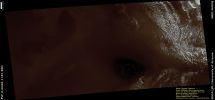
PSP_010449_1745_RED_abrowse.jpgPossible Hematite Deposits in West Candor Chasma (Natural Colors; credits: Lunar Explorer Italia)70 visitenessun commentoMareKromium
|
|
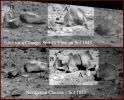
SOL1833-1843-4596-RS02.jpgThe "Unbelievable Behaviour" of some Martian pseudo-Rocks... - Sol 1833/Sol 1843 (credits: The Horizon)70 visitenessun commentoMareKromium
|
|

ESP_012226_1815_RED_abrowse.jpgDark Sands Deposits or Surfacing Hydrocarbons? (Natural Colors; credits: Lunar Explorer Italia)70 visitenessun commentoMareKromium
|
|

APOLLO_15_-_AS15-84-11313_HR.jpgAS 15-84-11313 - Mount Hadley70 visitenessun commentoMareKromium
|
|

APOLLO_12_-_AS_12-49-7318_HR2.jpgAS 12-49-7318 - Mysterious reflection... (HR; additional process. by Dr M. Faccin)70 visitenessun commentoMareKromium
|
|
| 25353 immagini su 2113 pagina(e) |
 |
|
|
|
|
936 | |
|
|
|
|





