| Piú viste |

SunDogs.jpgSuomi's Sundogs70 visiteWhat's happened to the Sun? Sometimes it looks like the Sun is being viewed through a large lens. In the above case, however, there are actually millions of lenses: ice crystals. As water freezes in the upper atmosphere, small, flat, six-sided, ice crystals might be formed. As these crystals flutter to the ground, much time is spent with their faces flat, parallel to the ground. An observer may pass through the same plane as many of the falling ice crystals near sunrise or sunset. During this alignment, each crystal can act like a miniature lens, refracting sunlight into our view and creating phenomena like parhelia, the technical term for sundogs. The above image was taken during early 2006 February near Helsinki, Finland with a quickly deployed cellular camera phone. Visible in the image center is the Sun, while two bright sundogs glow prominently from both the left and the right. Also visible is the 22° halo also created by sunlight reflecting off of atmospheric ice crystals.
|
|
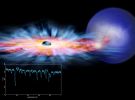
BH-Black_Hole-2.jpgCosmic "Thief"...70 visite"...Venuto dal Sole, o da Terre
Gelate,
Perduto in Novembre o, col vento
D'Estate,
Io t'ho amato sempre,
Non t'ho amato mai...
Amore che vieni,
Amore che vai...
Io t'ho amato sempre,
Non t'ho amato mai...
Amore che vieni,
Amore che vai...".
Fabrizio De Andrè - "Amore che vieni, Amore che vai"
|
|

Venusian_Surface-Venera_09-000.jpgVenera 9: the Spacecraft70 visiteGiven the intense temperatures and pressures of Venus, it is indeed impressive that Russian engineers were able to successfully land vehicles there 10 times during the 1970s and 1980s. These were Venera 7 to 14, and Vega 1 and 2 which deployed landers and balloon-born instrument packages. Although not designed to land, one of the free-falling Pioneer atmosphere probes gets honorable mention by surviving impact and continuing to transmit for a few minutes. The atmosphere of Venus is so thick that terminal velocity was only about 30 mph.
Seen above, the six-foot-tall Venera 9 lander was the first to take pictures of the surface, on October 20, 1975. The Venera orbiter and lander was a 10,000-pound spacecraft, one of the largest unmanned vehicles ever sent into space. Besides the camera system, the Venera landers measured the sky spectrum, atmospheric gases, cloud particles, and performed chemical analysis of surface rocks.
Looking out through 1 cm quartz pressure windows, Venera 9 to 14 captured spherical panoramas of 40º by 180º. The cameras used a pivoting mirror and photomultiplier tube, giving remarkably low-noise images which were digitized to 9 bits per pixel. Venera 13 and 14 had two cameras and were able to capture images though clear, red, green and blue filters. So some portions of their panoramas contain color information. Venera 11 and 12 were unable to return pictures because of an equipment failure, but the rest of their experiments were successful.
These images have often been displayed as very poor quality pictures taken off film or even photographed off printed pages of Soviet journals. The images I show here are derived from the digital telemetry by the Russian image processing team. In the case of Venera 9 and 10, I undid a pixel replication and replaced it with a higher quality interpolation filter. For Venera 13 and 14, I combined the chroma signal from the dark somewhat noisy color images with the luminance signal of the clear-filter images.
Venera 13 and 14 survived longer than expected and returned dozens of images, repeating their program of clear and color scans. I hope to process that data into a super resolution image and to recalculate the perceptual color values.
|
|
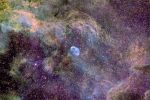
NGC-6888-03.jpgNGC 6888 - The "Bubble Nebula"70 visite"...Keep me as the apple of Your eye; hide me under the shadow of Your wings..."
Psalm 17:8
|
|
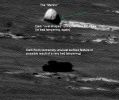
OPP-SOL873-1P205688604EFF735TP2442R2M1-3.jpgThe "Menhir" and something else... (extreme detail mgnf - labeled) - Sol 87370 visiteSu un'ottima segnalazione del nostro Amico e Socio, Matteo Fagone, abbiamo preparato un extreme detail mgnf dell'area su cui si trova la roccia che abbiamo battezzato "Menhir". Lo scopo, oltre a farVi notare che esiste una sorta di rilievo ovoidale scuro sul bordo Dx del Menhir (Sx di chi guarda) la cui origine è indeterminabile (almeno per ora), è anche quello di portare alla Vostra attenzione l'ulteriore rilievo ambiguo che ha notato e stigmatizzato Matteo Fagone e che noi, per ora, abbiamo battezzato "Dark Rock".
Il punto è che Dark Rock sembra essere, da svariati punti di vista, il prodotto di un'Anomalìa di un qualche tipo (o forse di una manipolazione) e noi non abbiamo idea di che cosa si tratti.
E poi, in fondo, forse non si tratta neppure di una "roccia"...
|
|

vo1_083a37.jpgMars: according to Viking 1 Orbiter70 visitenessun commento
|
|

vo2_065b74.jpgMars, according to Viking 2 Orbiter70 visitenessun commento
|
|

OPP-SOL881-1P206393606EFF74AZP2550R1M1.jpgShell-Rock - Sol 88170 visiteSelezionata dal Dr Barca, un'immagine splendida, ricca di dettagli e di spunti di riflessione: Shell Rock, una delle infinite - ma sempre intriganti ed affascinanti - "pseudo-rocce" Marziane.
|
|
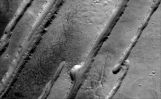
Fractures-Panchaia_Rupes-PIA08622-1.jpg"Linear Fractures" or "Through Segments" in Panchaia Rupes Region (Original NASA/JPL/ASU b/w Frame)70 visiteImage information: VIS instrument;
Latitude: 29,9° North;
Longitude: 138,5° East;
Resolution: 19 meter/pixel.
|
|
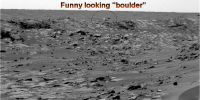
OPP-SOL894-1P207549799ESF74V1P2354L5M1-A.jpgFunny-looking "Boulder" (context image) - Sol 89470 visitenessun commento
|
|

Titan_s Rain~0.jpgTitan's "Rain"...70 visiteDa "NASA - Picture of the Day" del 2 Agosto 2006:"Might it rain cold methane on Saturn's Titan? Recent analyses of measurements taken by the Huygen's probe that landed on Titan in 2005, January, indicate that the atmosphere is actually saturated with methane at a height of about 8 Km. Combined with observations of a damp surface and lakes near the Poles, some astrobiologists conclude that at least a methane drizzle is common on parts of Titan. Other astrobiologists reported computer models of the clouded moon that indicate that violent methane storms might even occur, complete with flash floods carving channels in the landscape. The later scenario is depicted in the above drawing of Titan. Lighting, as also depicted above, might well exist on Titan but has not been proven. The findings increase speculation that a wet Titanian surface might be hospitable to unusual forms of life".
Attenzione all'ultima frase: "Queste scoperte fanno crescere (la validità) di una ipotesi speculativa secondo cui la superficie di Titano, laddove effettivamente umida, potrebbe essere idonea ad ospitare "inusuali" forme di Vita".
Il significato e la portata di questa frase sono evidenti e di valore storico, ma c'è una domanda che ci incuriosisce e, in fondo, un pò ci turba: cosa intende la NASA quando parla di "unusual life forms"?...
|
|

SettingSun.jpgA Day of the Sun70 visite"...Peace I leave with you; my Peace I give to you..."
- John 14:27
nota: "A Day of the Sun" è anche il titolo di una serie di opere dedicate al Sole, realizzate dal Pittore Tetsuro Sawada.
|
|
| 25353 immagini su 2113 pagina(e) |
 |
|
|
|
|
934 | |
|
|
|
|





