| Piú viste |
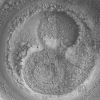
SOL830-PIA08455.jpgThe "Mark" (full mosaic) - Sol 83070 visiteThe grinding teeth have worn away on the rock abrasion tool of NASA's MER Spirit (after exposing interiors of five time more rock targets than its design goal of three rocks) but the tool still has useful wire bristles for brushing targets. In this image, a figure-eight-like imprint in the Martian soil marks the spot where Spirit has begun examining subsurface deposits layer by layer. The circular indentations resulted from brushing by the RAT, one of several instruments on the Rover's RA. As an effective brushing tool it is now fulfilling a soil profiling experiment on a target called "Progress". The experiment is a multi-step process of carefully brushing away fine layers of soil and then using the Moessbauer and Alpha particle X-ray Spectrometers, MI, and PanCam to examine the exposed surfaces during the long Martian Winter.
This view is a mosaic of exposures taken by Spirit's MI during the Rover's 830th Sol (such as (May 4, 2006). The total area shown here is about 6 cm (such as 2,4") square.
|
|

Volcanic_Features-Collapse_Pit_Chain-Tharsis_Tolus-MGS.JPGCollapse Pit-Chain near Tharsis Tholus (Original NASA/MGS/MSSS b/w Frame)70 visiteCaption NASA originale:"This MGS-MOC mage shows a portion of a Chain of Collapse Pits on a Lava and Dust-covered Plain, North/West of Tharsis Tholus —one of the many volcanic constructs in the Tharsis Region of Mars.
Pit chains, such as this one, are associated with the collapse of surface materials into subsurface voids formed by faulting and expansion — or extension — of the bedrock".
Location near: 16,4° North Lat. and 92,6° West Long.
Image width: ~3 Km (~1,9 mi)
Illumination from: lower left
Season: Northern Winter
|
|
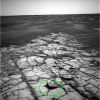
OPP-SOL822-1N201154528EFF703FP1795R0M1-2.jpgWho (or "what") is "pushing"?!?... - Sol 82270 visiteCerchiatura Verde: una roccia che si è "sollevata" dalla Pavimentazione alla quale accede e che lascia intuire un'apertura verso un sempre più probabile - ed enigmatico - mondo sotterraneo.
Il frame è di qualità troppo cattiva per scendere in dettaglio, ma la sensazione (e nulla di più) che si ricava esaminando i bordi del blocco di roccia sollevatosi dal suolo (aguzzi e spigolosi) nonchè le peculiarità dell'area che lo circonda (quasi del tutto priva di accumuli di polvere) è che questa specifica caratterizzazione della superficie possa essere estremamente recente...
|
|
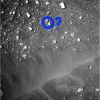
SOL848-2P201646839EFFAR00P2295R1M1.jpgStones, cobbles and sand... (4) - Sol 84870 visiteCerchiatura Blu: il rilievo circolare "poggia" su qualcosa, è parzialmente infossato o si è formato un deposito di polveri chiare tutto intorno alla sua base? Difficile a dirsi... (filtro n. 1)
|
|

NGC-6188-1.jpgNGC 6188 - Emission Nebula70 visite"...Ora che lo vogliono abbattere
dai muri ove, silenzioso,
sopravvive all'ignoranza
degli studenti, il Crecefisso
non è più morto: parla
con la penna degli agnostici.
Ti difendono quale cavaliere
di civiltà, perchè pedagogo
ai barbari delle emozioni del bello,
del senso del bene e del male.
Il sacerdozio nelle polverose
sacrestie tace, dondolandosi
tra incenso e broccati.
Il Crocefisso è risorto da lontano
ma è morto per i vicini servi, inutili".
Pietro Zovatto
|
|

SunDogs.jpgSuomi's Sundogs70 visiteWhat's happened to the Sun? Sometimes it looks like the Sun is being viewed through a large lens. In the above case, however, there are actually millions of lenses: ice crystals. As water freezes in the upper atmosphere, small, flat, six-sided, ice crystals might be formed. As these crystals flutter to the ground, much time is spent with their faces flat, parallel to the ground. An observer may pass through the same plane as many of the falling ice crystals near sunrise or sunset. During this alignment, each crystal can act like a miniature lens, refracting sunlight into our view and creating phenomena like parhelia, the technical term for sundogs. The above image was taken during early 2006 February near Helsinki, Finland with a quickly deployed cellular camera phone. Visible in the image center is the Sun, while two bright sundogs glow prominently from both the left and the right. Also visible is the 22° halo also created by sunlight reflecting off of atmospheric ice crystals.
|
|
BH-Black_Hole-2.jpgCosmic "Thief"...70 visite"...Venuto dal Sole, o da Terre
Gelate,
Perduto in Novembre o, col vento
D'Estate,
Io t'ho amato sempre,
Non t'ho amato mai...
Amore che vieni,
Amore che vai...
Io t'ho amato sempre,
Non t'ho amato mai...
Amore che vieni,
Amore che vai...".
Fabrizio De Andrè - "Amore che vieni, Amore che vai"
|
|

Venusian_Surface-Venera_09-000.jpgVenera 9: the Spacecraft70 visiteGiven the intense temperatures and pressures of Venus, it is indeed impressive that Russian engineers were able to successfully land vehicles there 10 times during the 1970s and 1980s. These were Venera 7 to 14, and Vega 1 and 2 which deployed landers and balloon-born instrument packages. Although not designed to land, one of the free-falling Pioneer atmosphere probes gets honorable mention by surviving impact and continuing to transmit for a few minutes. The atmosphere of Venus is so thick that terminal velocity was only about 30 mph.
Seen above, the six-foot-tall Venera 9 lander was the first to take pictures of the surface, on October 20, 1975. The Venera orbiter and lander was a 10,000-pound spacecraft, one of the largest unmanned vehicles ever sent into space. Besides the camera system, the Venera landers measured the sky spectrum, atmospheric gases, cloud particles, and performed chemical analysis of surface rocks.
Looking out through 1 cm quartz pressure windows, Venera 9 to 14 captured spherical panoramas of 40º by 180º. The cameras used a pivoting mirror and photomultiplier tube, giving remarkably low-noise images which were digitized to 9 bits per pixel. Venera 13 and 14 had two cameras and were able to capture images though clear, red, green and blue filters. So some portions of their panoramas contain color information. Venera 11 and 12 were unable to return pictures because of an equipment failure, but the rest of their experiments were successful.
These images have often been displayed as very poor quality pictures taken off film or even photographed off printed pages of Soviet journals. The images I show here are derived from the digital telemetry by the Russian image processing team. In the case of Venera 9 and 10, I undid a pixel replication and replaced it with a higher quality interpolation filter. For Venera 13 and 14, I combined the chroma signal from the dark somewhat noisy color images with the luminance signal of the clear-filter images.
Venera 13 and 14 survived longer than expected and returned dozens of images, repeating their program of clear and color scans. I hope to process that data into a super resolution image and to recalculate the perceptual color values.
|
|
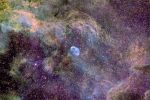
NGC-6888-03.jpgNGC 6888 - The "Bubble Nebula"70 visite"...Keep me as the apple of Your eye; hide me under the shadow of Your wings..."
Psalm 17:8
|
|
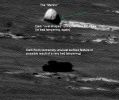
OPP-SOL873-1P205688604EFF735TP2442R2M1-3.jpgThe "Menhir" and something else... (extreme detail mgnf - labeled) - Sol 87370 visiteSu un'ottima segnalazione del nostro Amico e Socio, Matteo Fagone, abbiamo preparato un extreme detail mgnf dell'area su cui si trova la roccia che abbiamo battezzato "Menhir". Lo scopo, oltre a farVi notare che esiste una sorta di rilievo ovoidale scuro sul bordo Dx del Menhir (Sx di chi guarda) la cui origine è indeterminabile (almeno per ora), è anche quello di portare alla Vostra attenzione l'ulteriore rilievo ambiguo che ha notato e stigmatizzato Matteo Fagone e che noi, per ora, abbiamo battezzato "Dark Rock".
Il punto è che Dark Rock sembra essere, da svariati punti di vista, il prodotto di un'Anomalìa di un qualche tipo (o forse di una manipolazione) e noi non abbiamo idea di che cosa si tratti.
E poi, in fondo, forse non si tratta neppure di una "roccia"...
|
|

vo1_083a37.jpgMars: according to Viking 1 Orbiter70 visitenessun commento
|
|

vo2_065b74.jpgMars, according to Viking 2 Orbiter70 visitenessun commento
|
|
| 25353 immagini su 2113 pagina(e) |
 |
|
|
|
|
933 | |
|
|
|
|





