| Piú viste |
PSP_004313_1760_RED_abrowse-02.gifWinslow Crater's Changing (GIF-Movie; credits: NASA)71 visitenessun commentoMareKromium
|
|

Prometheus-PIA09834.jpgThe "visual meaning" of Gravity71 visiteCaption NASA:"Two dark gores in Saturn's F-Ring demonstrate the gravitational influence of the shepherd moon Prometheus.
The older gore at the top of this view is at a steeper angle than the newer addition just above and to the left of Prometheus, since the former has sheared out over the course of an orbit: particles on the inner (right) side of the F-Ring travel faster in the same amount of time than the particles on the outer (left) side, leaving the outer particles behind. Prometheus (102 Km, or about 63 miles across) is lit at left by direct sunlight and at right by reflected light from Saturn. The bright, sunlit portion of the moon is overexposed.
Two background stars are captured above Prometheus in this view, which looks toward the unilluminated side of the Rings from about 33° above the Ring-Plane.
The image was taken in visible light with the Cassini spacecraft narrow-angle camera on Jan. 1, 2008. The view was acquired at a distance of approx. 1,5 MKM (such as Rabout 956.000 miles from Saturn and at a Sun-Saturn-spacecraft, or phase, angle of 62°.
Image scale is roughly 9 Km (approx. 6 miles) per pixel".
MareKromium
|
|

UnknownOrigin.jpgUnknown Origin (by Dr Marco Faccin)71 visite"...We are not, what we are;
And we are not, what we seem to be.
We are not, what we do;
And we are not, what we feel and fight for.
We are not, what we say;
And we are not, what we think.
We are not, what we are;
And we are not, what we pretend to be..."
P.C. Floegers - "Repetita Iuvant"MareKromium
|
|

SOL443-2.jpgPeace of Mind (a Martian Fantasy by Dr Paolo C. Fienga - Lunexit Team)71 visitenessun commentoMareKromium
|
|
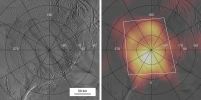
Enceladus-PIA10360.jpgStripes and Heat Map Side-by-Side71 visiteCaption NASA:"Cassini's March 12, 2008, flyby of Enceladus provided the best view yet of the heat radiation from the active South Pole of the satellite. These images summarize what was learned about the South Polar landscapes and heat radiation during the previous close flyby on July 15, 2005.
The left panel shows a map of the South Pole constructed from images taken by the Spacecraft's Imaging System. Four prominent fractures, informally called "Tiger Stripes", cut diagonally across the South Polar Region. In the right-hand panel, a July 2005 map of the south polar heat radiation, obtained by Cassini's Composite Infrared Spectrometer, is superimposed in false color on the visible images.
The observations revealed a prominent warm region centered on the South Pole, appearing yellow and orange in this view, which coincides with the locations of the tiger stripes. However, these data were taken from too far away from Enceladus (about 80.000 Km) to distinguish the fine details of the heat radiation.
The July 2005 flyby also included some scattered close-up snapshots by the Composite Infrared Spectrometer; these showed that the heat radiation was concentrated along the Tiger Stripe fractures, but those snapshots covered only a small fraction of the South Polar Region.
The white lines enclose the area covered by the much more detailed view of the South Pole obtained by the spectrometer during the March 12, 2008, flyby.
Numbers on the map show Latitude and Longitude".MareKromium
|
|
SOL634.jpgGreenish Rock - Sol 634 (Superdefinition; credits: Dr G. Barca)71 visitenessun commentoMareKromium
|
|
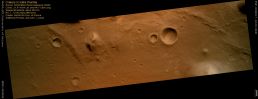
PSP_008017_2020_RED_abrowse.jpgCraters in Isidis Planitia (MULTISPECTRUM; credits: Lunexit)71 visiteThis image shows a young impact crater in the Northern part of Isidis Planitia. The crater is fresh enough to preserve some fine textures that are eroded around other craters.
The ejecta blanket of material thrown out of the crater is distinctly dark and rough, with many small boulders and rugged texture. To the South of the crater there is a wedge-shaped area with little ejected material. This may indicate that the impactor which formed this crater came from the south, since at moderate impact angles ejecta is preferentially thrown in the direction of motion of the impactor.
Eventually, a combination of erosion and mantling by dust will smooth and obscure the ejecta and cover over the crater, turning it into a shallow depression like the others in this image. Reworking of the crater is already beginning, as shown by the network of fine ridges (wind-blown ripples) on the crater floor.MareKromium
|
|
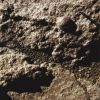
OPP-SOL212-1.jpgWhat a Vision!... - Sol 212 (Superdefinition + MULTISPECTRUM; credits: Dr G. Barca & Lunexit)71 visitenessun commentoMareKromium
|
|
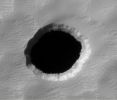
PSP_008130_1745_RED_abrowse-02.jpgSmall but deep Collapse Pit, North of Arsia Mons (extra-detail mgnf n. 2; credits: Dr G. Barca)71 visitenessun commentoMareKromium
|
|
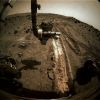
SOL1187-Front.jpgFront-View - Sol 1187 (Superdefinition + MULTISPECTRUM; credits: Dr G. Barca & Lunexit)71 visitenessun commentoMareKromium
|
|
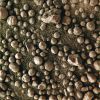
OPP-SOL910-2.jpgBerries and "Greenish" Dust - Sol 806 (Superdefinition + MULTISPECTRUM; credits: Dr G. Barca & Lunexit)71 visitenessun commentoMareKromium
|
|

OPP-SOL1602-FrontHazCam-RGB.jpgLook: Opportunity is VERY clean! - Sol 1602 (Natural Colors; credits for the additional process. and color.: Dr Marco Faccin - Lunexit Team)71 visitenessun commentoMareKromium
|
|
| 25353 immagini su 2113 pagina(e) |
 |
|
|
|
|
920 | |
|
|
|
|





