| Piú viste |
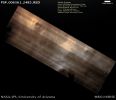
PSP_006561_2485_RED_abrowse.jpgWinter Sunrise in Vastitas Borealis (Absolute Natural Colors; credits for the additional process. and color.: Dr Paolo C. Fienga)72 visiteThis High Latitude image shows a portion of the Landing Ellipse for the Mars Scout Spacecraft Phoenix as seen during late Winter on Mars. Phoenix will land somewhere within the Ellipse on Memorial Day, 2008, but probably not within this image.
While the Phoenix Lander will land in Mid-Spring and operate through the Martian Summer, the current Winter landscape looks somewhat different. The Sun is beginning to rise from the Winter night and is only 10° above the horizon to illuminate the Surface in this image.
As a result, what few rocks are present cast noticeable shadows, and every bump and undulation of the Surface, now matter how small, is accentuated.
In this Winter image, a blanket of CO2 Frost (dry ice snow) about a foot deep covers the Surface. Bright patches in the image are areas where the Frost is relatively clean, while in darker areas over much of the image, the Frost is either dirty with Atmospheric dust or the Frost is somewhat translucent allowing us to see a little of the Soil forming the Surface.
Summertime images of this Region show that small Hexagonal and Polygonal Patterns a few meters (yards) in size ubiquitously cover the entire Region. These Patterns are the result of annual thermal contraction in ice-cemented soil forming a honeycomb network of small fractures below the Surface that manifest themselves as small shallow Troughs (---> canaletti) at the Surface.
Interestingly, these Patterns are not visible in this image. The shallow Troughs that mark the polygons are currently filled in with CO2 Frost making them virtually invisible.
As Spring approaches the CO2 Frost will slowly sublimate (changes directly from ice to gas) and the Polygons will once again become visible. MareKromium
|
|
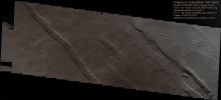
Volcanoes-Arsia_Mons-Graben-20071119a-PCF-LXTT.jpgGraben on Arsia Mons (Absolute Natural Colors; credits for the additional process. and color.: Dr Paolo C. Fienga - Lunexit Team)72 visitenessun commentoMareKromium
|
|
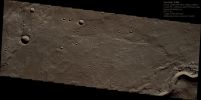
Volcanic_Regions-Buvinda_Vallis-Hecates_Tholus-MO-PCF-LXTT.jpgBuvinda Vallis (Absolute Natural Colors; credits for the additional process. and color.: Dr Paolo C. Fienga - Lunexit Team)72 visitenessun commentoMareKromium
|
|
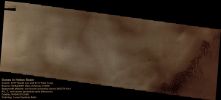
Dunefields-Hellas_Planitia-PCF-LXTT.jpgDunefield in Hellas Planitia (Absolute Natural Colors; credits for the additional process. and color.: Dr Paolo C. Fienga - Lunexit Team)72 visitenessun commentoMareKromium
|
|
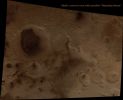
Craters-Crater_Field-h1640_0000_nd3.jpgHeavily Cratered Region and Candidate Migrating Dunefields (Natural Colors; credits for the additional process. and color.: Dr Paolo C. Fienga - Lunexit Team)72 visitenessun commentoMareKromium
|
|

ESP_020799_1385_RED_abrowse.jpgFeatures of Argyre Basin (Absolute Natural Colors; credits for the additional process. and color.: Dr Paolo C. Fienga - Lunexit Team)72 visitenessun commentoMareKromium
|
|
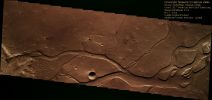
Channels-Hebrus_Vallis-20080522a-PCF-LXTT.jpgChannel and Tributaries - Hebrus Vallis (Absolute Natural Colors; credits for the additional process. and color.: Dr Paolo C. Fienga - Lunexit Team)72 visitenessun commentoMareKromium
|
|

ESP_025042_1375_RED-PCF-LXTT-00.jpgLarge Dunefield in Noachis Terra (CTX Frame - Absolute Natural Colors; credits for the additional process. and color.: Dr Paolo C. Fienga - Lunexit Team)72 visiteMars Local Time: 14:52 (early afternoon)
Coord. (centered): 42,4° South Lat. and 42,0° East Long.
Spacecraft altitude: 252,2 Km (such as about 157,6 miles)
Original image scale range: 25,2 cm/pixel (with 1 x 1 binning) so objects ~ 76,0 cm across are resolved
Map projected scale: 25 cm/pixel
Map projection: EQUIRECTANGULAR
Emission Angle: 0,4°
Sun - Mars - MRO (or "Phase") Angle: 69,9°
Solar Incidence Angle: 69° (meaning that the Sun is about 21° above the Local Horizon)
Solar Longitude: 36,5° (Northern Spring)
Credits: NASA/JPL/University of Arizona
Additional process. and coloring: Lunar Explorer ItaliaMareKromium
|
|

OPP-SOL2840-1P380322805EFFBR43P2443L1M1-PCF-LXTT.jpgPanorama from "Greeley Haven" - Sol 2840 (Absolute Natural Colors; credits for the additional process. and color.: Dr Paolo C. Fienga - Lunexit Team)72 visitenessun commentoMareKromium
|
|
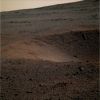
OPP-SOL3019-GB-LXTT-IPF.jpgLooking Around... - Sol 3019 (RAW Natural Colors; credits for the additional process. and color.: Dr Gianluigi Barca - Lunexit Team)72 visitenessun commentoMareKromium
|
|

ZZ-Mercury-Craters-Eitoku_Crater-PIA16361-PCF-LXTT.jpgEitoku Crater (Absolute Natural Colors; credits for the additional process. and color.: Dr Paolo C. Fienga/Lunar Explorer Italia/Italian Planetary Foundation)72 visiteThe main and really impressive Impact Crater visible in this NASA - MESSENGER Spacecraft image, Eitoku (which has a diameter of approx. 100 Km - such as about 62 miles) , displays several (almost) Central Peaks that appear especially prominent due to the high Solar Incidence Angle (meaning that the Sun was setting onto the imaged Local Horizon at the time that this picture was taken - and therefore the shadows of each and every Mercurian relief resulted way more visible - i.e.: longer - and suggestive) as well as to the fact that this frame has not been Map Projected. Note that Central (and/or almost Central, like in this case) Peaks are a relatively common Feature in Mercury's larger Impact Craters. Note, also, that the smaller Impact Craters visible on the Floor and Rim (which, on its side, appears quite degraded) of Eitoku Crater indicate/suggest that we are actually looking at an old Impact Feature.
Date acquired: July, 3rd, 2012
Image Mission Elapsed Time (MET): 249790754
Image ID: 2129670
Instrument: Narrow Angle Camera (NAC) of the Mercury Dual Imaging System (MDIS)
Center Latitude: 21,77° South
Center Longitude: 202,6° East
Resolution: 120 meters/pixel
Solar Incidence Angle: 83,4° (meaning that the Sun, at the time that the picture was taken, was about 6,6° above the imaged Local Mercurian Horizon)
Emission Angle: 59,9°
Sun-Mercury-Messenger (or "Phase") Angle: 134,5°
This picture (which is an Original NASA - MESSENGER Spacecraft color frame published on the NASA - Planetary Photojournal with the ID n. PIA 16361) has been additionally processed and then colorized in Absolute Natural Colors (such as the colors that a human eye would actually perceive if someone were onboard the NASA - MESSENGER Spacecraft and then looked down, towards the Surface of Mercury), by using an original technique created - and, in time, dramatically improved - by the Lunar Explorer Italia Team. Different colors, as well as different shades of the same color, mean, among other things, the existence of different Elements (Minerals) present on the Surface of Mercury, each having a different Albedo (---> Reflectivity) and Chemical Composition.MareKromium
|
|

Titan-PIA16635-PCF-LXTT-IPF-1.jpgTitanian Northern Lakes (Absolute Natural Colors; credits for the additional process. and color.: Dr Paolo C. Fienga/Lunar Explorer Italia/Italian Planetary Foundation)72 visiteThe Lakes existing on the Saturnian moon Titan, reflect Radio Waves in varying ways, as it can be noticed in this Radio-Image obtained by the the NASA - Cassini Spacecraft. Scientists think the variations in Reflectivity, or Brightness, have to be related with the smoothness (such as the so-called "texture") of the imaged Surface. However, if a Lake is fully liquid, it always looks VERY dark (actually black); but if it is only partially liquid, then it looks a lot brighter. In this frame, taken from Titan's High Northern Latitudes (such as at approx. 79° North Latitude and 58° West Longitude) on May, 22, 2012, the Lakes located on on the left (Sx) side of it are full of Liquid Hydrocarbons, while the ones - barely visible - located on the top right (Dx) of the picture are only partially filled - it has to be said, however, that what can be seen on the right side of the frame, could even be the representation of simple Saturated Ground (---> a Surface Feature - or, better yet, a Surface "Condition" - known as "Mudflat" ---> Mudflats or Mud Flats, also known as Tidal Flats, are Coastal Wetlands that form when huge quantities of Mud are deposited by the action of Oceanic Tides or particularly fast-flowing Rivers).
The Lakes visible in this image are each about 35 to 45 Km (such as approx. 22 to 30 miles) across, or about the size of Lake Tahoe, on the California-Nevada Border. Some of the differences in Reflectivity could also be explained by the presence, in the Lakes, of floating blocks of Hydrocarbon Ice. The image was obtained by the Cassini Radar Mapper at a scale of about 350 meters (1100 feet) per pixel.
This frame (which is a crop obtained by an Original NASA - CASSINI Spacecraft Radio-Image published on the NASA - Planetary Photojournal with the n. PIA 16635), since it is just a Radio-Image of the Titanian Surface and NOT a real view of it, has been colorized, according to an educated guess, by Dr Paolo C. Fienga (LXTT-IPF), in what they could reasonably be its possible Absolute Natural Colors (such as the colors that a human eye would perceive if someone were onboard the NASA - CASSINI Spacecraft and, once the thick layer of Titanian Hazes and Fogs shall have been completely overcome, looked down, towards the Surface of Titan itself), by using an original technique created - and, in time, dramatically improved - by the Lunar Explorer Italia Team.MareKromium
|
|
| 25353 immagini su 2113 pagina(e) |
 |
|
|
|
|
912 | |
|
|
|
|





