| Piú viste |

PSP_002922_1725-PCF-GB-LXTT1.jpgUnusual Surface Feature on Arsia Mons' Flank (Natural Colors; credits for the additional process. and color.: Drr Gianluigi Barca & Paolo C. Fienga)72 visitenessun commentoMareKromium
|
|

SOL0583-2P178121605EFFAE03P2261L5M1.jpgHorizon - Sol 583 (Absolute Natural Colors; credits for the additional process. and color.: Dr Paolo C. Fienga - Lunexit Team)72 visitenessun commentoMareKromium
|
|
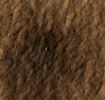
ESP_018273_2245_RED_abrowse-04-MF-LXTT.jpgExposed Ice in Fresh Crater (Natural Colors; credits for the additional process. and color.: Dr Marco Faccin - Lunexit Team)72 visitenessun commentoMareKromium
|
|

PSP_003234_2210-PCF-LXTT1.jpgThe "Face on Mars" (Natural Colors; credits for the additional process. and color.: NASA/JPL and Dr Paolo C. Fienga - Lunexit Team)72 visitenessun commentoMareKromium
|
|

OPP-SOL1036-1P220150783EFF77UNP2445L5M1.jpgOn the Edge of Victoria - Sol 1036 (Natural - but enhanced - Colors; credits: Paolo C. Fienga - Lunexit Team) 72 visitenessun commentoMareKromium
|
|

Japetus-PIA12706.jpgJapetus72 visiteCaption NASA:"Some of Japetus' Dark Surface interrupts the moon's lighter Terrain in this Cassini view.
Scientists continue to investigate the nature of this moon's dark and light Surface. Lit Terrain seen here is on the Trailing Hemisphere of Japetus. North on Japetus is up and rotated 10° to the right.
The image was taken in visible light with the Cassini Spacecraft narrow-angle camera on May 9, 2010. The view was acquired at a distance of approx. 1,3 MKM (about 808.000 miles) from Iapetus and at a Phase Angle of 95°.
Image scale is roughly 8 Km (about 5 miles) per pixel".MareKromium
|
|
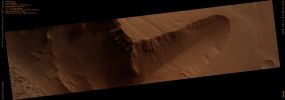
ESP_018374_1740_RED_abrowse.jpgWest Candor (Natural Colors; credits: Dr Paolo C. Fienga - Lunexit Team)72 visitenessun commentoMareKromium
|
|
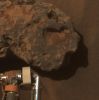
OPP-SOL2371-PIA13419.jpgIron Meteorite: Close View - Sol 2371 (Approx. True Colors; credits: NASA/JPL-Caltech/Cornell University)72 visiteCaption NASA:"This is an image of the Meteorite that NASA's Mars Exploration Rover Opportunity found and examined in September 2010. MER Opportunity's cameras first revealed the Meteorite in images taken on Sol 2363 (Sept. 16, 2010). This view was taken with the PanCam on Sol 2371 (such as Sept. 24th, 2010).
The science team used two tools on Opportunity's Arm - the Microscopic Imager and the Alpha Particle X-Ray Spectrometer - to inspect the rock's texture and composition. Information from the Spectrometer confirmed that the rock is a Nickel-Iron meteorite. The team informally named the rock "Oileán Ruaidh", which is the Gaelic name for an island off the coast of North-Western Ireland.
Opportunity departed Oileán Ruaidh and resumed its journey toward the mission's long-term destination, Endeavour Crater, on Sol 2374 (Sept. 28, 2010) with a drive of about 100 meters (328 feet).
This view, presented in Approximately True Color, combines component images taken through three PanCam filters admitting wavelengths of 601 nanometers, 535 nanometers and 482 nanometers". MareKromium
|
|
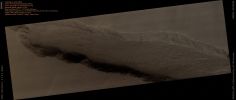
PSP_004412_1715_RED_abrowse-PCF-LXTT.jpgArsia "Dusty" Layers (Absolute Natural Colors; credits for the additional process. and color.: Dr Paolo C. Fienga - Lunexit Team)72 visiteThis image covers a Pit in the lower West Flank of Arsia Mons, one of the 4 giant Volcanos of the Tharsis Region.
Many Layers are exposed in the Pit, probably marking individual Lava Flows that overlapped (meaning: ONE Layer - ONE Flow), and provide information about the nature of the volcanic eruptions. This image was acquired in the middle of large regional Dust Storms on Mars, but the Atmosphere over this image is only moderately dusty because the altitude is 6,5 Km higher than the Planetary Mean (-----> media altitudine planetaria), so the air is quite thin and cannot hold as much Dust.
Although the Atmosphere is not too dusty, the Surface is buried by a Dust Layer that might be meters thick. These high-altitude locations on Mars have thick Dust Deposits because the thin air cannot blow away the Dust, or at least not as fast as it accumulates. On Earth the Oceans serve as "Dust Traps", while on Mars such Traps are the highest Volcanoes. MareKromium
|
|

Comets-Comet_Hartley_2-EB-LXTT4.jpgComet "Hartley 2" (credits for the additional process. and color.: Elisabetta Bonora - Lunexit Team)72 visitenessun commentoMareKromium
|
|

SOL354-MF-LXTT-1.jpgEffects of Abrasion - Sol 354 (an Image-Mosaic in Natural Colors by Dr Marco Faccin - Lunexit Team)72 visitenessun commentoMareKromium
|
|
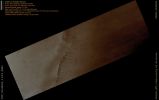
PSP_004804_1105_RED_abrowse.jpgGullies in Sisyphi Planum (Absolute Natural Colors; credits for the additional process. and color.: Dr Paolo C. Fienga - Lunexit Team)72 visiteImage PSP_004804_1105 shows the Walls of a large Pit inside Lyell Crater, near the South Polar Region.
This image was acquired during a period of elevated Atmospheric Dust, following a series of Dust Storms that encircled the Planet; this is the cause of the longitudinal bands of contrasting gray levels in the image. We can still see through the thick Atmosphere, though, Gullies and other subtle features which could have been produced by water and ice present at or near the Surface.
The otherwise subdued Surface in this Region is criss-crossed by numerous fissures, forming Polygons some 10 mt (9 yards) across. Similar features in both shape and scale can be found in terrestrial Periglacial Regions such as Antarctica, where ice is present at or near the Surface. Antarctica's features are the product of repeated expansion and contraction of the soil-ice mixture due to seasonal temperature oscillations. This results in Polygonal Networks of Stress Fractures. MareKromium
|
|
| 25353 immagini su 2113 pagina(e) |
 |
|
|
|
|
911 | |
|
|
|
|





