| Piú viste |

OPP-SOL2540-1P353671303EFFB1I5P2264L2M1-PCF-LXTT.jpgView from the Rim of Santa Maria - Sol 2540 (Natural Colors; credits for the additional process. and color.: Dr Paolo C. Fienga)252 visitenessun commentoMareKromium
|
|
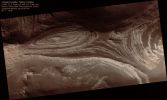
PSP_001596_1525_RED_browse-01-PCF-LXTT.jpgLayering inside Terby Crater (Absolute Natural Colors; credits: Dr Paolo C. Fienga - Lunexit Team)252 visiteImage PSP_001596_1525 shows a sequence of predominantly light-toned, layered, sedimentary rocks exposed by erosion on the floor of Terby Crater. Terby Crater is ~165 Km (~100 miles) in diameter. It's located on the northern rim of the Hellas impact basin in the Southern Hemisphere of Mars.
The layered sequence is ~2 Km (~1,2 miles) thick and consists of many repetitive, relatively horizontal beds. The beds appear to be laterally continuous, which means you can identify a given layer in many locations across the area.
Details in the layering seen in this HiRISE image reveal variations in the brightness of the layers and may indicate differing mineralogies. Based on the ease with which wind appears to erode these layers, they are believed to be composed mostly of fine-grained sediments.
However, one or more of the beds is weathering to form meter(yard)-scale boulders that have accumulated downslope in fans of debris.
These larger boulders indicate the material in the layers may be stronger than just fine-grained sediments.
It's not clear how these layers formed, but it may have involved deposition by wind or volcanic activity. Another theory involves all or part of the Hellas basin being filled with ice-covered lakes at one time in the past. The layers we see may have formed as material that was suspended in the water dropped down to the bottom of the lake. MareKromium
|
|
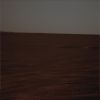
OPP-SOL2551-1P354656726EFFB1__P2386L2M1-PCF-LXTT.jpgMeridiani Planum - Sol 2551 (Absolute Natural Colors; credits for the additional process. and color.: Dr Paolo C. Fienga - Lunexit Team)252 visitenessun commentoMareKromium
|
|

Dunes-Terra_Cimmeria-20071129a-PCF-LXTT-2.jpgDunes in Terra Cimmeria (Absolute Natural Colors; credits for the additional process. and color.: Dr Paolo C. Fienga - Lunexit Team)252 visitenessun commentoMareKromium
|
|
OPP-SOL2572-1R356522040EFFB4X2P1312R0M1-PCF-LXTT.jpgFoggy and Overexposed Horizon - Sol 2572 (RAW Natural Colors; credits for the additional process. and color.: Dr Paolo C. Fienga - Lunexit Team)252 visitenessun commentoMareKromium
|
|
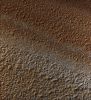
Chasma_Boreale-TRA_000840_2750_IRB-005-PCF-LXTT.jpgOn the Edge of Chasma Boreale (Natural Colors; credits for the additional process. and color.: Dr Paolo C. Fienga - Lunexit Team)252 visitenessun commentoMareKromium
|
|
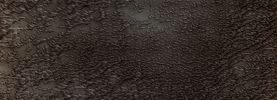
ESP_024478_2550-PCF-LXTT.jpgFeatures of the North Polar Erg (Absolute Natural Colors; credits for the additional process. and color.: Dr Paolo C. Fienga - Lunexit Team)252 visiteMars Local Time: 13:49 (early afternoon)
Coord. (centered): 75,0° North Lat. and 300,0° East Long.
Spacecraft altitude: 318,7 Km (such as about 199,2 miles)
Original image scale range: 31,9 cm/pixel (with 1 x 1 binning) so objects ~ 96 cm across are resolved
Map projected scale: 25 cm/pixel
Map projection: POLAR STEREOGRAPHIC
Emission Angle: 1,4°
Phase Angle: 69,2°
Solar Incidence Angle: 70° (meaning that the Sun is about 20° above the Local Horizon)
Solar Longitude: 16,2° (Northern Spring)
Credits: NASA/JPL/University of Arizona
Additional process. and coloring: Lunar Explorer ItaliaMareKromium
|
|

APOLLO 13 AS 13-62-8954.jpgAS 13-62-8954 - Waiting for another "sign"...251 visiteIl viaggio di ritorno continua e gli astronauti, nelle pause fra un problema e l'altro, scattano altre fotografie allo spazio esterno. In questa vediamo la Terra, ancora lontana, che aspetta. Non è circostanza inutile da sottolineare quella che ci dice che vengono utilizzati vari finestrini per effettuare gli scatti. In questo frame, in realtà, non si vede nulla di particolare, ma nel prossimo accadrà qualcosa...
|
|

TEMPERATURA SU MARTE.jpgMars Temperatures251 visiteNel frame precedente: un'immagine ad ottima definizione di strisce di luce dal movimento incoerente (rispetto al movimento del Pianeta) nel Cielo di Marte (Raggi Cosmici?) ed in questo frame un grafico meritevole di studio sulle temperature del Pianeta a diverse ore ed altitudini.
Due frames - comunque - molto discutibili.
|
|

Milky_Way.jpgThe Milky Way: a picture or a drawing?251 visiteThis panorama view of the sky is really a drawing. It was made in the 1940s under the supervision of astronomer Knut Lundmark at the Lund Observatory in Sweden. To create the picture, draftsmen used a mathematical distortion to map the entire sky onto an oval shaped image with the plane of our Milky Way Galaxy along the center and the north galactic pole at the top. 7.000 individual stars are shown as white dots, size indicating brightness. The "Milky Way" clouds, actually the combined light of dim, unresolved stars in the densely populated galactic plane, are accurately painted on, interrupted by dramatic dark dust lanes. The overall effect is photographic in quality and represents the visible sky. Can you identify any familiar landmarks or constellations? For starters, Orion is at the right edge of the picture, just below the galactic plane and the Large and Small Magellanic Clouds are visible as fuzzy patches in the lower right quadrant.
|
|
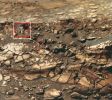
ZZ-ZZ-ZZ-ZZ-ZZ-ZZ-ZZ-ZZ-ZZ-ZZ-ZZ-ZZ-ZZ-ZZ-ZZ-ZZ-ZZ-ZZ-ZZ-ZZ-OPP-SOL1019-EDM.jpgThe Martian "Star" (by Ivana Tognoloni & Lorenzo Leone)251 visiteUna curiosissima "Surface Feature", situata all'interno del Cratere Victoria, ci è stata segnalata dalla nostra Amica Lettrice Ivana Tognoloni. Il detail mgnf con evidenziazione del particolare, è stato realizzato dal nostro vecchio Amico e Ricercatore Esterno Senior, Lorenzo Leone.
Come commentare questa Singolarità? Difficile, molto difficile...Diciamo che, da una certa distanza, l'apparenza del rilievo può effettivamente richiamare alla mente una sorta di "Stella Marina", magari un pò "contorta", così come accade quando esse riposano su rilievi non proprio piatti. Tuttavia, a mano a mano che ci avviciamo al particolare, allora la sensazione è che non si tratti di un corpo unitario "tentacolare", bensì di più rilievi a forma simil-tubolare, leggermente accavallati (sovrapposti, se volete).
Uno di questi "rilievi tubolari" (esterno alla Singolarità investigata) lo potete scorgere appena sulla Sx della "Stella" (cioè a Dx dell'Osservatore).
Di che cosa si tratta?
Alla NASA non si sono (ufficialmente) mai occupati di questi dettagli, ma la loro forma potrebbe far pensare a delle mini "ripples" (dunette fatte di sabbia rappresa - indurita dal freddo e dal vento e, dopo ere ed ere, di fatto quasi "cementata" - tipo "Yardangs") le quali, a seguito di processi geologici ed atmosferici che non sempre siamo in grado di capire sino in fondo e/o, quindi, di spiegare, si configurano nelle maniere più bizzarre.
"Ripples" sovrapposte, sollevate parzialmente dal suolo (sino a formare archi o segmenti d'arco - o "simil-ponti"), intrecciate e di dimensioni enormemente più grandi di queste, sono osservabili in svariati frames orbitali ed una loro "giustificazione razionale" ancora manca.
Qualche Ricercatore (a nostro parere peccando di eccesso di Fantasia) vede nelle Mega-Ripples alle quali accennavamo qui di sopra, delle Strutture Aliene Artificiaili e Complesse; il Dr Feltri - come anche alcuni altri Ricercatori "Immaginifici" - avanza l'ipotesi secondo cui si potrebbe anche trattare di Forme Vitali Indigene, a Matrice Bio-Magnetica.
Altri Ricercatori, infine, propendono verso l'ipotesi per cui si possa trattare di "rilievi a Natura Mista".
"Mista" nel senso che, allorchè tali "Ripples Intrecciate" vengono individuate su scala "ridotta" - "Mini-Ripples", come in questo caso, all'interno del Cratere Victoria - si ipotizza una loro Matrice Organica, la quale ci suggerisce che si potrebbe trattare di fossili; nel caso di scala "gigante" - "Mega-Ripples", visibili - BENE! - anche da centinaia di Km di altitudine - si tende invece ad optare per una loro Matrice Geologica, la quale ci spinge a considerare simili rilievi come "Anomalìe di Superficie" o "Surface Oddities".
Decidete Voi quale ipotesi Vi soddisfa di più (oppure provate a suggerirne una nuova, se volete) e, per il momento, COMPLIMENTI alla Sig.ra Tognoloni per l'"occhio" ed al nostro Carissimo Amico, sempre attento e puntuale, Lorenzo Leone, per la pazienza avuta e per l'eccellente elaborazione addizionale del frame!MareKromium
|
|

PSP_002291_1335_red-PCF-LXTT~0.jpgGullies in Terra Sirenum (Natural Colors; credits for the additional process. and color.: Dr Paolo C. Fienga - Lunexit Team)251 visitenessun commentoMareKromium
|
|
| 25353 immagini su 2113 pagina(e) |
 |
|
|
|
|
91 | |
|
|
|
|





