| Piú viste |

Titan-Regions-Aztlan,_Fensal_and_Senkyo_Region-PIA12655-PCF-LXTT2.jpgAztlan, Fensal and Senkyo Region (Natural Colors; credits: Dr Paolo C. Fienga - Lunexit Team)72 visiteNota Lunexit: questa colorizzazione è stata INTEGRALMENTE ottenuta mediante l'impiego di Illuminazione Virtuale.MareKromium
|
|
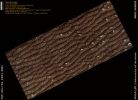
PSP_001736_2605_RED_abrowse.jpgOlympia Undae (Natural Colors; credits for the additional process. and color.: Dr Paolo C. Fienga - Lunexit Team)72 visiteThis observation shows Dark Dunes and light Polygonal Terrain in Olympia Undae, also known as the North Polar Erg.
Two sets of Dunes are obvious. The major set trends North-South, indicating winds from the East or West. Between the crests of these Dunes is a second set oriented mostly East-West.
Zooming in on the Dunes, a rippled texture is apparent, probably due to redistribution of sand at the scale of meters and less. Near the crests of some Dunes are Channel-like features, with some branching downslope. The origin of these Channels is unknown, but they may result from the flow and displacement of sand that was fluidized by sublimating CO2 or water frost.
Bright patches of ground are found in some inter-dune areas, with many having a polygonal texture.
Polygons on Earth form from contraction induced by stresses from dehydration, cooling and other processes, so these features may have a similar origin. The CRISM instrument on MRO and OMEGA on Mars Express indicates that many dunes in Olympia Undae are rich in the mineral Gypsum (---> gesso).MareKromium
|
|

Lutetia-01.jpgAsteroid "Lutetia"72 visiteAsteroid Lutetia will no longer remain a mystery as the European Space Agency's (ESA) Rosetta has captured the first close-up images of this Celestial Body, which will help them gain insights into the composition of the space rock that has long puzzled the scientists.
In what can be termed as the closest encounter with one of the largest asteroid, ever visited ESA led robotic spacecraft mission, Rosetta, raced past Lutetia as close as 3200 Km, with the closest encounter at 18:10 CEST (Central Europe Standard Time), when the spacecraft was just 3162 Km away from the giant asteroid.
Rosetta, which had a first look of Lutetia in January 2007, has this time “triumphed at asteroid” and captured images like never before.MareKromium
|
|

Black_Hole-PIA13275.jpgDisk around a massive "Baby Star"?72 visiteCaption NASA:"Astronomers have obtained the first clear look at a Dusty Disk closely encircling a massive "Baby Star", providing direct evidence that massive stars do form in the same way as their smaller brethren -- and closing an enduring debate.
This artist's concept shows what such a massive Disk might look like. The Flared Disk extends to about 130 times the Earth-Sun distance (such as 130 UA), and has a mass similar to that of the star, roughly twenty times the Sun. The inner parts of the Disk are shown to be devoid of dust).
Nota Lunexit: questa è dunque, according to NASA, la rappresentazione artistica di un Disco di polveri e materiale Primordiale posizionato attorno ad una giovane stella supermassiva.
Può anche darsi, ma secondo noi la NASA ha scelto male l'immagine da abbinare alla caption e questa, in effetti, è la rappresentazione artistica di un Buco Nero, oppure di un Quasar.
Chissà...MareKromium
|
|

PSP_002922_1725-PCF-GB-LXTT1.jpgUnusual Surface Feature on Arsia Mons' Flank (Natural Colors; credits for the additional process. and color.: Drr Gianluigi Barca & Paolo C. Fienga)72 visitenessun commentoMareKromium
|
|

SOL0583-2P178121605EFFAE03P2261L5M1.jpgHorizon - Sol 583 (Absolute Natural Colors; credits for the additional process. and color.: Dr Paolo C. Fienga - Lunexit Team)72 visitenessun commentoMareKromium
|
|
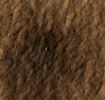
ESP_018273_2245_RED_abrowse-04-MF-LXTT.jpgExposed Ice in Fresh Crater (Natural Colors; credits for the additional process. and color.: Dr Marco Faccin - Lunexit Team)72 visitenessun commentoMareKromium
|
|

PSP_003234_2210-PCF-LXTT1.jpgThe "Face on Mars" (Natural Colors; credits for the additional process. and color.: NASA/JPL and Dr Paolo C. Fienga - Lunexit Team)72 visitenessun commentoMareKromium
|
|

OPP-SOL1036-1P220150783EFF77UNP2445L5M1.jpgOn the Edge of Victoria - Sol 1036 (Natural - but enhanced - Colors; credits: Paolo C. Fienga - Lunexit Team) 72 visitenessun commentoMareKromium
|
|

Japetus-PIA12706.jpgJapetus72 visiteCaption NASA:"Some of Japetus' Dark Surface interrupts the moon's lighter Terrain in this Cassini view.
Scientists continue to investigate the nature of this moon's dark and light Surface. Lit Terrain seen here is on the Trailing Hemisphere of Japetus. North on Japetus is up and rotated 10° to the right.
The image was taken in visible light with the Cassini Spacecraft narrow-angle camera on May 9, 2010. The view was acquired at a distance of approx. 1,3 MKM (about 808.000 miles) from Iapetus and at a Phase Angle of 95°.
Image scale is roughly 8 Km (about 5 miles) per pixel".MareKromium
|
|
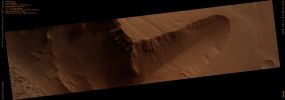
ESP_018374_1740_RED_abrowse.jpgWest Candor (Natural Colors; credits: Dr Paolo C. Fienga - Lunexit Team)72 visitenessun commentoMareKromium
|
|
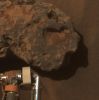
OPP-SOL2371-PIA13419.jpgIron Meteorite: Close View - Sol 2371 (Approx. True Colors; credits: NASA/JPL-Caltech/Cornell University)72 visiteCaption NASA:"This is an image of the Meteorite that NASA's Mars Exploration Rover Opportunity found and examined in September 2010. MER Opportunity's cameras first revealed the Meteorite in images taken on Sol 2363 (Sept. 16, 2010). This view was taken with the PanCam on Sol 2371 (such as Sept. 24th, 2010).
The science team used two tools on Opportunity's Arm - the Microscopic Imager and the Alpha Particle X-Ray Spectrometer - to inspect the rock's texture and composition. Information from the Spectrometer confirmed that the rock is a Nickel-Iron meteorite. The team informally named the rock "Oileán Ruaidh", which is the Gaelic name for an island off the coast of North-Western Ireland.
Opportunity departed Oileán Ruaidh and resumed its journey toward the mission's long-term destination, Endeavour Crater, on Sol 2374 (Sept. 28, 2010) with a drive of about 100 meters (328 feet).
This view, presented in Approximately True Color, combines component images taken through three PanCam filters admitting wavelengths of 601 nanometers, 535 nanometers and 482 nanometers". MareKromium
|
|
| 25353 immagini su 2113 pagina(e) |
 |
|
|
|
|
905 | |
|
|
|
|





