| Piú viste |

Venus~0.jpgNight-flight to Venus (by Roberto Tremolada)72 visitenessun commentoMareKromium
|
|

Kaguya-040-hdtv_057_l.jpgPythagoras Crater72 visiteCaption JAXA:"Here is a snapshot around the Central Peak of Pythagoras Crater (the center is located at about 63,5° North and 63° West; D = approx. 142 Km), obtained by HDTV-TELE at 2008/12/12 08:36:00 (UT)".MareKromium
|
|

PSP_002047_1890-3.jpgUnbelievable Surface Features... (credits: Dr G. Barca)72 visitenessun commentoMareKromium
|
|

Starburst_Spider_(ESP_011842_0980)-5_color.jpgStarburst Spiders (Natural Colors; credits: Dr G. Barca & Lunar Explorer Italia)72 visitenessun commentoMareKromium
|
|
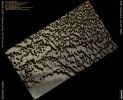
PSP_009324_2650_RED_abrowse.jpgNorth Polar Dunes (Natural Colors; credits: Lunar Explorer Italia)72 visitenessun commentoMareKromium
|
|

MA_ADIM_VALLIS-440-20090629-6393-6-co-01_H1-1.jpgProximities of Ma'adim Vallis (Natural Colors; credits: ESA)72 visiteCaption ESA:"Mars Express image of a Region close to Ma’adim Vallis, one of the largest - after Vallis Marineris - canyons on Mars.
The imaged Region lies South-East of Ma’adim Vallis; the pictures are centred at about 29° South Lat. and 182° East Long. and have a ground resolution of 15 mt/pixel.
Ma’adim Vallis is located between the Volcanic Province of Tharsis, which harbours 4 volcanoes, including the largest in the Solar System, and the Hellas Planitia Impact Basin.
The canyon, approx. 20 Km wide and 2 Km deep, originates in the Southern Highlands close to the so-called ‘Dichotomy Boundary’ and ends in Gusev Crater.
The Dichotomy Boundary is a narrow Region separating the cratered Highlands, located mostly in the Southern Hemisphere of Mars, from the Northern Hemisphere's Lowland Plains".MareKromium
|
|
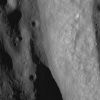
LRO-0007-375109main_lroc_20090730_burgcrater_full.jpgInside Bürg Crater72 visiteBürg is a 40-Km (about 25 miles) diameter, Copernican-aged, complex crater located within Lacus Mortis (the Lake of Death), on the Near-Side of the Moon.
Complex craters, like this one, have terraced walls and a Central Peak (not shown here). The Rim of the crater is along the right side and the walls slope down towards the left of the image.
The terrace is about 3,5 Km (about 2,2 miles) wide and is pockmarked with smaller craters. Terraces form as sections of the Crater wall slump downward after the impact (image width: about 7,9 Km across, roughly 4,9 miles).
Note that there are very few impact craters on the wall of the Crater. Usually fewer craters indicate a surface is younger, however in this case it's simply that material slides down the crater wall's steep slopes, erasing craters.
Note also that LROC, LRO's camera, is powerful enough to see a shadow cast by a boulder about 8 mt wide (about 26 feet) at the contact between the wall and the terrace near the top of the figure.MareKromium
|
|

OverMars.jpgOverMars (by Marco Faccin)72 visitenessun commentoMareKromium
|
|

Blue_Star-PIA12174.jpgSpace "Cube"72 visiteThis drawing illustrates the extent to which astronomers have been underestimating the proportion of small to big stars in certain galaxies. Data from NASA's Galaxy Evolution Explorer Spacecraft and the Cerro Tololo Inter-American Observatory in Chile have shown that, in some cases, there can be as many as four times more small stars compared to large ones.
In the drawing, a massive blue star is shown next to a stack of lighter, yellow stars. These big blue stars are 3 to 20 times more massive than our Sun, while the smaller stars are typically about the same mass as the Sun or smaller.
Before the Galaxy Evolution Explorer study, astronomers assumed there were 500 small stars for every massive one (lower stack on right). The new observations reveal that, in certain galaxies, this estimation is off by a factor of four; for every massive star, there could be as many as 2000 small counterparts (such as the entire stack - the "Cube" - on the right).MareKromium
|
|

TheRunners-1.gifUnusual "Star-like" Surface Feature and Dust Devils (CTX GIF-Movie; credits: Dr M. Faccin)72 visiteLa curiosa "Star-like" Surface Feature che abbiamo visto in innumerevoli frames Spirit, splende di luce fissa e non appare risentire nè del trascorrere del tempo (ergo dell'incedere del Sole nel - quasi - perennemente limpido Cielo di Marte), nè del vicino transito di svariati Dust-Devil (i quali, indubitabilmente, mentre spazzano le sue vicinanze, probabilmente scagliano anche polveri e detriti vari in direzione dell'Anomalìa).
Di che si tratta? Sicuramente NON di un image-artifact. Per il resto, dato che la lucentezza ed il colore del dettaglio sono costanti a tutte le ore del giorno, ci sta iniziando a venire il sospetto che l'Anomalìa potrebbe risplendere di luce propria...MareKromium
|
|

Craters-KaiserCrater-20091028a.jpgDunes inside Kaiser Crater (Daytime IR)72 visiteCoord.: 47,5° South Lat. and 19,6° East Long.MareKromium
|
|
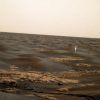
OPP-SOL2072-1P312124433ESFA9R5P2595L4M1-4.jpgA "Metallic Spindle" in the Meridiani Desert?!? - Sol 2072 (Possible True Colors - credits: Dr G. Barca)72 visiteL'Oggetto Sconosciuto che splende sotto i raggi del Sole è un Oggetto REALE. A nostro avviso, non ci sono dubbi.
La sua Natura ed i suoi scopi (ammesso che ne abbia e, volendo escludere l'ipotesi "Probe/oggetto in movimento", ammesso pure che non si tratti di una sorta di "rudere/relitto" - o magari un frammento di una struttura maggiore non visibile, poichè andata in pezzi...), ovviamente, sono destinati a rimanere un mistero...MareKromium
|
|
| 25353 immagini su 2113 pagina(e) |
 |
|
|
|
|
903 | |
|
|
|
|





