| Piú viste |

Psp_009757_2675_red.jpgHigh-Latitude Exposure of North Polar Layered Deposits (possible True Colors; credits: Lunar Explorer Italia)72 visiteMars Local Time: 14:41 (early afternoon)
Coord. (centered): 87,3° North Lat. and 77,4° East Long.
Spacecraft altitude: 342,6 Km (such as about 214,1 miles)
Original image scale range: 68,5 cm/pixel (with 1 x 1 binning) so objects ~2,06 mt across are resolved
Map projected scale: 50 cm/pixel
Map projection: EQUIRECTANGULAR
Emission Angle: 23,8°
Phase Angle: 47,9°
Solar Incidence Angle: 66° (meaning that the Sun is about 24° above the Local Horizon)
Solar Longitude: 117,8° (Northern Summer)
Credits: NASA/JPL/University of Arizona
Additional process. and coloring: Lunar Explorer ItaliaMareKromium
|
|

W-5_Star_Forming_Region-PIA11726.jpgIn the Cosmic Hurricane...72 visiteThis image from NASA's Spitzer Space Telescope shows the nasty effects of living near a group of massive stars: radiation and winds from the massive stars (white spot in center) are blasting planet-making material away from stars like our sun. The planetary material can be seen as comet-like tails behind three stars near the center of the picture. The tails are pointing away from the massive stellar furnaces that are blowing them outward. The picture is the best example yet of multiple sun-like stars being stripped of their planet-making dust by massive stars.
The sun-like stars are about 2 three 3 million years old, an age when planets are thought to be growing out of surrounding disks of dust and gas. Astronomers say the dust being blown from the stars is from their outer disks. This means that any Earth-like planets forming around the sun-like stars would be safe, while outer planets like Uranus might be nothing more than dust in the wind.
This image shows a portion of the W5 star-forming region, located 6,500 light-years away in the constellation Cassiopeia. It is a composite of infrared data from Spitzer's infrared array camera and multiband imaging photometer. Light with a wavelength of 3.5 microns is blue, while light from the dust of 24 microns is orange-red.MareKromium
|
|

SOL1785-2N284827960ESFAZ89P1561L0M1.jpgGusev Skyline - Sol 1785 (interp. n. 1 - possible True Colors; credits: Lunar Explorer Italia)72 visiteLa differenza fra l'interpretazione n. 1 e la n. 2 è nell'utilizzo, in fase di colorizzazione, di due filtri diversi: un filtro giallo (nell'interpretazione n. 1) oppure un filtro celeste (nell'interpretazione n. 2). E' curioso notare che, in accordo al nostro istogramma di trasformazione del bianco/nero in colore, anche in caso di non uso del filtro celeste, il Cielo di Marte comunque tende a schiarirsi ed a colorarsi di deboli sfumature azzurrine.
Il fatto che il Cielo di Marte, in TUTTE le elaborazioni NASA, resti sempre di colore giallo intenso/marroncino (Gusev, Chryse Planitia), o verdognolo (Meridiani), o bianco/giallo (Vastitas, Utopia Planitia), rimane, per noi, un mistero.MareKromium
|
|

Ice-5.JPGIcy Corals... (by Dr M. Faccin)72 visitenessun commentoMareKromium
|
|
SOL411-2P162859483EFFA800P2270L6M1.jpgPanorama (5) - Sol 411 (Natural Colors; credits: Lunar Explorer Italia)72 visitenessun commentoMareKromium
|
|

Civilization.jpgCivilization (by Roberto Tremolada)72 visitenessun commentoMareKromium
|
|
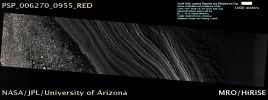
PSP_006270_0955_RED_abrowse~0.jpgSouth Polar Layered Deposits and Residual Ice Cap (natural colors; credits: Lunexit)72 visiteA wide variety of South Polar Terrains are on display in this spectacular HiRISE image. The reddish material on the left of the image is the SPLD. These deposits are a stack of layered, dusty water ice. Scientists believe that these layers record previous climatic conditions on Mars, much like terrestrial ice-sheets provide a record of climate change on the Earth.
This image shows the face of one of the many scarps or shallow cliffs that cut into the SPLD. These scarps expose the internal layers within the SPLD. You can see these climate-recording layers in the last2/3rds of the image, left side, running from lower-left to upper-right.
The terrain in the last third of the image is quite different in both appearance and composition. The bright, white-ish material is a thin covering of CO2 ice draped over the flat areas of the SPLD. This covering of CO2 is being eroded away by expanding flat-floored pits. Parts of the floors of these pits show the reddish brown coloring of the underlying SPLD.
These pits have eroded the CO2 ice layer to such an extent that only isolated mesas remain today and even these shrink in extent by a few meters each year.
These mesas also have several layers within them, indicting that they likely contain a climatic record, albeit a much shorter one than preserved in the SPLD.
Most of the isolated mesas have white-ish tops; however, some (near the foot of the SPLD scarp) have reddish tops. This may either be due to bright CO2 ice thinning to reveal the older (and darker) CO2 ice that makes up the main body of the mesa, or perhaps dust has settled out of the atmosphere to cover the brighter frost.
Remember that there was a large Martian Dust Storm earlier this year which could have caused either effect.MareKromium
|
|

SOL573-1-GB.jpgRocks, Rover Tracks, Pebbles and Pink Dust - Sol 573 (RAW True Colors; credits: Dr Barca)72 visiteUna necessaria precisazione: dopo i Natural, i True, i Possible Natural e True e gli Approximate Natural e True Colors, COSA SIGNIFICHERA' MAI "RAW True Colors"?
Significa che questa elaborazione addizionale costituisce il primo passo del processing che porta alle colorizzazioni Lunexit (Natural e True), ma non ne esaurisce l'iter.
Dopo questa prima colorizzazione, infatti, vengono operati degli aggiustamenti "ad hoc", i quali variano di volta in volta e considerano elementi quali l'Opacità Atmosferica, l'Ora Locale, il Filtro usato, la distanza media della camera dal Main Target etc.
E' anche per questo motivo che le colorizzazioni Lunexit sono - a nostro modo di vedere - "uniche": lo sono perchè vengono realizzate, di fatto, manualmente, in steps successivi e tenendosi conto di tutte le variabili rilevanti e conosciute.
La NASA (e ci scusino tanto gli Amici di Pasadena) non opera così (almeno: NON PUBBLICAMENTE...).
Ed idem dicasi per altri Artisti e Mastri Colorizzatori Americani, tanto cari alla NASA stessa (i quali producono una o due colorizzazioni l'anno.
Noi, qui, su Lunar Explorer Italia, ne produciamo a decine ogni giorno. In questo caso, così da rendere un dovuto omaggio ad uno dei nostri migliori colorizzatori (il Dr Gianluigi Barca - alias Big "G"), Vi proponiamo la colorizzazione RAW, senza "personalizzazione". Diciamo che Vi offriamo il primo passo di un processo che, prima di esaurirsi, di "passi" ne richiede davvero parecchi...
Meditate, Amici, meditate...MareKromium
|
|

SOL562-1-GB.jpgSkyline - Sol 562 (RAW Natural Colors; credits for the additional process. and color.: Dr Gianluigi Barca - Lunexit Team)72 visitenessun commentoMareKromium
|
|
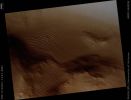
PSP_010447_1525_RED_abrowse.jpgKashira Crater (Natural Colors; credits: Lunar Explorer Italia)72 visiteMars Local Time: 15:44 (middle afternoon)
Coord. (centered): 27,0° South Lat. and 342,2° East Long.
Spacecraft altitude: 257,4 Km (such as about 160,8 miles)
Original image scale range: 51,5 cm/pixel (with 1 x 1 binning) so objects ~ 1,54 mt across are resolved
Map projected scale: 50 cm/pixel
Map projection: EQUIRECTANGULAR
Emission Angle: 0,3°
Phase Angle: 68,8°
Solar Incidence Angle:69° (meaning that the Sun is about 21° above the Local Horizon)
Solar Longitude: 143,7° (Northern Summer)
Credits: NASA/JPL/University of Arizona
Additional process. and coloring: Lunar Explorer ItaliaMareKromium
|
|

PSP_010460_2500_RED_abrowse.jpgVastitas' Texture (Enhanced Natural Colors; credits: Lunar Explorer Italia)72 visiteMars Local Time: 15:11 (early afternoon)
Coord. (centered): 69,6° North Lat. and 331,4° East Long.
Spacecraft altitude: 314,8 Km (such as about 196,7 miles)
Original image scale range: 63,0 cm/pixel (with 1 x 1 binning) so objects ~ 1,89 mt across are resolved
Map projected scale: 50 cm/pixel
Map projection: EQUIRECTANGULAR
Emission Angle: 0,2°
Phase Angle: 62,8°
Solar Incidence Angle: 63° (meaning that the Sun is about 27° above the Local Horizon)
Solar Longitude: 144,2° (Northern Summer)
Credits: NASA/JPL/University of Arizona
Additional process. and coloring: Lunar Explorer ItaliaMareKromium
|
|

ESP_011460_0980_RED_abrowse.jpgMonitor Seasonal Changes at a South Polar Cracked and Gullied Site (Natural Colors; credits: Lunar Explorer Italia)72 visiteMars Local Time: 17:02 (middle afternoon)
Coord. (centered): 81,7° South Lat. and 66,3° East Long.
Spacecraft altitude: 246,5 Km (such as about 154,1 miles)
Original image scale range: 49,3 cm/pixel (with 1 x 1 binning) so objects ~ 1,48 mt across are resolved
Map projected scale: 50 cm/pixel
Map projection: EQUIRECTANGULAR
Emission Angle: 1,2°
Phase Angle: 86,5°
Solar Incidence Angle: 85° (meaning that the Sun is about 5° above the Local Horizon)
Solar Longitude: 186,1° (Northern Autumn)
Credits: NASA/JPL/University of Arizona
Additional process. and coloring: Lunar Explorer ItaliaMareKromium
|
|
| 25353 immagini su 2113 pagina(e) |
 |
|
|
|
|
902 | |
|
|
|
|





