| |
| Piú viste |

NGC-6745.jpgNGC 6745 - Collision of Galaxies73 visite"...Whoever welcomes one such child in my name, welcomes me..."
Matthew, 18:5
|
|
IC-1805-1.jpgIC 180573 visite"...Quos vult perdere, Iupiter dementat prius..."
(ignoto)
"...Dio rende per prima cosa folli coloro dei quali si vuol disfare..."
Nota: sentenza usata per indicare coloro che, testardi sino alla follia, perseguono la propria rovina disprezzando od ignorando i consigli che vengono loro dati.
|
|

SNR-0103.jpgSNR 0103 - Supernova Remnant73 visite"...The poet is the priest of the invisible..."
Wallace Stevens (1879-1955) - "Adagia"
|
|

Coronal Loops-TRACE.jpgCoronal loops73 visiteDa "NASA - Picture of the Day" del 14 Agosto 2005:"Why is the Corona of the Sun so hot? Extending above the photosphere or visible surface of the Sun, the faint, tenuous Solar Corona can't be easily seen from Earth, but it is measured to be hundreds of times hotter than the photosphere itself. Astronomers have long sought the source of the Corona's heat in magnetic fields which loft monstrous loops of solar plasma above the photosphere. Detailed observations of coronal loops from the orbiting TRACE satellite are pointing more closely to the unidentified energy source. Recorded in extreme ultraviolet light, this and other TRACE images indicate that significant heating occurs low in the corona, near the bases of the loops as they emerge from and return to the solar surface. This tantalizing TRACE image shows clusters of the majestic, hot coronal loops which span 30 or more times the diameter of planet Earth".
|
|

SOU-SOL006-LandingSiteMap1.jpgThe pinpointing of the Mars Pathfinder Landing Site73 visitenessun commento
|
|
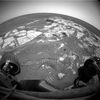
OPP-SOL591-1F180653216EFF60Y1P1201L0M1.jpgThe outcrops of Erebus Crater (1) - Sol 59173 visitenessun commento
|
|

Hyperion-N00040207.jpgHyperion (4)73 visiteSiamo a meno di 75.000 Km da Hyperion: il rilievo a forma ellissoidale a cui avevamo fatto cenno in precedenza (e che la NASA battezzerà certamente come "impact basin") si riesce a vedere molto bene, così come si vede molto bene che l'intera superficie di Hyperion, in tutte le direzioni, è (letteralmente) martoriata da crateri (crateri che, sulla base della nostra esperienza, presentano caratteristiche esteriori - diremmo una "conicità" pronunciata - tali da renderli decisamente anomali). Molto interessante, inoltre, potrebbe essere il rilievo - che abbiamo cerchiato in grigio - il quale è appena intuibile, fra luce ed ombra, sul Polo Nord apparente di Hyperion.
Forse una montagna? O forse, dopo una depressione posta proprio su quello che, in questi frames, appare come il Polo Nord di Hyperion, si innalza una nuova parete rocciosa di svariati Km? Noi non lo sappiamo, ma quello che vediamo ci spinge a credere che il record di altezza di un crepaccio (attualmente detenuto dalle "Verona Rupes") sia in pericolo.
|
|
DEM L 106-2.jpgN30B inside DEM L 106 Nebula73 visite"...Fallacia alia aliam trudit..."
(Terenzio)
"...Una menzogna (o "una cattiva azione") tira l'altra..."
|
|
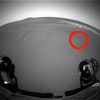
OPP-SOL608-1F182159290EFF62HEP1235R0M1.jpgLandscape from the Front-HazCam (2) - Sol 60873 visiteE così, mentre si parla di Anomalie et sim., ecco che un altra - a detta della NASA - "rarissima singolarità" emerge davanti agli occhi del Rover: l'ennesimo "mini-cratere" è servito.
Abbiamo già detto in passato di come questa circostanza, se la teoria esplicativa NASA/ESA fosse anche solo in minima parte realistica, dovrebbe farci pensare ad un'attività meteorica quasi ininterrotta (e ad un Rover sfacciatamente fortunato a non essersi ancora preso un bel macigno sulla "testa"...) oppure ad una "stasi totale" dell'ambiente Marziano di Meridiani (dato, quest'ultimo, contraddetto già più volte dalla NASA stessa la quale dice di aver rilevato venti piuttosto forti e frequenti nell'area attraversata da Opportunity).
E allora, tanto per essere pragmatici e per non cercare misteri sempre ed a tutti i costi, come vogliamo spiegare la presenza di questi mini-crateri? Attività recentissime o sabbie immobili? Se qualche Lettore avesse una teoria da proporre, basta che la scriva e ce la mandi...
|
|

Neptune-PIA00048.jpgNeptune in true colors, from Voyager 273 visiteOriginal caption:"This image of clouds in Neptune's atmosphere is the first that tests the accuracy of the weather forecast that was made eight days earlier (nota: questa caption è relativa all'Estate del 1989) to select targets for the Voyager narrow angle camera. Three of the four targeted features are visible in this photograph; all 3 are close to their predicted locations.
The "Great Dark Spot" with its bright white companion is slightly to the left of center. The small bright "Scooter" is below and to the left, and the second "Dark Spot" with its bright core is below the Scooter. Strong eastward winds up to 400 mph cause the second dark spot to overtake and pass the larger one every five days. The spacecraft was 6,1 MKM (about 3,8 MMs) from the Planet at the time of camera shuttering, and the images uses the orange, green and clear filters of the camera".
Qualche nota sui Voyager 1 e 2: Voyager 1, launched September 5, 1977, visited Jupiter in 1979 and Saturn in 1980. It is now leaving the solar system, rising above the ecliptic plane at an angle of about 35 degrees, at a rate of about 520 million kilometers a year.
Voyager 2, launched August 20, 1977, visited Jupiter in 1979, Saturn in 1981 and Uranus in 1986 before making its closest approach to Neptune on August 25, 1989. Voyager 2 traveled 12 years at an average velocity of 19 kilometers a second (about 42,000 miles an hour) to reach Neptune, which is 30 times farther from the Sun than Earth is. Voyager observed Neptune almost continuously from June to October 1989. Now Voyager 2 is also headed out of the solar system, diving below the ecliptic plane at an angle of about 48 degrees and a rate of about 470 million kilometers a year.
Both spacecraft will continue to study ultraviolet sources among the stars, and their fields and particles detectors will continue to search for the boundary between the Sun's influence and interstellar space. If all goes well, we will be able to communicate with the two spacecraft for another 20 years, until their radioactive power sources can no longer supply enough electrical energy to power critical subsystems.
|
|

NGC-6992-00.jpgNGC 699273 visiteSometimes, just before the sleep comes around me
Sweeping my eyes away, with his images
His dreams, his subtle metaphores and
His often obscure allegories that
Even though I try, striving beyond my limits,
I cannot understand and I never will,
I turn my eyes to God, so beautiful and yet
So far, sometimes,
And sometimes so close that, in the rapture
That divides watching from sleeping,
It seems to me that I could touch Him
And so, then, I barely touch Him:
But is only a reflection, elusive and flickering,
Like a portrait painted on water,
A portrait that even the sweetest and slightest touch
Shall inevitably shatter away…
And it really does not matter if that portrait, like a spell,
Shall rebuild itself once again and again, for maybe a million times,
The Artist does not care if his art, so perfect,
Must remain untouchable and elusive...
Some other times, before the sleep may catch me,
I turn my eyes to myself,
That myself who’s a Saint and a Sinner
So small and yet so great
Hidden inside me
Maybe better than me...
And so, in the darkness of the Night that surrounds me
Swept away by my thoughts
And by my memories, now so close and then so far
Tired, because of my fears and anxieties,
I indulge myself up to the waves of the hours
Hours that come and go, in a strange procession,
Too slow or too fast,
But not a single hour, anyway, lasts an hour only
In the Night that surrounds me
When my soul gropes in the darkness...
A starless and silent Night
A peaceful and yet shattered Universe
One beginning and one end, so close,
As close as the trails and the lights
Of a beautiful new Town, that is waiting for me
At the end of this road...
And so, in that peace that only the Awareness,
When enlightened by Pain and Hope can give,
I realize that nothing is really important
And, in the same time, that everything must be...
The face of an ant reminds me of buried brothers
Buried in the sand and fog of Time that has gone by
I cannot see them, but I can hear their voices:
They whisper the sweetest words
And so my eyes, flooded by useless tears, close.
And finally, there’s only the Night.
Paolo C. Fienga - "Poesie"
|
|

SOL621-8-Everest_L257atc-A622R1.jpgFragments of a "strange" Panorama - Sol 62173 visiteCaption NASA originale:"If a human with perfect vision donned a spacesuit and stepped onto the martian surface, the view would be as clear as this sweeping panorama taken by NASA's Mars Exploration Rover Spirit. That's because the Rover's PanCam has the equivalent of 20-20 vision. Earthlings can take a virtual tour of the scenery by zooming in on their computer screens many times to get a closer look at, say, a rock outcrop or a sand drift, without losing any detail. This level of clarity is unequaled in the history of Mars exploration.
It took Spirit 3 days, sols 620 to 622 (Oct. 1 to Oct. 3, 2005), to acquire all the images combined into this mosaic, called the "Everest Panorama", looking outward in every direction from the true Summit of Husband Hill. During that period, the sky changed in color and brightness due to atmospheric dust variations, as shown in contrasting sections of this mosaic".
|
|
| 25353 immagini su 2113 pagina(e) |
 |
|
|
|
|
882 | |
|
|
|
|
|
|





