| Piú viste |

Terra_Meridiani-The_Sentinels-M0001661-00.jpgUnusually-looking Features in Terra Meridiani (Original NASA/MGS/MSSS b/w CTX Frame)74 visitenessun commento
|
|

Acidalia_Region-M0300102-00.jpgBizarre-looking Troughs in Acidalia Region (1 - Original NASA/MGS/MSSS b/w CTX Frame)74 visiteLa NASA vede solo degli antichi canali, ormai totalmente secchi (dried out troughs), i quali presentano, nel loro letto, le curiose dunette che ormai conosciamo bene e che sembrano caratterizzare l'intero Pianeta Rosso. Altri vedono delle strutture tipo 'Gallerie Translucide' o, comunque, dei rilievi assolutamente anomali ed inspiegabili.
Le immagini, in questo caso, sono quello che sono: ed è troppo difficile esprimere un'opinione che non abbia il sapore del 'tirare ad indovinare'. Guardate i frames e poi maturate le Vostre opinioni. Provare ad andare oltre le sensazioni - in questo caso - ci sembra davvero difficile ed azzardato...
|
|

Noachis_Terra-M0705535-02.jpgBizarre-looking Features of Southern Noachis Terra: the "Source of the Dark (pseudo) Lake" (EDM n.1, taken from the Original NASA/MGS/MSSS b/w M0705535 Frame)74 visiteSi tratta di semplici rocce stratificate alle quali, forse in ragione della loro composizione, si è associato un fenomeno di ossidazione, oppure si è effettivamente aperta una crepa sul margine di questo grande cratere e, dall'interno di quel 'crack' - come pare essere accaduto in altre zone di Marte - è fuoriuscito qualcosa di...indefinibile che, alla fine, si è raccolto sul fondo del cratere stesso?
Le immagini, in questo caso, sembrano chiare: provate a giudicare Voi stessi...
|
|

SOL536-2N173952759EFFACB9P0683L0M1.jpgNew landscape, but an old stone... - Sol 53674 visiteQuesta sorpresa proprio non ce l'aspettavamo: guardate bene quella pietra scura indicata dalla freccia... Non ne ricordate una (diciamo) simile, MOLTO simile, vista un bel pò di tempo fa?
Provate ad andare nella Sez. Mars Spirit Anomalies, pagina 4, secondo e terzo frame della prima striscia di immagini (titolo: Natural or "man-made"?) e poi fate il raffronto. Certo, non sono pietre identiche ma - caspita - la somiglianza (tra forma e colore) è impressionante!
E se poi provate ad ingrandire leggermente il frame (senza esagerare, perchè l'immagine si sgrana subito), noterete anche uno o due dettagli in comune.
Un caso abbastanza impressionante, ma certo non l'unico: anche il nostro vecchio Amico "Roby" aveva trovato pietre simili (anzi: diremmo identiche), sia davanti a Spirit, sia davanti ad Opportunity (guardate il frame "One and the Same", inserito nell'ultima pagina di entrambe le Sez. dedicate alle Mars Spirit e Mars Opportunity Anomalies).
Che cosa ne potremmo dedurre?
|
|
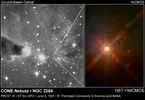
NGC-2264-1.jpgNGC 2264 - Deep inside the "Cone Nebula"74 visite"...What you get in science fiction is what someone once called ' the view from a distant star'. It helps us to see our World from outside..."
Frederik Pohl - "Wordsmiths of Wonder" (1993)
|
|

SNR-0103.jpgSNR 0103 - Supernova Remnant74 visite"...The poet is the priest of the invisible..."
Wallace Stevens (1879-1955) - "Adagia"
|
|

SOL572-2P177142231ESFADAEP2541R2M1.jpgInteresting rock (2) - Sol 57274 visiteForse si tratta di una cerchiatura inutile, ma qualche Lettore distratto lo troviamo sempre... Ecco quindi, ora bene evidenziata, una sostanziale Singolarità: c'è un bel buco (un ennesimo "foro"), dai contorni definiti, sulla parte della roccia alla Vostra Sx.
La NASA, questo tipo di Anomalie, non le commenta mai, ma se Voi avete qualcosa da dire...Allora scriveteci!
|
|

Hyperion-N00040207.jpgHyperion (4)74 visiteSiamo a meno di 75.000 Km da Hyperion: il rilievo a forma ellissoidale a cui avevamo fatto cenno in precedenza (e che la NASA battezzerà certamente come "impact basin") si riesce a vedere molto bene, così come si vede molto bene che l'intera superficie di Hyperion, in tutte le direzioni, è (letteralmente) martoriata da crateri (crateri che, sulla base della nostra esperienza, presentano caratteristiche esteriori - diremmo una "conicità" pronunciata - tali da renderli decisamente anomali). Molto interessante, inoltre, potrebbe essere il rilievo - che abbiamo cerchiato in grigio - il quale è appena intuibile, fra luce ed ombra, sul Polo Nord apparente di Hyperion.
Forse una montagna? O forse, dopo una depressione posta proprio su quello che, in questi frames, appare come il Polo Nord di Hyperion, si innalza una nuova parete rocciosa di svariati Km? Noi non lo sappiamo, ma quello che vediamo ci spinge a credere che il record di altezza di un crepaccio (attualmente detenuto dalle "Verona Rupes") sia in pericolo.
|
|
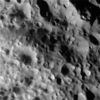
Hyperion-N00040329.jpgHyperion (13)74 visiteSiamo a circa 16.700 Km dalla superficie di Hyperion.
I dettagli che abbiamo cercato di portare alla Vostra attenzione tramire i frames precedenti si confermano.
Difficile pensare che questo tipo di superficie sia il prodotto di un semplice bombardamento meteorico...
|
|

M-031-6.jpgM 31 (infrared vision) - SST74 visite"...In una cultura che ha rinnegato la ragione e l’etica, il ruolo dell’intellettuale rischia di diventare assurdo. Ed è proprio quello che vogliono le classi dirigenti: fare dell’intellettuale un odioso grillo parlante che pretende di insegnare a vivere, magari rifiutando quei modelli di vita che vengono annunciati al mondo come nuovo vangelo, modelli fondati sul denaro (fatto non importa come, purché sia molto, moltissimo), sul lusso ostentato, sullo sfarzo e lo spreco.
Ma c’è un pericolo ancora più grave, ed è costituito dall’intellettuale che si fa servo del potere. È l’intellettuale (ma dovrei dire pseudo-intellettuale, perché ne è la versione corrotta ed aberrante) che, per vanità, per desiderio di condividere un’infinitesima parte di potere, per avidità o per debolezza, si fa araldo e difensore del potere, dell’asservimento, della prevaricazione, dell’ingiustizia...".
Paolo Cortesi
|
|

Prometheus&Pandora-PIA07612.jpgCosmic race: Prometheus and Pandora74 visiteSaturn's moon Prometheus (Sx) chases Pandora (Dx) in this Cassini view, but the outcome of their race has already been decided by gravity. Prometheus orbits closer to Saturn and thus moves faster than does Pandora. This view is from a third of a degree (1/3°) beneath the Ringplane. Familiar Ring features that are visible from higher angles above the Rings are foreshortened here. The Planet's dark shadow stretches across the Ringplane at center.
The image was taken in visible light with the Cassini spacecraft narrow-angle camera on Sept. 8, 2005, at a distance of approx. 1,8 MKM (such as about 1,1 MMs) from Saturn. The image scale is 10 Km (about 6 miles) per pixel on Prometheus and Pandora.
|
|

Neptune-PIA00048.jpgNeptune in true colors, from Voyager 274 visiteOriginal caption:"This image of clouds in Neptune's atmosphere is the first that tests the accuracy of the weather forecast that was made eight days earlier (nota: questa caption è relativa all'Estate del 1989) to select targets for the Voyager narrow angle camera. Three of the four targeted features are visible in this photograph; all 3 are close to their predicted locations.
The "Great Dark Spot" with its bright white companion is slightly to the left of center. The small bright "Scooter" is below and to the left, and the second "Dark Spot" with its bright core is below the Scooter. Strong eastward winds up to 400 mph cause the second dark spot to overtake and pass the larger one every five days. The spacecraft was 6,1 MKM (about 3,8 MMs) from the Planet at the time of camera shuttering, and the images uses the orange, green and clear filters of the camera".
Qualche nota sui Voyager 1 e 2: Voyager 1, launched September 5, 1977, visited Jupiter in 1979 and Saturn in 1980. It is now leaving the solar system, rising above the ecliptic plane at an angle of about 35 degrees, at a rate of about 520 million kilometers a year.
Voyager 2, launched August 20, 1977, visited Jupiter in 1979, Saturn in 1981 and Uranus in 1986 before making its closest approach to Neptune on August 25, 1989. Voyager 2 traveled 12 years at an average velocity of 19 kilometers a second (about 42,000 miles an hour) to reach Neptune, which is 30 times farther from the Sun than Earth is. Voyager observed Neptune almost continuously from June to October 1989. Now Voyager 2 is also headed out of the solar system, diving below the ecliptic plane at an angle of about 48 degrees and a rate of about 470 million kilometers a year.
Both spacecraft will continue to study ultraviolet sources among the stars, and their fields and particles detectors will continue to search for the boundary between the Sun's influence and interstellar space. If all goes well, we will be able to communicate with the two spacecraft for another 20 years, until their radioactive power sources can no longer supply enough electrical energy to power critical subsystems.
|
|
| 25353 immagini su 2113 pagina(e) |
 |
|
|
|
|
865 | |
|
|
|
|





