| Piú viste |

PSP_009342_1725_RED_JP2-01.jpgRolling, Rolling, Rolling Rocks... (2)75 visitenessun commentoMareKromium
|
|

SOL1959-Panoramic-GB.jpgRocky Skyline - Sol 1959 (Natural Colors; credits: Dr G. Barca)75 visitenessun commentoMareKromium
|
|

Titan-PIA11567.jpgTitan's Atmosphere... (Natural Colors; credits: Lunar Explorer Italia)75 visiteCaption NASA:"The Cassini Spacecraft looks at Saturn's largest moon, Titan, revealing its halo-like ring formed in the upper hazes of the moon's extensive Atmosphere.
This view looks toward the darkened Leading Hemisphere of Titan, but lit terrain seen here is on on the Trailing Hemisphere and anti-Saturn side of the moon.
The moon's North Pole lies on the Terminator between the illuminated and unilluminated parts of the moon. The Pole is rotated 11° to the right in this image.
The image was taken with the Cassini Spacecraft narrow-angle camera on July 5, 2009 using a spectral filter sensitive to wavelengths of UltraViolet light centered at 338 nanometers. The view was acquired at a distance of approx. 1,3 MKM (about 808.000 miles) from Titan and at a Sun-Titan-Spacecraft, or Phase, Angle of 148°.
Image scale is roughly 8 Km (about 5 miles) per pixel".MareKromium
|
|
SOL1957-2N300122271EFFB1E5P1901R0M1-2.jpgSunset - Sol 1957 (Natural Colors; credits: Dr G. Barca)75 visitenessun commentoMareKromium
|
|

Titan-Regions-Senkyo_Region-PIA11577-02.jpgLight and dark Surface Features of Senkyo (possible Natural Colors; credits: Lunexit)75 visiteCaption NASA:"The Cassini Spacecraft peers through the hazy Atmosphere of Titan for a close view of light and dark Terrain on Saturn's largest moon.
This view is centered on Terrain at 28° South Lat. and 334° West Long. and shows a small part of the albedo feature named Senkyo on the Trailing Hemisphere of Titan.
The image was taken with the Cassini Spacecraft narrow-angle camera on July 9, 2009 using a spectral filter sensitive to wavelengths of Near-InfraRed Light centered at 938 nanometers. The view was obtained at a distance of approx. 251.000 Km (such as about 156.000 miles) from Titan and at a Sun-Titan-Spacecraft, or Phase, Angle of 27°.
Image scale is about 1 Km (3281 feet) per pixel".MareKromium
|
|

LRO-1002-392723-MainCabaeus_full.jpgLCROSS Impact Location75 visitenessun commentoMareKromium
|
|
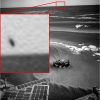
OPP-SOL2022-1N307687655EFFA7ARP1943L0M1-3.jpgImage-Artifact? - Sol 2022 (by Dr G. Barca)75 visitenessun commentoMareKromium
|
|

ShootingStar.jpgShooting Star75 visiteDa "NASA - Picture of the Day" del giorno 15 Ottobre 2009:"The brilliant fireball meteor captured in this snapshot was a startling visitor to Tuesday evening's twilight skies over the city of Groningen (NL).
In fact, sightings of the meteor, as bright as the Full Moon, were widely reported throughout the Netherlands and Germany at approximately 17:00 UT. Accompanied by sonic booms and rumbling sounds, the meteor was seen to break up into bright fragments, eventually leaving a persistent smoke-like trail.
Even though there are bright fireball meteors in planet Earth's Atmosphere every day, sightings of them are relatively rare because they more often occur over oceans and uninhabited areas".MareKromium
|
|
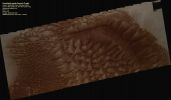
Craters-Russel_Crater-20091019a.jpgUnusually-looking Dunefield inside Russel Crater (Natural Colors; credits: Lunexit)75 visitenessun commentoMareKromium
|
|

ESP_014380_1775_RED_abrowse-02.jpgExtremely Unusually-looking Skylight (SuperEDM n.2 - credits: Dr G. Barca)75 visitenessun commentoMareKromium
|
|

ESP_014033_1910-01.jpgLayers and Ripples in Arabia Terra (EDM n.1 - Natural Colors; credits: Dr M. Faccin & Lunexit)75 visite...A proposito della "Natura come Arte"...MareKromium
|
|
OPP-SOL1009-1P217765022EFF768UP2432R2M1~0.jpgAround Victoria Crater - Sol 1009 (Natural Colors; credits: Lunexit)75 visitenessun commentoMareKromium
|
|
| 25353 immagini su 2113 pagina(e) |
 |
|
|
|
|
858 | |
|
|
|
|





