| Piú viste |

OPP-SOL1162-1N231354490EFF82K5P0755L0M1.jpgThe pink, morning Sky of Mars (2) - Sol 116275 visitenessun commentoMareKromium
|
|

Titan-PIA09034_H-1.jpgCrescent Titan75 visiteHuygens scored a first in 2005 by measuring the electrical conductivity of Titan’s atmosphere. The results hint at a new way to investigate the subsurface layers of Titan and could provide insight into whether or not Titan has a subsurface ocean.
The Permittivity, Waves and Altimetry (PWA) sensor on the Huygens Atmosphere Structure Instrument (HASI) detected an extremely low frequency (ELF) radio wave during the descent. It was oscillating very slowly for a radio wave, just 36 times a second, and increased slightly in frequency as the probe reached lower altitudes.
If the PWA team confirms that the signal is a natural phenomenon and not an artefact of the way the instrument worked, they will have discovered a powerful new way to probe not just the atmosphere of Titan but its subsurface as well.
The only other world on which ELF waves were detected before was Earth. They are reflected by both the surface of the Earth and its ionosphere, the rarefied region of the atmosphere where most particles are electrically charged. This turns the atmosphere into a giant ‘sound box’ where certain frequencies of ELF waves resonate and are reinforced, whilst other die away.
On Titan, however, the surface is a poor reflector because of its low conductivity and so these waves penetrate the interior. “The wave could have been reflected by the liquid-ice boundary of a subsurface ocean of water and ammonia predicted by theoretical models,” says Fernando Simões, CETP/IPSL-CNRS, France, and a member of the PWA team.
If Simões is right, successful modelling of how ELF waves resonate on Titan could lend support to the ocean’s existence and tell scientists about the depth at which it sits. Understanding the resonance however, is difficult.
Above about 100 kilometres altitude on Earth, the ionosphere provides the upper reflecting layer of the resonating cavity. At Titan, PWA revealed that things are more complicated. Apart from the ionosphere, at a much higher altitude of about 1200 kilometres, Huygens found a layer of ionized particles consisting of electrons, at 63 kilometres. “This does not match any previous prediction for Titan,” says Simões. To some extent, it splits Titan’s atmosphere into two resonating chambers.
With so much at stake, the PWA team are checking to make sure the detection is real and not an artefact generated by the spacecraft. They have already ruled out electrical interference from the instrument itself.
Two small arms, one on either side of Huygens, create an antenna and the team’s next goal is to investigate whether the arms could have oscillated during the descent. Simões and colleagues are building a special chamber to hold a replica of the instrument at the low temperature of Titan’s atmosphere, between 100-200 degrees Kelvin (about -173 to -73 °C), in order to check whether the antenna resonates at 36 hertz. If it does, it probably means that the signal is an artefact. If it does not, confidence in the signal’s reality will increase and the investigation of the atmosphere and subsurface can begin.
But perhaps the biggest mystery is what generated the ELF wave in the first place. On Earth, they are initiated by lightning strikes that make electrons in the atmosphere oscillate, releasing the ELF waves.
The PWA was designed to search for ELF waves on Titan while a microphone on Huygens kept an ear out for thunder – a sure sign of lightning. Cassini has also been watching for lightning using its cameras.
However, Huygens suggests that there is no lightning, or very little. “If there is lightning on Titan, it is significantly less than the amount of lightning that Earth experiences,” says Simões. So what generated Titan’s ELF? No one is quite sure yet. “It might be generated by an interaction with Saturn’s magnetosphere or related to Titan’s intrinsic fields,” suggests Simões. “Titan is proving to be an intriguing environment.”
One thing is certain: there is plenty to investigate. “The measurement of atmospheric electricity is something really new and exciting,” says Jean-Pierre Lebreton, ESA Huygens Project Scientist. “We could send similar instruments to study atmospheric electricity on other celestial bodies, in particular Venus, Mars, and the giant planets,” adds Simões.
The PWA team expect to release more definitive results when their investigation is complete.
MareKromium
|
|

005-vg2_2686312.jpg016-Uranus' Fly-By (2 - natural colors; elab. Lunexit)75 visitenessun commentoMareKromium
|
|

as17-152-23301.jpgAS 17-152-23301 - The Moon (elab. in true colors by Lunexit)75 visitenessun commentoMareKromium
|
|

Voyagers-02.jpgMessage in a "Bottle"...75 visiteCaption NASA:" Launched 30 years ago, NASA's Voyager 1 and 2 Spacecraft are now respectively 15 and 12,5 BKM from the Sun, equivalent to about 14 and 11,5 Light-Hours distant. Still functioning, the Voyagers are being tracked and commanded through the Deep Space Network. Having traveled beyond the outer planets, they are only the third and fourth spacecraft from planet Earth to escape toward interstellar space, following in the footsteps of Pioneer 10 and 11.
A 12" gold plated copper disk (a phonograph record) containing recorded sounds and images representing human cultures and life on Earth, is affixed to each Voyager - a Message in a Bottle, cast into the Cosmic Sea.
The recorded material was selected by a committee chaired by astronomer Carl Sagan. Simple diagrams on the cover symbolically represent the Spacecraft's origin and give instructions for playing the disk. The exotic construction of the disks should provide them with a long lifetime as they coast through the interstellar space". MareKromium
|
|

Japetus-N00092000.jpgThe "Cassini Regio" of Japetus (1) - possible natural colors; elab. Lunexit75 visiteCaption NASA:"Iapetus, Saturn's third largest moon, is a candidate for the strangest moon of Saturn. Tidally locked in its orbit around the Ringed Gas Giant, Iapetus is sometimes called the "Yin-Yang Moon" because its Leading Hemisphere is very dark, reflecting about 5% of the Sun's light, while its Trailing Hemisphere is almost as bright as snow. This recent Cassini spacecraft flyby image is one of the closest views ever and spans about 35 Km across a cratered transition zone between bright and dark terrain. Iapetus itself has a density close to that of water ice, but the detailed reflective properties of the dark material suggest an organic composition.
Honoring the moon's discoverer, the dark terrain is called Cassini Regio".MareKromium
|
|

APOLLO_11_AS_11-37-5440_HR-1.jpgF.M.O. (Fast Moving Object) near Apollo 11 - AS 11-37-5440 (context frame)75 visitenessun commentoMareKromium
|
|
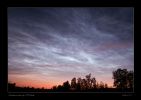
NoctilucentClouds.jpgNoctilucent Clouds over Sweden75 visiteCaption NASA:"Sometimes it's night on the ground but day in the air. As the Earth rotates to eclipse the Sun, sunset rises up from the ground.
Therefore, at sunset on the ground, sunlight still shines on clouds above. Under usual circumstances, a pretty sunset might be visible, but unusual noctilucent clouds float so high up they can be seen well after dark.
Pictured above last month (September 2007), a network of noctilucent clouds cast a colorful but eerie glow after dusk near Vallentuna, Sweden.
Although noctilucent clouds are thought to be composed of small ice-coated particles, much remains unknown about them. Satellites launched to help study these clouds includes Sweden's Odin and NASA's AIM.
Recent evidence indicates that at least some noctilucent clouds result from freezing water exhaust from Space Shuttles".MareKromium
|
|

SOL1362-Reconstruction.jpgSpirit and the "Tepee" (a reliable reconstruction)75 visiteUna bellissima ricostruzione/photo-collage realizzata dal Dr Faccin, ci fa vedere le migliori inquadrature disponibili del "Tepee" ed evidenzia altresì alcune delle sue più bizzarre caratterizzazioni superficiali.
Come avevamo subito sospettato osservando le immagini, il terreno nelle immediate prossimità del "Tepee" è fortemente disturbato e, come il collage del bravissimo Dr Faccin prova a dimostrare, il disturbo potrebbe essere/è stato causato dallo stesso Rover, il quale si sarebbe/è avvicinato al rilievo anomalo sin quasi a toccarlo.
Solo sospetti e speculazioni?
Diremmo di no, poichè abbiamo tutti imparato a riconoscere le tracce che il Rover lascia sul terreno sul quale si muove (e, in parte, si trascina) e, a ben guardare, le tracce esistenti nei pressi del "Tepee" sono difficilmente controvertibili...
A questo punto, se la ricostruzione grafica del Dr Faccin fosse corretta, le domande diventerebbero del tutto ovvie.
Per esempio: dove sono le foto che Spirit ha scattato al Tepee quando è giunto sin quasi a toccarlo?
Certo, si potrebbe dire che di foto del "Tepee" non ne vengono mostrate perchè non ce ne sono...
Va bene, noi potremmo anche crederci, ma a quel punto sarebbe inevitabile chiedersi la ragione per cui la NASA continua a scattare innumerevoli fotografie a sassetti, terriccio e polveri (ottenendo migliaia di frames fiacchi, irrilevanti e ripetitivi) e poi ignora - deliberatamente? - un rilievo che (ne siamo certi) non può non affascinare chi lo guarda...
O forse gli Amici di Pasadena non hanno notato il "Tepee"?
O forse sono proprio i rilievi come il "Tepee" ad essere vuoti ed irrilevanti?
Che dire? Complimenti - come sempre - al Dr Faccin; per il resto...occorre aspettare, osservare, valutare e porsi domande.
Sempre.
MareKromium
|
|

Kaguya-013-20071128_kaguya_tc02_04.jpgDyson Crater (2)75 visitenessun commentoMareKromium
|
|

NGC-1973-1975-1977.jpgNGC 1973, 1975 and 197775 visite"...Cui fu donato in copia,
Doni con volto amico,
Con quel tacer pudico,
Che accetto il don ti fa..."
(A. Manzoni)MareKromium
|
|

SN-Cassiopeia_A_-PIA10206.jpgCassiopeia "A" - Supernova Remnants75 visite"...L'Arte rappresenta l'unica forma di collaborazione fra Dio e l'uomo; e meno l'uomo fa, meglio è..."
(André Gide)MareKromium
|
|
| 25353 immagini su 2113 pagina(e) |
 |
|
|
|
|
853 | |
|
|
|
|





