| Piú viste |

OPP-SOL2410-GB-LXTT-NavCam.jpgIntrepid Crater - Sol 2410 (an Image-Mosaic in RAW Natural Colors by Dr Gianluigi Barca - Lunexit Team)77 visitenessun commentoMareKromium
|
|
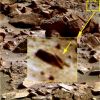
OPP-SOL2161-GB-IT-LXXT5.jpgExtremely unusually-looking Surface Feature: The "Mouse-Trap" (CTX Frame - credits for the additional process. and color.: Ivana Tognoloni - Lunexit Team)77 visitenessun commentoMareKromium
|
|
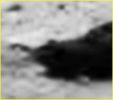
OPP-SOL2167-1N320567338EFFABJKP1986L0M1-IT-02.jpgMartian Gargoyles: "The Beaver" - Sol 2167 (EDM n.2 - credits for the research and add. process.: Ivana Tognoloni - Lunexit Team)77 visitenessun commentoMareKromium
|
|
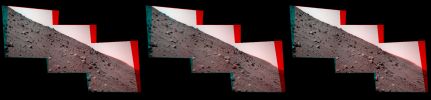
SOL1651-MF-LXTT-1.jpgRocky Landscape - Sol 1651 (High-Def-3D and Superdefinition; credits for the additional process. and color.: Dr Marco Faccin - Lunexit Team)77 visitenessun commentoMareKromium
|
|

Dione-PIA12743.jpgErulus Crater (Absolute Natural Colors; credits for the additional process. and color.: Dr Paolo C. Fienga - Lunexit Team)77 visiteCaption NASA:"The Cassini spacecraft snapped this shot of cratered Dione as it flew by the Saturnian moon on Oct. 17, 2010. The large crater at the center of the image is Erulus, which is about 120 Km, or approx. 75 miles, across. This view looks toward the Southern Latitudes of the Leading Hemisphere of Dione.
The image was taken in Visible Light with the Cassini Spacecraft narrow-angle camera. The view was acquired at a distance of approximately 41.000 Km (such as about 25.000 miles) from Dione and at a Sun-Dione-Spacecraft, or Phase, Angle of 53°.
Image scale is roughly 240 meters (787 feet) per pixel".MareKromium
|
|

OPP-SOL2298-PIA13709.jpgCape Tribulation - Sol 2298 (Super-Resolution; credits: NASA/JPL-Caltech/Cornell University)77 visiteCaption NASA:"NASA's MER Opportunity used its PanCam in a Super-Resolution technique to record this Eastward View of the Horizon on the 2298th Sol of the Rover's work on Mars (July 11, 2010).
Rising above the Horizon in the right half of the image is a portion of the Western Rim of Endeavour Crater, including a ridge informally named "Cape Tribulation".
Super-resolution is an imaging technique combining information from multiple pictures of the same target in order to generate an image with a higher resolution than any of the individual images".MareKromium
|
|

OPP-SOL2450-PIA13707.jpgSanta Maria Crater - Sol 245077 visiteNASA's Mars Exploration Rover Opportunity used its NavCam to record this view of Santa Maria Crater at the end of a drive during the 2450th Sol of the Rover's work on Mars (Dec. 15, 2010). The drive brought Opportunity to the Western Edge of this crater, and this view is Eastward across it.
Santa Maria Crater is about 90 meters (295 feet) in diameter. The rover team plans to spend a few weeks investigating this small Crater before resuming Opportunity's long-term trek toward Endeavour Crater".
Nota Lunexit: la NASA, in realtà, nella sua "Caption Originale" del Planetary Photojournal ha scritto "before resuming Opportunity's long-term trek toward Endurance Crater". Che questa "svistina" degli Amici di Pasadena (svistina che se l'avessimo presa noi ci sarebbe valsa la nomea imperitura di p.p. (poveri pirla) Vi sia di monito sull'attenzione e la cura che costoro impiegano nel redigere i commenti ai loro frames.
E cioè zero o quasi (ovviamente le loro captions non se rileggono neppure). Meditate Amici, meditate...MareKromium
|
|

PSP_005387_1935_RED_abrowse-00-PCF-LXTT.jpg"Sinuous" Collapse Pits on Ascraeus Mons (Absolute Natural Colors; credits for the additional process. and color.: Dr Paolo C. Fienga - Lunexit Team)77 visitenessun commentoMareKromium
|
|
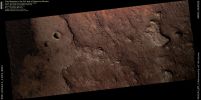
PSP_006625_1405_RED_abrowse-00-PCF-LXTT.jpgClay Minerals in the NW side of Bosporos Montes (Absolute Natural Colors; credits for the additional process. and color.: Dr Paolo C. Fienga - Lunexit Team)77 visiteThe Bosporos Montes make up part of the Rim of the giant Argyre Impact Basin on Mars. The Compact Reconnaissance Imaging Spectrometer (CRISM) identified this as a location with Clay Minerals (---> minerali a matrice argillosa). Such minerals contain water and may have formed under conditions favorable for life.
This HiRISE image was taken to support the CRISM Team’s investigation of this area. While HiRISE does not have the ability to identify minerals the way CRISM can, the enhanced colors in this image are similar to those seen in other Clay-containing parts of Mars.
The light-toned Mesas and Plains are crisscrossed with small Fractures that could have formed as a muddy Clay Deposit dried. However, this material is strong enough to form Boulders where it has been hit by Impact Craters.MareKromium
|
|
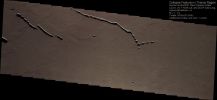
Volcanic_Features-Collapse_Pit_Chains-Tharsis-MO-PCF-LXTT.jpgPit-Chains in Tharsis (Absolute Natural Colors; credits for the additional process. and color.: Dr Paolo C. Fienga - Lunexit Team) 77 visitenessun commentoMareKromium
|
|
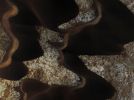
PSP_005684_1890_RED_abrowse-01.jpgDark Dunefield in Nili Patera Caldera (EDM - Enhanced Absolute Natural Colors; credits for the additional process. and color.: Dr Paolo C. Fienga - Lunexit Team)77 visitenessun commentoMareKromium
|
|

OPP-SOL1045-MI-MF-LXTT-4.jpgOn the Surface of Meridiani Planum... - Sol 1045 (Superdefinition; credits for the additional process. and color.: Dr Marco Faccin - Lunexit Team)77 visitenessun commentoMareKromium
|
|
| 25353 immagini su 2113 pagina(e) |
 |
|
|
|
|
829 | |
|
|
|
|





