| Piú viste |

OPP-SOL287-1P153661918EFF37MIP2270L7M1.jpg"Burns Cliff": the inner wall of Endurance Crater (2)78 visitenessun commento
|
|

NGC-2683.jpgNGC 2683 - Spiral Galaxy78 visite"...Quae Fato manent, quamvis significata, non vitantur..."
(Tacito)
"...Gli eventi che appaiono scritti nel Destino, sebbene possano (talvolta) essere intuiti, non si possono (mai) evitare..."
(nota: la possibile visione/comprensione - che Tacito, in questo passaggio, chiama "significata" - del futuro, non fa venir meno la sua inevitabilità. E' una mera boutade filosofica, quella espressa da Tacito - e da tanti altri... -, oppure si tratta dell'embrione di un Principio Scientifico Universale il quale è sempre e comunque presente in noi, anche quando non siamo "uomini di scienza"?)
|
|

OPP-SOL328-1P157306731EFF40A3P2360L2M1.jpgThe Heat-Shield and its surroundings (2)78 visiteIl "cratere" da impatto prodottosi a seguito dell'urto dello Scudo con il Suolo Marziano. Così, ad occhio, sembrano vedersi delle aree "scure" che assomigliano a delle bruciature (ma potrebbe anche trattarsi di un'illusione causata dal particolare filtro-colore usato). Voi che ne dite?!?
|
|

OPP-SOL332-1N157664885EFF40B8P1997L0M1.jpgClose encounter with the Heat-Shield - Sol 33278 visiteUna spettacolare e ravvicinatissima ripresa di alcuni frammenti dello Scudo Termico e del suolo di Marte il quale sembra mostrare qualche "ferita" da impatto.
|
|

NGC-4039_-_HST.jpgNGC 4039 - The "Antennae" Colliding Galaxies78 visite"...A tragic situation exists when virtue does not triumph but when it is still felt that man is nobler than the forces that destroy him..."
George Orwell - "Lear, Tolstoy and the Fool"
|
|

Comets-Comet_Machholz-Pleiades.jpgComet Machholz and M 4578 visiteRipresa amatoriale (ma di grande effetto scenico) effettuata il giorno 9 Gennaio 2005 dalla Germania - Baviera (località Oberjoch) dal Sig. Stefan Seip. Perfetta la visione della chioma - color verde/acqua - della Cometa (le dimensioni stimate della chioma stessa si aggirano intorno ai 500.000 Km mentre il suo nucleo roccioso dovrebbe avere un diametro compreso fra i 5/7 Km) e molto suggestiva la combinazione (ma si tratta, come ovvio, di un semplice effetto prospettico) fra l'alone blu proprio di M 45 e la coda ionica (anch'essa vagamente bluastra) della Cometa Machholz. Da notarsi che le dimensioni ridotte (ma solo in apparenza) della coda di Machholz (la quale si estende per svariati milioni di Km - 8/10) dipendono anch'esse da un semplice effetto prospettico il quale sfavorisce la nostra osservazione.
|
|

Vega-PIA07218_fig1.jpgVega78 visiteCaption NASA originale:"NASA's Spitzer Space Telescope recently captured these images of the star Vega, located 25 LY away in the constellation Lyra. SST was able to detect the heat radiation from the cloud of dust around the star and found that the debris disc is much larger than previously thought.
This side by side comparison, taken by Spitzer's multiband imaging photometer, shows the warm infrared glows from dust particles orbiting the star at wavelengths of 24 microns (in blue) and 70 microns (in red).
Both images show a very large, circular and smooth debris disc. The disc radius extends to at least 815 Astronomical Units. (One astronomical unit is the distance from Earth to the Sun, which is 150 MKMs or 93 MMs).
Scientists compared the surface brightness of the disc in the infrared wavelengths to determine the temperature distribution of the disc and then infer the corresponding particle size in the disc. Most of the particles in the disc are only a few microns in size. These fine dust particles originate from collisions of embryonic planets near the star at a radius of approximately 90 astronomical units, and are then blown away by Vega's intense radiation. The mass and short lifetime of these small particles indicate that the disc detected by Spitzer is the aftermath of a large and relatively recent collision, involving bodies perhaps as big as the planet Pluto".
|
|
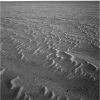
OPP-SOL358-1P159971557EFF40FWP2372L7M1.jpg"Side-Winders" from Sol 358 (1)78 visiteDal Sol 358 del Rover Opportunity, ci arrivano queste immagini dell'orizzonte di Meridiani Planum e delle sue incredibili dune che noi abbiamo battezzato "Side-Winders" (espressione difficilmente traducibile - lett. "lato del vento" - la quale sta a significare un "movimento ondeggiante e sinuoso", proprio come quello che vediamo caratterizzare le forme delle dunette che circondano Opportunity).
Questa immagine è stata ripresa con il "filtro 7".
Inutile dire che sull'origine di queste formazioni sabbiose stiamo ancora brancolando nel buio...
|
|
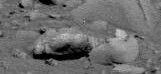
SOL392-detail2-2P161170457EFFA400P2369L7M1.jpg"Clear - Unclear Rock" - from Sol 39278 visiteUna roccia piuttosto lunga che, nel suo lato inferiore, ci mostra dei rilievi piuttosto chiari e marcati, quasi certamente di origine naturale; tuttavia, se poi guardate verso il suo margine superiore, noterete una sorta di "arco" (rivolto verso il basso) che divide la "porzione NITIDA" della roccia da un'altra "porzione OPACA" e dai margini confusi ed indistinti. La porzione inferiore della roccia è anche "luminosa" (bianca, in alcuni punti, come se fosse lucida e riflettesse i raggi del Sole); la porzione superiore è "buia" e "grigia". Elaborando lil dettaglio - nonostante la povera definizione - emergono con chiarezza "piallature" e "tagli".
Che cosa sia la roccia "Chiara-Non Chiara" non lo sappiamo, ma che il frame sia stato MANIPOLATO è del tutto evidente!
|
|
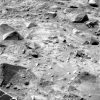
SOL422-2P163830012EFFA890P2377L2M1.jpgFlat, conical and squared stones on Sol 422 (3)78 visitenessun commento
|
|

OPP-SOL128-1N139562156EFF3031P1981L0M1.jpgOn the edge... - Sol 12878 visitenessun commento
|
|

Craters-Geopert_Crater-PIA00269.jpgMagellan Probe: radio image of Geopert-Meyer Impact Crater78 visiteCaption NASA originale:"During the third global cycle of Magellan's radar mapping mission, images were obtained at viewing angles that were slightly different than those used in the first two cycles. This strategy was designed to produce stereo image pairs, which take advantage of distortions induced by the different views to provide details of the surface topography. This is a stereo image pair of Crater Geopert-Meyer, named for the 20th Century Polish physicist and Nobel laureate (60° north latitude; 26,5° east longitude). The Crater, 35 Km (22 miles) in diameter, lies above an escarpment at the edge of a ridge belt in southern Ishtar Terra. West of the crater the scarp has more than 1 Km of relief. Perception of relief may be obtained with stereo glasses or a stereoscope".
|
|
| 25353 immagini su 2113 pagina(e) |
 |
|
|
|
|
807 | |
|
|
|
|





