| Piú viste |

Rhea-PIA09799.jpgRising Rhea (natural colors; credits: Lunexit)79 visiteCaption NASA:"The low illumination angle near the Terminator makes visible the steep topography of craters on Rhea's battered surface. This view is centered on 10° North Latitude, 128° West Longitude.
The image was taken in visible light with the Cassini spacecraft narrow-angle camera on Nov. 16, 2007. The view was obtained at a distance of approx. 313.000 Km (such as about 195.000 miles) from Rhea and at a Sun-Rhea-spacecraft, or phase, angle of 128°. Image scale is 2 Km (a little more than 1 mile) per pixel".MareKromium
|
|

OPP-SOL291-1N154005002EDN37MIP1580L0M1.jpgBig clouds over Endurance Crater (2 - True Colors; credits: Lunexit)79 visitenessun commentoMareKromium
|
|

SOU-SOL002-80827_full.jpgBig Rock - Sol 1 (MULTISPECTRUM; credits: Lunexit)79 visiteUn esempio di come il "foto-mosaico" manuale realizzato dalla NASA sia uno strumento di analisi delle immagini non solo "imperfetto" (portate il frame sino al full-size e quindi guardate gli innumerevoli vizi di "cucitura" (--> "seaming") delle singole immagini -, di "luminosità" - poichè i singoli frames sono stati evidentemente ottenuti a diverse ore del giorno locale, ergo in diverse condizioni di illuminazione e, probabilmente, attraverso diversi filtri/colore - e di "messa a fuoco"), ma anche del tutto inidoneo a subire un processo di colorizzazione ex-post.
Ad ogni modo, e muovendoci al massimo delle nostre capacità di elaborazione in colori naturali ai quali viene abbinata la tecnica MULTISPECTRUM, il risultato che vedete in questo quadro lo riteniamo comunque "abbastanza buono" e "realistico" per quanto riguarda sia i colori veri e propri del Landing Site, sia per ciò che attiene la "luminosità media" del Landing Site medesimo, tenuto conto dell'ora locale (tarda, a ridosso del tramonto) della maggioranza dei frames e della stagione.MareKromium
|
|
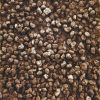
SOL607.jpgGreenish "dust" and pebbles - Sol 607 (Superdefinition; credits: Dr G. Barca)79 visitenessun commentoMareKromium
|
|
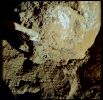
AP_15_AS_15-86-11570.jpgAS 15-86-11570 - The "Lunar Pearls" of Station 2 Boulder (special processing by Dr M. Faccin)79 visiteUn'elaborazione in "colori naturali" operata dal Dr Faccin che, oltre a mostrare la Superficie della Luna come non era mai stata vista prima, ci offre anche degli spunti di riflessione sulle "perle" che, simili a gocce (alcune opache, altre limpide) di cristallo, appaiono sul lato visibile di questo macigno che, purtroppo (ed almeno "ufficialmente"...) NON è stato MAI indagato a fondo.MareKromium
|
|

OPP-SOL015-1.jpgExtremely Unusual Surface Feature - Sol 15 (Superdefinition; credits: Dr G. Barca)79 visitenessun commentoMareKromium
|
|
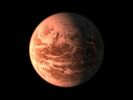
Gliese-876d-2.jpgGliese 876d79 visite"...Se l'Uomo non è pronto neppure per "vedere", cosa ti fa pensare che esso sia pronto per "toccare"?!?..."
P.C. Floegers - "Conversations"MareKromium
|
|
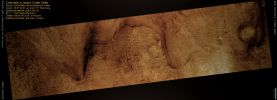
PSP_007925_1990_RED_abrowse-00.jpgChannels in Jezero Crater Delta (context frame - MULTISPECTRUM; credits: Lunexit)79 visiteBillions of years ago, this water-carved channel in Nili Fossae Region transported sediments across the Martian Surface and deposited them on the floor of an impact crater just south of this image.
The sediments were deposited in a delta-like mound on the floor of Jezero Crater, suggesting that the crater may have contained a lake at the time.MareKromium
|
|
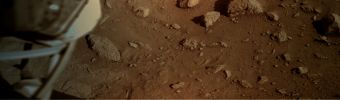
ZE-I-Viking1-PIA10738.jpgMars Surface near Viking Lander 1 Footpad (MULTISPECTRUM; credits: Lunexit)79 visiteCaption NASA:"This image, which has been flipped horizontally, was taken by Viking Lander 1 on August 1st, 1976, 12 Soles after the landing. Much like images that have returned from Phoenix, the soil beneath Viking 1 has been exposed due to exhaust from thruster engines during descent.
This is visible to the right of the struts of Viking's surface-sampler arm housing, seen on the left".MareKromium
|
|
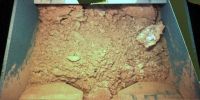
PHOE-SOL011-PIA10773.jpgArtificially illuminated Martian Soil - Sol 1179 visiteAvevamo visto giusto, quindi: quando il terriccio di Vastitas appare di una colorazione simile (giallo-arancio, arancio mattone ed arancio vivo) è perchè il "gruppo luce" di Phoenix sta lavorando. Leggete il commento NASA al riguardo:"NASA's Phoenix Mars Lander scooped up this Martian Soil on the mission's 11th Sol after landing (June 5, 2008) as the first soil sample for delivery to the laboratory on the lander deck.
The material includes a light-toned clod possibly from crusted surface of the ground, similar in appearance to clods observed near a foot of the Lander.
This approximately true-color view of the contents of the scoop on the Robotic Arm comes from combining separate images taken by the Robotic Arm Camera on Sol 11, using illumination by red, green and blue light-emitting diodes on the camera.
The scoop loaded with this sample was poised over an open sample-delivery door of Thermal and Evolved-Gas Analyzer at the end of Sol 11, ready to be dumped into the instrument on the next Sol".MareKromium
|
|
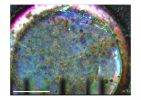
PHOE-SOL017-lg_4869.jpgParticles of Soil on Silicone - Sol 17 (2 - credits: NASA/Univ. of Arizona)79 visite"We've seen no major dust clouds at the landing site during the mission so far," Renno said. "That's not a surprise because we landed when dust activity is at a minimum. But we expect to see big dust storms at the end of the mission. Some of us will be very excited to see some of those dust storms reach the lander".
Studying dust on Mars helps scientists understand atmospheric dust on Earth, which is important because dust is a significant factor in global climate change.
"We've learned there is well-mixed dust in the Martian Atmosphere, much more mixed than on Earth, and that's a surprise," Renno said. Rather than particles settling into dust layers, strong turbulence mixes them uniformly from the surface to a few kilometers above the surface.
Scientists spoke at a news briefing today at the University of Arizona, where new color views of the spacecraft's surroundings were shown.
"We are taking a high-quality, 360-degree look at all of Mars that we can see from our landing site in color and stereo," said Mark Lemmon, Surface Stereo Imager lead from Texas A&M University, College Station.
"These images are important to provide the context of where the lander is on the surface. The panorama also allows us to look beyond our workspace to see how the polygon structures connect with the rest of the area. We can identify interesting things beyond our reach and then use the camera's filters to investigate their properties from afar".MareKromium
|
|

OPP-SOL369-1.jpgFamily Reunion! - Sol 369 (Superdefinition + MULTISPECTRUM; credits: Dr G. Barca & Lunexit)79 visitenessun commentoMareKromium
|
|
| 25353 immagini su 2113 pagina(e) |
 |
|
|
|
|
801 | |
|
|
|
|





