| Piú viste |

OPP-SOL740-1N193877640EFF64NVP0715R0M1.jpgMini-craters...once more! - Sol 74079 visiteCerchiature Rosse: si tratta ancora una volta di mini-crateri (ma anche la NASA sembra aver abbandonato questa costruzione - a nostro parere davvero improbabile, come già detto ampiamente in passato), oppure di cedimenti del suolo (si veda il bellissimo articolo del Dr Pullini - Martian Sandglasses - su TruePlanets) o magari di evidenze di un qualche tipo di attività (sulla superficie o appena al di sotto di essa)?
Voi che dite?
|
|
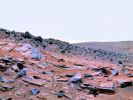
SOL759-HomePlate-MarsDaily.jpgHome Plate in false (but nice) colors - Sol 75979 visiteSpirit got its first view of Home Plate last August (2005), after cresting Husband Hill. It took the Rover 94 Martian Days, or Soles, to drive the 848 mt (about 2.782 feet, a little more than half a mile) of the formation. In all, the golf cart-sized Rover has driven about 4 miles across the surface at Gusev. The rocks and geologic characteristics of Home Plate are like no other found by either MER in the 25 months they have been rolling over the Red Planet.
Steve Squyres, the Mission's Principal Investigator, took time out from his hectic schedule to answer a few quick questions about the rock formation and about the overall status of the Rovers:
Space Daily:
The Home Plate rocks look like a volcano had rained down debris in the middle of water-sculpted strata.
Steve Squyres:
Well, that's an interesting interpretation, but we're a long way from having an answer yet.
SD:
Does anybody on the team have any idea how such markedly different rocks could lie in such close proximity?
SS:
There are a bunch of possibilities: Impact deposits, volcanic deposits, maybe wind- or water-lain sediments. In the images we have so far, the rocks look to some of us like they might be explosive volcanic deposits, but that's purely conjecture at this point - a working hypothesis. Everything is on the table until we've gotten more data down.
SD:
The rovers seem to be impervious to the Martian environment. Are they giving any signs of breaking down, or might they still be working when the Mars Science Laboratory lands in a few years?
SS:
They are not showing signs of breaking down. They are showing definite signs of age, but all the signs of age so far are ones that we can work around. So they're still very capable vehicles.
Of course, that could change at any time. We are 'waaay' past warranty on these vehicles, and there is no telling when they will die. It could be two years or now, or it could be tomorrow. So we treat each day as a gift.
As for the MSL, it's going to land in 2010 if all goes well, more than four years from now. If either MER rover is still alive when that happens, I will be very surprised.
|
|

Kane Crater - Light Ray (1).jpgLight rays inside Kane Crater (1)79 visitenessun commento
|
|

OPP-SOL762-1N195804327ESF65KEP1588L0M1.jpgPhotoartifacts and a Little Star-like Object? - Sol 76279 visiteCaption NASA originale:"Left NavCam Non-linearized Sub-frame EDR acquired on Sol 762 of Opportunity's mission to Meridiani Planum at approximately 04:55:10 MLT".
Nota: gli oggetti luminosi (visibili in prevalenza sulla Vostra Sx) sono, con ogni probabilità, dei photoartifacts; l'oggetto cerchiato in verde - sulla superficie di Marte - potrebbe non essere un photoartifact; i due oggetti cerchiati in rosso nella prima cerchiatura rossa da Sx, a nostro parere, non dovrebbero essere dei photoartifacts; l'oggetto isolato e cerchiato in rosso nella seconda cerchiatura rossa da Sx NON è un photoartifact.
|
|

SOL796-2P197031063EFFAQEMP2398L7M1.jpgMartian balance... - Sol 79679 visitenessun commento
|
|

Aurora Borealis - Norway.jpgBlack Aurora over Norway79 visiteDa "NASA - Picture of the Day" del 29 Marzo 2006:"What causes gaps between aurora curtains? These unusual gaps can make auroral displays appear more detailed and intricate. Research using data from four Cluster Spacecraft orbiting the Earth has likely found the secret: auroral gaps, sometimes knows as "black auroras", are actually anti-auroras. In normal auroras, electrons and/or predominantly negatively charged particles fall toward Earth along surfaces of constant magnetic field. They ionize the Earth's atmosphere on impact, causing the bright glows. In auroral gaps, however, negatively charged particles may be sucked out from the Earth's ionosphere along adjoining magnetic field lines. These dark anti-auroras can climb to over 20.000 Km and last for several minutes. Pictured above, a series of well-defined auroral gaps is seen dividing green aurora curtains high above Harstad, Norway, earlier this month".
|
|

13-Billy Crater.jpgBilly Crater (HR)79 visiteCrater Billy, located at 50,1° West and 13,8° South on the Lunar Surface at the southern edge of Oceanus Procellarum, has a diameter of 46 Km and is up to 1,3 Km deep.
Billy is filled with dark mare material and is one of the darkest spots on the Lunar Surface. The crater is deemed to be of age class 5 - indicating an ancient crater [in this case at least 3,2 BY old] and filled, or partially filled with lava.
The image represents a composite made from two raw images (i.e. no flat field or other corrections have been applied) of the region taken one orbit apart.
|
|

The Moon - North Pole - Galileo.JPGThe North-Pole of the Moon, from Galileo79 visitenessun commento
|
|
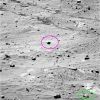
SOL817-2P198894438EFFAR00P2281L7M1.jpgAnomalous shadow and Rocky "Hat" - Sol 81779 visiteCerchiatura Fucsia: piccola roccia ovale (sembra una specie di geode) che appare caratterizzata da un margine superiore squadrato e da un'ombra impossibile.
Cerchiatura Verde: una roccia che ci ricorda, a causa della sua forma del tutto bizzarra, una sorta di cappello con visiera. Attenzione: portando ilo frame alla sua dimensione originale ed analizzando l'ombra proiettata al suolo da quella che potremmo definire come la "visiera" del "cappello di roccia", sembra apparire un vizio dell'immagine il quale ha, secondo noi, il profumo della manipolazione (un "taglio", diremmo) venuta non proprio a regola d'arte...
|
|
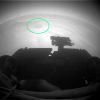
OPP-SOL814-1F200451415EFF70FFP1211L0M1-2.jpgRound shadow on the ground? - Sol 81479 visiteLa segnalazione del rilievo anomalo (o, quantomeno, assai curioso) è del nostro Amico e Socio, Dr Gianluigi Barca, la domanda è ovvia: di che cosa si tratta?
Un'ombra? Decisamente no (un'ombra di che cosa?).
Una "scoloritura" del terreno (un affioramento di qualcosa, magari)? Può darsi, ma non abbiamo elementi per sostenere questa ipotesi.
Forse un photoartifact? Ancora no: l'ombra circolare appare in (almeno) quattro frames (2 per l'occhio Dx e due per l'occhio Sx della Front HazCam).
E allora?
La verità è che non sappiamo di che cosa si tratti e, come già avemmo occasione di dire in altre circostanze, è comunque già una gran bella cosa essere capaci (ed avere il coraggio) di dire, a fronte di un'immagine che mostra un rilievo di assai dubbia natura, di che cosa "NON" si tratti...
Per il resto, dobbiamo - come sempre - aspettare.
|
|
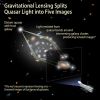
Gravitational Lenses-00.jpgGravitational Lenses (1)79 visite"...Nemo solus satis sapit..."
(Plauto)
"...Nessun (uomo) solitario (che viva lontano dagli altri uomini) può di dire di sapere abbastanza..."
|
|
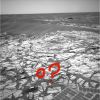
OPP-SOL824-1N201333551EFF7100P1795R0M1~0.jpgMore alterations?!? - Sol 82479 visiteCerchiatura Rossa: un particolare molto interessante (ed estremamente ambiguo) segnalatoci dal nostro Amico e Socio, Lorenzo Leone. Che cosa c'è sul bordo di questo Pavimento Marziano? Un "disegno", una qualche forma di "abrasione meccanica" (come quelle operate dal Rock Abrasion Tool - RAT - di Opportunity) o una nuova ed assolutamente inspiegabile (che cosa c'è da nascondere in quel punto?) "cancellatura/manipolazione digitale"?
Voi che dite?...
|
|
| 25353 immagini su 2113 pagina(e) |
 |
|
|
|
|
799 | |
|
|
|
|





